
Day Seventeen – Super Typhoon Yolanda
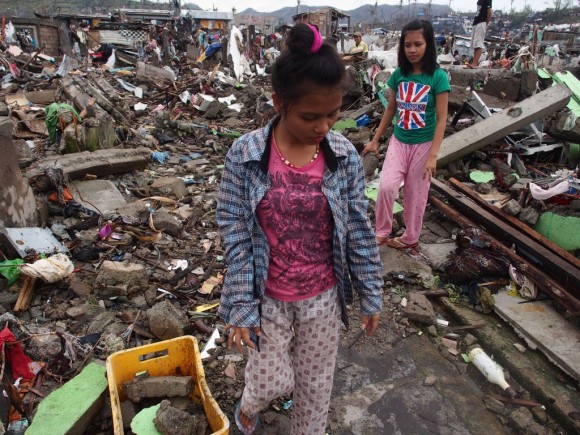
Yesterday was a day for public urination. No matter where I went, which street I went down, which corner I turned, I came across a man sending out a splendid stream of bright yellow liquid. That’s not uncommon, of course. There aren’t thousands of “Don’t Urinate Here” signs all over the Philippines for nothing. But yesterday was something special, like there was a urination festival that no one told me about. And when I got back to the pension house, two little boys were peeing off the third floor verandah in unison and calling out “Shower! Shower! Shower!” in English. As if I wasn’t wet and dirty enough already with the rain hardly ever letting up. Today looks more promising. It rained during the night, but there are patches of clear sky out there at the moment.
A few things of note occurred in the morning. I did some housekeeping and then went out on what have become my rounds. Liv was not at home. She and her family appear to have finally decamped and gone to parts unknown – presumably somewhere with electricity and less mud. Dan was not at home either. Various people at his house (as usual, I had no idea who these people were – family units and household units are very complex and changeable here), but I eventually managed to coax one person to tell me that Dan was at City Hall. I walked through RTR park and noted that the tents of the Canadian CASDDA team were gone. I scanned the area to see if they had left anything important behind, but all I saw was one extremely muddy cloth and a half-filled bottle of Coke. I was wondering if the bottle of Coke I had given Sylvie was as flat and unappetizing as the one I had bought for myself. Judging by that partially drunk bottle left behind, it was. That’s too bad. I feel about that, but I didn’t know it was flat. I bought it in good faith. Oh, well.
The Canadians were not at the Fire Station either and nor was my BFP EMS team. They had all been rotated out and been replaced by a new team. That’s bad news for me as I now know far less people there. I picked up my recharged camera battery from Gerald, and then I went across the street to my final stop – Hayward. I had been busy with the CASDAA team the last two or three days and hadn’t had a chance to sit down and chat with Manny. I had just gone there to purchase beer and such things. This morning, I had more time, and when Manny waved me inside, I sat down beside him for a chat and a cup of coffee – one that I was allowed to make for myself at a table inside his shop.
Manny was his old self and was wheeling and dealing. He had scooter loads of products coming in from Samar – the only way that he could get new stock. This was expensive and he had had to raise some of his prices to cover his new costs. He had a deal brewing with the Japanese embassy to rent them a couple of rooms on his second floor to be used as some kind of relief command center. The deal hadn’t been finalized yet. Manny was waiting to see if they would meet his price. He didn’t say what his price was, but it certainly would not have been cheap. As I passed his place at the end of the day, a big contingent of Japanese were arriving – climbing out of official vehicles with the Japanese flag on the hoods – so I guess they had met his price in the end.
Manny also told me that two Dutch journalists had arrived and were staying on his third floor. He’d told them about me and they had expressed some interest in meeting me – a foreign witness of Typhoon Yolanda. To my delight, these two journalists showed up while I was sitting there with Manny. They had been out on the back of one of Manny’s scooters with one of his employees driving. Apparently, they had gone to Palao and Tanauan. I’d been hearing the name Tanauan more and more lately. It seems hard to believe, but people said there had been more destruction there than even in Tacloban. If my bicycle were in working order, I’d go there and check it out for myself. Unfortunately, I’m still immobile.
The two Dutch journalists were youngish women – perhaps in their late twenties – and they were quite wet and excited from their recent outing. They’d gotten stuck in traffic and been out longer than they expected. Manny introduced us, and, as I have to do these days, I offered them my left hand. I can’t shake with my right hand because of my injured finger. It’s way too painful. I forgot one time, and I shook Richard’s hand with my right hand. He had a powerful grip, and I almost fell to my knees with the pain. I’m now more careful. But this time, the Dutch journalist grimaced. The thumb on her left hand was injured!
They were interested in chatting with me, but since it had been raining, they hadn’t managed to make any notes on their trip. They had to rush up to their room and write down what they’d learned while it was still fresh in their minds. I am intensely curious about how they make things work as freelance journalists. Manny said they were quite the adventurers and had even been reporting from Iraq. I can understand the logistics and the mechanics of it all, but I wonder about the financial side. They’d have to make enough money from their stories to cover the costs of airfares and all their living expenses – and this could be considerable. How many stories do they write, and who do they sell them to in order to make a living? I also wonder what they write. The life of a freelance journalist seems romantic and interesting at first glance, but if you are a true journalist reporting only the facts, then it must be intensely boring and pointless and frustrating. Nailing down facts would be extraordinarily hard. The best you can do would be to ask official people your questions and then quote their answers. As such, you’d spend all your time trying to get access to people to interview them. The only type of reporting I could even imagine myself doing would be of the first-person experience type. I could write about what I myself saw, did, and experienced, but nothing more. This ties in with my thoughts about the CASDAA team. Doing what they do seems very exciting and appealing, but the reality of how much work they had to put in for just two days of work here makes it less appealing. You could even argue that it was not even that useful. Better would have been to take all the money that they spent to get here and just send that money. Of course, that route isn’t possible. According to any Filipino you’d ask, all that money would just vanish into some corrupt politician’s bank account.
When the Dutch journalists had gone up to their rooms, I asked Manny if I could go up to this second floor store to poke around. I have had an urge to buy a small pair of scissors, and I remembered seeing some nice ones in his shop. I have scissors on both my Leatherman and my Swiss Army Knife, and you’d think that would be sufficient, but neither pair really works anymore.
I went up to the store and looked around at all the interesting goods for sale. While there, a group of people in UNICEF shirts came in. They were very excited to find this treasure trove of imported goods, and they rushed around and filled their arms with familiar snacks and other things. I started up a conversation with one of them – a friendly and open man in his thirties. I was fairly certain what the answer would be, but I told him I’d be interested in volunteering with UNICEF if they had work that needed to be done. Not surprisingly, he said that there really was nothing that volunteers could do. In any event, their insurance policies would not allow them to involve volunteers. It’s a very interesting and telling contrast with the way that Filipino organizations operate. I had also spoken with the man organizing the body retrieval teams for the BFP. They were now all going out on foot patrols with canine units. I asked if they accepted volunteer help, and he said sure. All I had to do was show up before eight o’clock in the morning when they handed out assignments and I could join one of the teams. It was as simple as that. I can just imagine what a Western insurance company would think. I can see their insurance agents shuddering with horror. There is really nothing more dangerous you could do here then walk around on the debris fields and clear rubble to get at decomposing bodies. Yet, the BFP would be more than happy to let volunteers pitch in. No Western organization on the planet would allow it.
The man from UNICEF, just like the Canadians from CASDDA, seemed unusually sensitive to and rather shocked by the decomposing bodies. I imagined they would be accustomed to this sort of thing and would take it in stride. This man, after all, had even been in Rwanda during the genocide. But when the conversation got around to the situation here, he hardly seemed able to talk about it. He sort of shuddered and waved his hand at me and moaned to get me to stop talking when I described some of the things that I’d seen and experienced in the days since the typhoon.
It was a fortuitous encounter, however, and I ended up being able to do him a valuable service. He and his team had been driving around the Tacloban and San Jose area doing whatever it is that UNICEF is doing, and they had encountered some children that had lost all their family members. While walking around what was left of their home, he had actually come across the bodies of what were probably their parents and a sibling, buried in the debris. He was horrified at the thought that these children would stumble across those bodies themselves, and he had been wondering how in the world to get the situation taken care of. He was talking to the right guy as it turned out, because I’ve been spending the better part of the last two weeks with the very people whose job it was to retrieve dead bodies. I walked him over to the fire station and introduced him to the people that I knew there, and in a short while, the BFP had dispatched a small team to go with the UNICEF team to retrieve the bodies. The BFP teams themselves were all out in the field, but there happened to be a Mexican team there, and they were back for lunch. They quickly finished their lunch and climbed into the UNICEF vehicle with some body bags and other gear and went off to retrieve the bodies. I think the UNICEF rep wasn’t quite expecting that. He imagined that they would have their own vehicle, and he could either describe where the bodies were or his driver could show them the way in their car. As he said, he couldn’t exactly have dead bodies piled into his UNICEF vehicle. (There’s probably a clause in their insurance policy forbidding that.) But there was little he could do to stop it now. The momentum was there and the eager Mexican team was piling into his vehicle. I had been harbouring a forlorn hope that I would be invited along (despite the insurance policy), but with the Mexican team, the UNICEF team, and the driver, there was not a spare spot in the vehicle.
Lunch was a bowl of soup back at the pension house, and then I finally set off with my camera. Just outside the pension house, I turned down a street I hadn’t explored since the typhoon. Not surprisingly, it was almost exactly as it was right after the typhoon with all the debris and smashed vehicles right where the storm surge had left it. I snapped a few pictures of the debris, and of all the people that called out “One shot! One shot!” from the windows around me. A bit further on, I came across what a man told me was the largest tree in Tacloban. Large or not, it wasn’t able to stand up to Yolanda, and it had come crashing down on the man’s house. I tried to find a vantage point to capture the size of this tree, but it wasn’t possible to get up high enough.
On Copra Warehouse Street, I stopped here and there to take pictures of the people now living on the streets. At one spot, I stopped to chat with two little girls that were selling cigarettes on a little table. I was amused to see that both had red hair dye currently doing its work in their hair. Fashion goes on despite typhoons. While there, I recognized a woman sitting on the ground behind them. I had met her long ago in her little shack on the next street over. She had invited me inside, and we chatted for a while, and I got a great picture of her face. Her little shack had been destroyed in the typhoon (she had been paying 20 pesos a day to live there) and she didn’t have any money to build a new one.
I was pleased to see another big navy ship at the harbour. I still might end up having to take one of those to Cebu if my bicycle can’t be gotten in working order here. The main market buildings were still completely wrecked and mostly filled with garbage and debris. But on their edges, a bit of market life had begun to spring up. This consisted mostly of stalls selling dry goods – such as instant coffee and laundry soap – but there were also some fresh vegetables and bananas for sale. What struck me most, though, was the vast number of flies. The fly population has been increasing all over Tacloban, and it’s starting to get to plague proportions. I don’t know if they represent a real health hazard, but they certainly are a huge nuisance.
I was astonished when I saw how much construction had taken place in the shantytown area. On my other visits, there had been a couple of strong cement buildings that had withstood the typhoon and a couple of people had built little platform latrines over the water. Some others had begun hammering together the foundations for new homes, but that was about it. Now, by Day 16, the entire area was a beehive of construction and primitive wooden structures were going up all over the place. In another week or two, it will be unrecognizable as the disaster zone I first saw. The original shantytown will have recreated itself – though with all wooden construction to replace the cement houses that had been destroyed.
The scene, again, was beyond words. I found myself vocalizing the very apt, though not poetic, phrases “Holy shit”, “Oh, come on!” and “Oh, my gosh” again and again as I walked around. I took lots of pictures with only the vaguest hope that they would capture anything of the reality of what I was seeing.
A very common activity was simply clearing the space where houses used to stand so that people could begin building again. Many of these houses had been built with cement walls, and these had collapsed inward to fill the entire space with shattered cement connected with rebar. This had to all be removed by hand, and people were busy hammering with anything they could find to shatter the cement into manageable bits to be carted away. I was surprised, in fact, to see how easily this cement could be chipped away, and I wondered whether the poor quality of the construction had contributed to the disaster. Had the cement been stronger, would the houses have withstood the typhoon and storm surge?
Here and there, I saw newly bare patches of cement floor – the original footprint of the house. Most people were then erecting a rough wooden structure on those cement patches. The plan was to eventually rebuild with cement, but for now they needed shelter from the rain and they were building with whatever scrap material they could find.
I asked a lot of people for their typhoon experiences, and they largely fell into two categories. Some had gone to evacuation centers on Thursday and weren’t at home when the typhoon struck. Others had decided to tough it out, and they ended up having to flee to whatever high ground they could find. This consisted mainly of the scattering of two-story cement structures and some stronger one-story structures. The rooftops became crowded as more and more people climbed up onto them to escape the storm surge. Those that didn’t make it drowned. And everyone returned after the typhoon to find their homes and all their possessions simply gone. And now, with that typical (even baffling) Filipino good cheer, they were rebuilding and starting over.
Someone in Tacbloan had told me that these shanty towns were populated largely with people from Samar. And indeed, the people I spoke with were from Samar originally. One young man in particular spoke good English, and he explained that he had come here from Samar five years ago with his family. His family didn’t have title to the patch of land where his cement house had stood, but he said that they did have rights to it – squatter rights. There was always talk of moving the squatters out, and, indeed, a large number had been moved when the city built a large fish market building a short distance away. But for now, they still thought of that patch of cement they were slowly clearing as home. This construction crew consisted entirely of teenagers – including two pretty young girls in makeup and nice accessories. It was surreal to see them picking up chunks of cement and tossing them into baskets along with everyone else. It was tough, gruelling work for those young hands. But they did it with laughter and jokes.
One of the most astonishing sights I came across on my walk was of a big front end loader clearing a road that ran through the shanty town. This road acted as a kind of plug and captured all the debris that the storm surge had carried across Tacloban. The debris was at least fifteen feet deep, perhaps twenty feet, and it was so packed and heavy that there was very little chance that it could ever be shifted by hand. It consisted of not just wood but cement and steel and cars and tricycles all wrapped up with steel cables, electrical wires and twisted pipes. Without that front end loader, it was there for the ages.
Just as would happen anywhere in the world, a large crowd had gathered to watch the front end loader at work. People had climbed up onto the roofs of nearby building to watch. I climbed up with them to take pictures and what I hope is one epic video. The fascinating angle to all of this was the crowd of daring young men who would dash at the edge of the debris field whenever the front end loader retreated with a bucket load. The loader would have exposed a new cache of perhaps useable wood and other items. The young men ran in there and started grabbing whatever they could and tossing it to the side into other waiting hands. They would remain there until the very last second when the front end loader returned, and they’d dash to the side to get out of the way. The road was very narrow and the danger was very real. The loads were precarious and heavy items fell in all directions. Once, I saw them wrap a cable around a tricycle embedded in the debris. I smiled when I saw that this cable didn’t even have a solid loop on the end of any kind. To attach the cable to the bucket of the loader, they tied it in a loose knot! And then the loader pulled the tricycle free and raised it into the air – all on the strength of a loosely knotted cable. Children and teenagers and a dumb foreigner with a camera were all around crowding close, and I’m sure insurance adjusters all over North America were having nightmares. I was standing on a shifting and collapsing pile of debris along with a screaming and yelling group of children barely more than toddlers. At one point, the loader attacked the edge of the debris pile right beside us, and there was a good chance our entire pile would go crashing down. Bits and pieces of cement wall were still standing around us, but when I leaned on them, I could feel them shift and move. People were just on the other side of these walls watching the show, and if the walls fell, they would be crushed. It was the craziest thing I’d ever seen – a carnival of debris removal and collection. And in the middle of all this, my camera’s battery went dead and the memory card filled up. I had to change both while perched up there on a pile of scrap wood and cement. It was insane, but a huge amount of fun.
It was getting dark by this point, and I had to turn around and make my way out before it was too late. I hadn’t brought a flashlight, and I didn’t want to be stuck out there in the dark.
Just a final note or two before I begin my day here. Despite the tons and tons and tons of food aid that must be arriving here, people were still asking me for food – for rice and water in particular. One pathetic group of elderly people asked me for food and said that they were having trouble coming up with even one meal a day. People have also been asking for flashlights. Tacloban is still pitch black at night and moving around these areas is extremely difficult and dangerous. A few thousand flashlights would be a godsend to these people. So would any type of construction material or tools. That is what they really need.
Still, from the outside, it is impossible to say for sure what is needed and what would really help. One could help them rebuild their homes, but they would remain only until the next typhoon came along. And, in any event, it isn’t such a great place to live, period. It’s a crowded, unhealthy shantytown even when it’s not being destroyed by typhoons. In the end, these people just needed a better place to live away from the dangerous shoreline. But that is impossible to provide short of the entire Philippine economy improving. It’s the type of thing that has to happen organically.
And even my suggestion that a donation of flashlights and construction material and tools is not necessarily a good one. I can easily see handing out a thousand flashlights and then finding that they’d all been collected and were now for sale in the local market. Same thing if you distributed free hammers and nails and lumber and tin roofing. They would probably rebuild with the scraps anyway and try to sell the new material to get money. In the end, there is likely no perfect answer, and there probably doesn’t need to be. The Filipinos have expressed tremendous gratitude at the presence of so many people from around the world who have come to help. Yet, practically all of the useful and beneficial work that I’ve seen being done – restoring electrical lines, clearing trees, clearing debris, collecting dead bodies, distributing potable water, etc. – has all been done by Filipinos and Filipino agencies and organizations themselves. There are no end of international NGOs here, but I have no idea what any of them are doing (other than the work of CASDDA, which I saw for myself). I’m sure they’re doing useful work, but I just don’t know what it is. It isn’t visible work that I’ve seen while walking around.
On the personal side, there isn’t much to report. I’m hoping to get my bike worked on tomorrow along with Dan at the Bohol bicycle shop. I’m still staying at the pension house in room 17 and not paying any rent. The owners have not put in an appearance since the day after the typhoon. They just split and haven’t returned. Since Jeffery left, my position here has felt somewhat odd. I feel very much like a squatter myself. My only right to this room is that I happened to have been in it when the typhoon struck, and I still have the key. Beyond that, I have no legal tenancy here. It’s pretty lucky, to be honest. Other foreigners were kicked out of their hotels when they closed down and the staff was let go. The staff was let go here, too, but I was allowed to stay – or, like poor Rambo – just forgotten about. Foreigners that have arrived since the typhoon have experienced a lot of trouble finding a place to stay. Everything is full. And those places that are open are charging a lot of money. My free room here is quite the luxury in this place right now.
The BFP medical team is gone and no one has replaced them that I know about. So it is just me and the assortment of families that have moved in with their nine very annoying children. I do all of my cooking in my room now. It’s simply too dangerous for the children and too annoying for me to try to cook outside on the verhandah. I am extremely tired at night and go to bed quite early. I wake up at 4:30 as a rule, and the sun comes up at 5:30. I’m already showered and shaved and having a cup of coffee by that time. I continue to recharge my camera batteries at the fire station even though my contacts there are dwindling in number. My other toys – kindle, iPod, and speaker – are running low on power and have to be recharged soon. Another big problem is this NEO. The power is fine. It could run for months more on the AA batteries. The problem is memory as I babble on and on. I think I have enough memory for one more journal entry, and that is it. I have to find a computer that I can download the files to, but that could be an impossible task. It would be hard enough to find any type of available computer let alone one with power and one that I could use for two or three hours.
I still haven’t managed to get my Trangia X2 to work. I might try again today if I find the time. At least I have my jug of denatured alcohol. Turns out, though, that the jug isn’t a full gallon. It contains 3 liters, and it appears that some has been removed before I got it. The seal was broken and the contents felt somewhat empty. So I don’t have quite as much alcohol fuel as I thought. I probably should have followed my instincts and gotten two or three gallons when I had the chance. Still, the amount I have will easily last for two weeks and perhaps for three weeks. So I should be okay. I doubt I’ll still be here in three weeks. Food and water is becoming more and more readily available and has ceased to be a real concern for me. There are still no restaurants open, and I have to do all my own cooking, but I’m a simple man and am quite happy living on spaghetti and Vienna Sausages, oatmeal and cream, and soup and elbow macaroni. I have plenty of coffee, and that is the important thing.
Tags: BFP, Philippines Bike Trip 2013, Super Typhoon Yolanda, Tacloban, typhoon, UNICEF
Typhoon Yolanda diary: A little girl in a white dress
By Kent Page, Senior Communication Adviser, UNICEF
TACLOBAN, 24 November 2013–It’s Sunday in Tacloban. Two days ago, while working with journalists on the ground, we visited one of the hardest hit barangays (villages) of the city. It’s a coastal barangay where thousands of people lived in somewhat of a shanty town, about 200 meters from the ocean’s edge.
Their shanty town does not exist anymore. It bore the full force and fury of Super Typhoon Yolanda. There’s literally nothing left as homes were wiped out and literally washed away by the typhoon, storm surge and gale force winds.
All that remains are the remnants of everyday items we all have in our homes – not in huge piles of debris as seen throughout the city, but random items strewn about haphazardly. A doll here, a t-shirt there, a TV remote on the side, a small family photo album over there.
As we were wrapping up our work, I decided to take a walk around and about 75 meters away came upon two bodies. One appeared to be a young man, and the other was a little girl in a white dress, about six years of age.
At this point it was two weeks since Super Typhoon Yolanda struck the Philippines. Fourteen days that both bodies had been laying on their backs, staring up into the blazing sun and pouring rain that alternate daily in Tacloban. The decomposition and smell was overbearing, but I couldn’t take my eyes off the little girl in the white dress. It seemed so wrong for her to be left to the elements like that, stared at by anyone passing by. It also seemed wrong that other children could easily stumble across her, including possibly a brother or sister.
UNICEF is not in the business of body retrieval. We are about supporting the most vulnerable children in the world through our actions in health, nutrition, education, child protection, water and sanitation. We are working round the clock for all the children affected by the typhoon and are making progress, although there is still so much to do. But I thought that somehow, the little girl in the white dress was perhaps the most vulnerable child of all.
We had to leave, so I said a small prayer for both of them and then we moved on to do the rest of the day’s work. That night I asked how to get in touch with a body retrieval team with whom I would follow up the next day and have the little girl and the young man properly taken care of.
By the following afternoon we had wrapped up several more media interviews to show the world the challenges being faced by so many Filipino children. We then stopped at small store – one of the first to have opened in Tacloban – to buy some water. Inside, I met a fellow Canadian who had been biking around the Philippines and arrived in Tacloban just before Yolanda struck. He had postponed the rest of his trip and was now volunteering with the local fire department. “Doing what?” I asked. “Supporting their body retrieval operations.”
I quickly explained the situation and he took me over to the fire hall. Unfortunately, all their teams were already out working and the fire chief told me no one was available until Sunday. “Too late,” I said. “Is there anyone else?” “Maybe the Mexican team can help,” said the fire chief. “They’re in the next building.”
I went over and met the three body retrieval volunteers from Mexico. “We can go right now if you like,” they said. “We’ll bring a few extra body bags just in case, but our vehicle is out right now. Could we get a lift?”
Thirty minutes later, we had arrived back in the barangay and they started their detailed work – photographing them for later identification, interviewing the small group who had gathered around to collect information as to who they might be, checking wrists and necks for identification bracelets and necklaces, and taking careful notes of all the information and the exact location of the bodies.
And then they moved on to picking up and placing each body in the thick, dark blue Philippine Red Cross body bags. It’s important to describe how compassionately they did so, particularly for the little girl in the white dress. Kneeling down beside her, she was gently picked up, cradled in their arms and then even more gently laid into the protective, clean warmth of the bag, as if being tucked into bed. Her hands were placed across her chest and I’m sure a silent prayer was said by all who were watching.
And then ever so slowly, the bag was zipped up. No more oppressive sun, no more pouring rain, no more buzzing flies, no more curious onlookers – just a safe, protective, quiet peace for the little girl in the white dress.
We thought it was over, but sadly the work had only just begun. The local people pointed out seven other bodies lying twisted and turned amongst debris and uprooted palm trees in the swampy waters a bit further back. Five of them were children, about 9, 7, 5, 4 and 2 years of age. All of them girls.
The Mexican team treated each body carefully, with all the compassion and dignity they each deserved. Within two hours, nine people, six of them children, had finally and properly been cared for by the gentle and professional Mexican team.
There wasn’t a body bag for the last child found, but the Mexican team wouldn’t leave her exposed. They searched until they found some strewn about bedsheets which they washed in a pool of water. Then they wrapped her in the clean makeshift shroud. They then searched around for a few minutes and found a big colorful green and yellow piece of plastic sheeting in which they carefully wrapped the shroud. Somehow this makeshift body bag with its bright, beautiful colors was perfectly fitting for the lively spirit of a child.
Radio calls were made for a vehicle to come and retrieve the bodies, but as happens every day throughout Tacloban, the body bags would have to wait for a pick up the following day as demand is so high.
The Mexican team decided it would be easier to pick them all up the next morning, Sunday, if they were all brought down together to the beachfront. So they carried each body bag separately down to the edge of the beach, with the children being carried cradled in their arms. They slowly and carefully laid them down to rest on a clean concrete slab, once the foundation of a home, with their feet pointing towards the ocean.
Unlike two weeks ago, the ocean was calm and gentle now, with the waves peacefully breaking on the beach. It seemed as if the ocean was filled with remorse and regret about what it had done and was now trying to apologize. Clouds had set in overhead, but in the distance the rays of the setting sun broke through the clouds as the last child’s body was laid there. For a few moments the chaos and upheaval of Tacloban was overpowered by the peace, quiet and beauty of the scene.
Today is Sunday in Tacloban and churches throughout the city were overflowing with worshippers giving thanks for those who survived the typhoon and praying for those who had lost their lives. On this perfect Sunday morning with bright sunshine and blue skies, we heard that the bodies of the three adults and six children had been safely retrieved and taken by vehicle towards their final resting place.
A few minutes later we were just outside a crowded church where UNICEF has been supporting families living in the church since the typhoon destroyed their homes. I was getting ready to do an interview about the emergency vaccination campaign that would cover the children sheltering at the church, when a young man inside the church walked past an open door near me.
He was holding the hand of a little girl, perhaps his daughter, little sister or niece. They didn’t say a word as they walked toward the front of the church, but they both looked over and smiled as they passed by. The little girl was happy, healthy and protected. The little girl was wearing a white dress.
http://www.unicef.org/philippines/reallives_21905.html#.VAbqysWSzSs
Hello Kent!
Thanks so much for leaving this as a comment. It’s beautifully written and captures the scene in Tacloban after super typhoon Yolanda perfectly. Of course, I’m the “fellow Canadian” you mention in your feature. I was wondering how everything turned out with the Mexican team. It sounds like everything went well and the bodies were well taken care of. I’m very glad to hear it.
Best
Doug