
Day Eighteen – Super Typhoon Yolanda
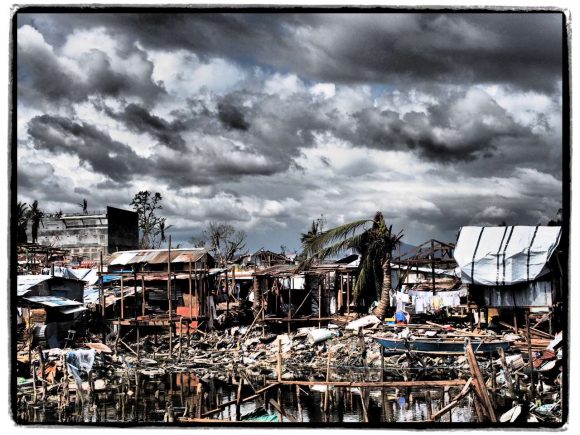
A city without power can be a very quiet place. Last night, the silence was so complete and for so many hours that I imagined that I had gone deaf. I made some noise from time to time to ensure that my ears still worked.
At four a.m. this morning, the sole rooster left in this part of Tacloban began his totally unchallenged (and therefore rather pointless) crowing. At five a.m., I began to hear the shrill yells of the children. At six, the revving of motorcycle engines began. Motorcycles suffered heavy damage from the flood of saltwater and despite cleaning and repairs, many have difficulty starting and the engines are revved for great lengths of time to warm them up and keep them running.
It was a rather long night for me. I had gone during the day on an extended photo walkabout in a very hot sun, and I was extremely tired as a result. I read for a while by flashlight once the sun had gone down, but it was a losing battle. My eyes burned, and I couldn’t keep them open. I think I was lying on my bed in the dark by seven p.m. And I was awake by four, which still gave me nine hours of sleep. Living by the rising and setting sun.
Normally, I’d have passed a considerable amount of time going over the photos I’d taken. However, with no electricity, I have to conserve battery power just for taking pictures. I can’t afford to use up my batteries by looking at the pictures. That will have to wait until I get to a place with steady power where I can recharge easily. At the moment, I’m still relying on the kindness of the BFP at the fire station to let me plug in my charger there. I have no particular right to do that, but a precedent was set and no one questions me when I show up and make my request. I leave my charger there overnight now and pick up the fully charged battery in the morning. It’s still not ideal. One battery charge doesn’t even get me through a normal day. That is one problem with a camera like this Olympus. It draws a lot more power than a regular DSLR would.
I tried to earn my keep at the fire station this time around by giving them the location of seven bodies that needed to be dealt with. These bodies were already inside body bags, but they’d been sitting out in the open down by the market area for several days. I’d passed them many times, and they were getting riper and riper. One doesn’t have to work very hard to come up with “symbols” of what this typhoon is all about and what life is like for local people, but this one certainly serves as well as any other. A large number of refugee families, for example, are now taking shelter in what remains of the various fish market buildings. It’s a thriving community now with hundreds of young children playing and lots of coming and going between the buildings and the nearby market area. These bodies are right in the middle of all that, and the children pass by them with no more than a glance and a T-shirt pulled up to cover their nose. A glimpse of a single dead body (newly dead and still fresh) by a child in Canada would probably result in weeks of counselling and other psychological support. Here, the children play beside a row of seven decomposing bodies. They were in body bags, as I said, but two of the bags had been opened or torn and one naked body was in full view from the waist down. This body had been decomposing for so long that it had reached some kind of mummy stage. The skin looked yellow and waxy and somewhat rubbery. The bodies inside the still-sealed bags were likely quite a bit more wet. In any event, they were still bloating and the bags were rising upwards each day and getting larger as if the bags contained the five fattest people in the Philippines – and still getting fatter.
When I first saw them, I assumed that the authorities knew about them. They were in body bags, after all. But after several days passed, it seemed clear that they’d gotten lost in the shuffle. Just in case that was true, I mentioned them to the BFP at the fire station and I pointed out their location on my map of Tacloban. I should have taken an overall picture of the bodies showing exactly where they were located, but I hadn’t thought to do that. But I think my information was clear enough, and they would be able to find them. They were, after all, sitting right in the center of a wide space of pavement in full view. It’s not like they’d be hard to spot.
Just past these fish market buildings are the barangays of Seawall and Anibong. These barangays had been completely destroyed, and it was in Anibong that the five large ships had been blown aground. I had gone there the previous day to take pictures intending to go all the way to the ships. However, there was so much of interest going on that I didn’t make it very far along the shore. I returned there intending to go all the way to the ships and back.
It was about 11 a.m. when I got there. I’d gone first to the fire station to pick up my camera battery. On the way, I realized that my Teva sandals had really gotten past the point of utility. I didn’t think I’d be able to walk very far in them – my feet hurt too much trying to walk in them – and I returned to the pension house to change into my running shoes. They were a much more sensible choice for walking around in that dangerous rubble anyway. It only meant that I’d have to be more selective in my route, as I wouldn’t be able to wade through deep water and get my feet wet with impunity.
Two other events took place before I set off – both of which also shed some light on the character of this country and the disaster that unfolded. The first was the live public broadcast in the RTR park of a well-publicised boxing match involving Manny Pacquiao. This event was of clear national importance and no super typhoon named Yolanda with a thirty- to forty-foot storm surge was going to get in the way of people seeing it. I don’t know who was behind the event, but someone had gone to the trouble of setting up immense viewing screens with a sophisticated sound system in RTR park, and thousands of people had turned up to watch. Everywhere I went that day, people were either watching the match (live or replays), listening to the match, or talking about the match. I don’t know who won, but I’m fairly certain it was Manny Pacquiao. I caught a glimpse of a TV screen at the fire station when I was telling them about the bodies, and the screen showed Pacquiao had won all of the five or six rounds fought so far.
The second event was the arrival at the pension house of a representative from the tourism office. She was a perky young woman with a pen and a notebook, and it was her job to visit all the hotels and pension houses in Tacloban and see what foreigners had been here during the typhoon and whether they could be accounted for. I felt quite honoured to be tracked down in this manner. She said that there was some kind of a meeting of embassy reps from various countries on the following day (today) and the hope was to inform them of the fate of any of their nationals. She indicated that the Canadian embassy would probably be quite concerned if they learned that I had been here during the typhoon, and they could probably offer me lots of assistance. I snorted inwardly when she said that. It’s not that I have a poor opinion of the embassy. I’m just fairly certain that they have bigger fish to fry than a lone Canadian on a bicycle – especially one dumb enough to get himself caught up in the center of the storm of the year. Still, if they offered to evacuate me back to Canada, I’d give it some thought. It might end up being wise to regroup – though going back there at the start of winter wouldn’t be the smartest thing I ever did.
This woman from the tourism office was quite chatty, and we exchanged our typhoon stories. I learned from her that, as I suspected, all the rumours about many foreigners dying were just that – rumours. She mentioned the possibility of one or two foreigners that might have died. In any event, they were unaccounted for at present. But that doesn’t mean anything. They could be in Cebu or any number of other places.
She also told me in some detail about all the clear warnings that had been issued about this typhoon – its wind strength and even the expected scale of the storm surge. My experience is quite different in that I wasn’t aware of any serious warnings – particularly about the storm surge. Then again, I would have had no way to come across them. I assume if there were such detailed warnings, they would have been on local television stations and radio stations, and I wouldn’t have been aware of them. I was going on the information I got from local Filipinos and there was little concern there. Even if I’d seen a warning on television and it was in English and very clear, I don’t know that I’d have done anything differently. Perhaps I’d have been smart enough to bring my bicycle inside and pre-pack my belongings. But I doubt very much that I’d have evacuated and gone to another city or to higher ground. With no experience of this type of thing, I couldn’t have known what this storm surge would mean, and evacuating would have been a huge pain in the butt. And where would I go? I couldn’t outrace a typhoon that size. Better to hunker down right where I was. In any event, I’m not expecting that a rep from the Canadian embassy will be knocking on my door with breathless concern for my welfare. In typical local fashion, the woman from the tourism office had only written down my name (in a barely legible scrawl) and my nationality. I kept waiting for her to ask for more information – at the very least for a contact phone number, maybe my passport number, next of kin in Canada, address in Canada, age, anything at all. But my name was all she wanted. Given the paucity of information she was collecting, I can’t imagine that the meeting with the embassy reps would mean anything at all.
Once she’d left, I gathered up my camera, pannier bag, and umbrella (just in case), and set off for Seawall and Anibong. I was astonished, again, at both the scale of the destruction and the speed with which people were rebuilding. The place seemed transformed even from the previous day. Of course, we’re not talking about the erection of three-bedroom homes with two baths and an indoor swimming pool. Their homes in most cases were not much more elaborate than the average fort that an ambitious youngster in Canada would build in his back yard. Still, they were rising very quickly and the place looked nothing like it did when I first saw it after the typhoon. The sounds were different, too. There were no sounds at all when I first went there. Now, the air was filled with banging hammers. Seawall and Anibong had become one huge construction site.
I went through the first part fairly quickly, concentrating on pictures of people rebuilding rather than on the destruction. Being midday, it was about the worst time to take pictures in terms of light, but I didn’t want to take the chance that it would start to rain in the afternoon. I didn’t have many significant encounters on this trip. Lots of people called out to me and asked to have their picture taken. People also asked me about relief food and other goods, saying that they didn’t have anything to eat. This kind of astonishes me. The typhoon was two and a half weeks ago, and if these people can be believed, they had received no assistance whatsoever – and these are among the hardest hit and most desperate of all the victims of the typhoon. What is going on?
It wasn’t easy in the heat, but I eventually made it to the end of Anibong, where the ships lay dramatically on the land. I used my wide angle lens (the one I haven’t dropped and smashed) to take what I hope are some dramatic pictures. I got to chatting with an educated Filipino man there, and he encouraged me to go to Tanauan. Everyone thinks I should go there if I am making a record of the typhoon’s destruction. I’d go there today if my bicycle were in working order.
Not much else occurs to me about that photo walkabout. I did run into an official photographer from the Philippines media. We chatted for a bit. He had a Canon DSLR with a monstrous telephoto lens on it. I also ran into a woman I’d spoken with before. She’d told me then that her Australian husband was going to fly in on the 22nd. Well, he never made it, for reasons that I couldn’t quite figure out. I was interested to see that the wire covers of electric fans had been put to good use. People were using them as baskets for carrying out the broken concrete. They tied the electric cord from the fan to the wire cover and then simply dragged the cover along the ground. It wasn’t quite as efficient as a wheelbarrow, perhaps, but it did the job quite well. I wonder who first thought of that. I’m sure one person did it, and then other people quickly copied the technique. In terms of the things that these people really needed, I can now add thick work gloves, wheelbarrows, and sledgehammers to the list. Something else I noticed was the household saints. These were obviously important to local people. They were the first things rescued, and they had been set out in prominent locations near their homes. Many, however, had been badly damaged in the typhoon and were largely missing their heads. I saw a large sign on a building that announced “Work-for-Cash Cleanup Drive”, so some NGO had set up a program to pay people to work clearing away the rubble and debris. I saw people crawling over the ships looking for anything of value. Thinking back, I should have climbed up into the ships myself. Not sure why I didn’t. I could probably have gotten some great pictures from up there. I guess my law-abiding Canadian nature kept me from turning into a land-based pirate.
Heavy equipment seems to me to be the key to this whole recovery. It has been essential in terms of clearing the roads and even the rivers. Yesterday, I saw a large backhoe type of machine clearing the debris from a river. Without that machine, the river would never have been cleared. There were lineups of dump trucks all over the city patiently waiting for the other machines to fill them up. Someone said something about these dump trucks being part of a Taiwanese relief effort. I saw nothing to indicate that, but it could be true. At the docks, I saw two more large machines being offloaded from ships to join the clean-up.
Tags: Canada, fire, Philippines Bike Trip 2013, Super Typhoon Yolanda, Tacloban, Tacloban City, typhoon