
Day Sixteen – Super Typhoon Yolanda
After my morning of running errands yesterday (buying alcohol fuel for my stove and food), my plans were to go out with my camera. However, it continued to rain, and there wasn’t much point to it. I hung out at the pension house drinking coffee, reading, making something to eat, and trying desperately to endure the children. I eventually had to lay down some ground rules and get a bit stern with them. They kept getting too close to the stove while I was cooking. The little table I’m using is quite tippy, and they kept leaning on it and nearly sending the entire stove crashing to the ground. This would ruin my lunch, sure, but it would also set fire to some children. The funny thing is that I tried to be a reasonable adult, and I explained to them and showed them how dangerous it was to lean on the table. But this had no effect at all. Children are very dumb, and they don’t listen to reason. I guess that’s why adults resort to the “Because I said so” routine. They have no choice.
As the afternoon drew to a close, I went out into Tacloban to see what was going on and if the Canadian team had returned from their work. I didn’t want to make a nuisance of myself, but I thought they might really benefit by a bucket bath and a chance to use a nice, private bathroom.
There was no activity at their tents when I went by the RTR park, and I continued my walk up to City Hall. There was still a lot of activity up there, but most of it seemed to be just people staying out of the rain and cooking for themselves and typing away on laptops and sending text messages on their cell phones. For all the world, it looked like a typical Canadian campground rather than a hive of relief activity. I’m sure that they are all doing great work, but I never see any of it. It would be nice to get an overall view of the situation and see what is really going on. I continue to see helicopters racing by overhead. Each time, I wonder what in the world those helicopters can be doing and what this or that expensive flight accomplished to benefit the local people that need help. Of course, I have a very limited view of things. My view extends only to the area of Tacloban that I can get to on foot. The typhoon affected a much larger area and there are people everywhere who need help. The busiest places by far continue to be the charging stations, the Internet access terminals, and a new tent at which people were getting free packages of text messages. My cell phone is up and running, and I’ve been getting a lot of text messages. I get excited each time I hear the beep, thinking someone I know is concerned and has asked how I am doing. But it’s always an advertisement from the Smart cell phone company. They keep telling me that I’m getting 15 free text messages to local networks and 3 international ones. I’ve gotten these messages before, and I never seem to actually get anything for free.
I tried to initiate a couple of conversations while I wandered around the NGO tents, but they didn’t go anywhere. One man seemed like a hopeful prospect for a chat. He stood there beside me once I said hello, and we exchanged some small talk. But then he suddenly said, “Excuse me” and turned away and unzipped. He had not been wanting to talk. He was waiting for me to go away so that he could take a leak.
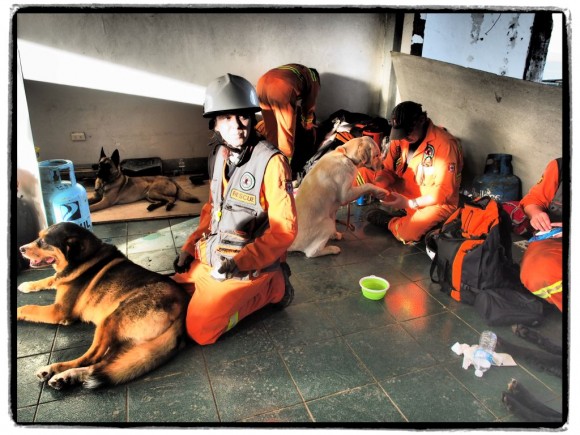
When I left City Hall, I saw that the Canadian team was back at the fire station. I popped in to say hello and see how their day had been. I keep hoping for interesting stories, but they are a tight-lipped group when it comes to their actual work. Perhaps there is a policy in place that they don’t discuss the details of their work – the number of bodies discovered, etc. Or perhaps everyone asks them, and they are tired of being the center of attention. Certainly, with their four big and gorgeous dogs, they attract a lot of attention. Richard mentioned that when they were in Prague one time, they were as much of a tourist attraction as the historic buildings in that city.
Later on, though, I started to get the idea that they were actually uncomfortable talking about the more gruesome aspects of their work, that, in fact, they themselves weren’t used to it. Their main focus, I learned, is not really body retrieval. They train specifically for finding live people underneath rubble. As such, they are more focused on earthquake situations in which rescue crews try to find people still alive underneath all the tons of concrete. Locating 2-week-old decomposing corpses is not common work for them. I believe for Karen this is her first disaster situation. She and her dog are highly trained and certified, but she hadn’t been in the field before. Plus, they generally aren’t even exposed to the bodies themselves. Their job is to locate them and then mark the location for the recovery teams. In this case, the Koreans are the recovery team. The Koreans move in to remove all the debris and dig up the body. Sylvie, Richard, Jen, and Karen have long since moved on and are locating more bodies and marking them. As a rule, they don’t even see the bodies. When it happened this time – because it takes so long for the local agencies to come and get the bodies – they were a bit taken aback by the sight and the smell. I was surprised that they were so squeamish, but I suppose it is understandable. I have had two full weeks to get accustomed to the business. I’ve seen huge numbers of bodies through all the stages of decomposition, and it has started to seem like business as usual. The other day, I didn’t even blink when I saw a single severed arm sitting in a plastic container. “Oh, look. There’s an arm. How interesting.”
The Canadian team posed for some pictures with the BFP EMS team, and then they walked back to their camp site. I hopped over to Hayward to pick up some beer for them, and I caught up with them a few minutes later. The first day, they had time to sit around and enjoy their beer. Today was a bit different largely because they had to deal with an intense infestation of white mites. I’d noticed these creatures myself out in the debris field. I think I mentioned that I put down my camera just for a minute, and when I picked it up, it was crawling with these white mites. The dogs had gotten covered in these bugs and so had their four handlers. I hadn’t been bitten by these bugs (that I’m aware of), but Jen said they bit hard and she had been covered in them. They were everywhere, even underneath her watch band. The first order of business, therefore, was to spray the dogs and wash and dry them to get rid of these bugs and then to spray themselves and all their clothing and gear with bug killer. They had gotten a can of bug spray from the Korean team. All this left no time to sit around and relax with a beer. In any event, it was still raining and it was hardly an enticing prospect to sit outside in the rain. Sylvie and Karen quickly got their work done and then ducked inside their tents. That left Richard, Jen and me. I repeated my offer of a bucket bath back at the pension house, and the two of them took me up on it. They got their dogs settled down in their tents and then they followed me as I led them down the streets and through the piles of vehicles and debris.
Things worked out quite well, I think. Both Jen and Richard were extremely happy to get cleaned up and have a chance to use a (somewhat) modern and clean bathroom. I fired up the Trangia, and we had a cup of coffee together and chatted for a bit. This is when I learned about how they were more trained for searching for live people in rubble. Jen’s dog in particular was trained for finding living people. She had hoped to get here in time to be able to help find live people. My sense is that it wouldn’t have mattered even if they got here the day after the typhoon. I don’t think anyone was trapped under rubble or anything like that. People either drowned or survived. There wasn’t much in between. And the one-story wooden and concrete structures here don’t collapse in such a way as to trap living people. They just aren’t big enough, and they don’t pancake like big hotels and such things do. I suppose if this pension house had collapsed, I could have been trapped under the rubble. Then I would be very glad to have this Canadian canine team show up. It’s unlikely that I’d have lived through the experience, though. It’s pretty much a certainty that I’d have drowned while trapped under the rubble.
I still hadn’t asked any of the team very many questions about their organization and their work, and I didn’t understand how it worked. Last night, however, a few things came up in conversation, and I was very surprised to learn that they were volunteers. I had assumed they were a professional team that did this for a living and were paid for it. In fact, their organization – CASDDA The Canadian Search & Destruction Dog Association – is voluntary. Their operating budget is covered through fundraising efforts and to that extent their flight here and many other things was paid for by CASDDA. But that still left them with many costs that they covered themselves – including the costs associated with the dogs. Richard estimated that it cost him and his wife $10,000 a year to care for and train Cassie, his beautiful white lab. More than that, they all have regular jobs and coming here meant taking time off – probably unpaid time. My mind boggles at all it cost them to come here and do this work. On top of the financial cost, there is the amount of time invested in training. Then they would have to do a lot of intense preparation and planning in a very short time to come to a place like Tacloban and perform this kind of specialized work. It gets even worse: Jen told me that she was stuck in the Vancouver airport for two days because one of the airlines suddenly switched policies on them and said that they couldn’t transport their dogs. They could transport the people, but not their dogs. That was clearly not an option, and it took them two days to come up with alternative arrangements. That meant losing two days in the field here. My mind boggled when I learned about all of this. It was a huge deal for these people to be here. Their presence represented a tremendous volunteer effort on their part. I can’t imagine how sleep-deprived, dirty, hungry, and tired they would have been when they arrived here. And they arrive in the middle of a disaster zone in a country they’ve never visited and in some of the worst weather (heat and rain) that they’ve ever experienced, and they immediately go out into the field to work. They work all day and then their reward is to march off alone to some random patch of grass in a city park to set up their tents and rip open an MRE and eat in the rain.
Considering all of this, it’s a surprise to me that they are scheduled to leave already. Personally, I would never go through all of that effort to get somewhere (no matter what my purpose was) unless I was going to stay there for at least a month. This team, because of the flight delays, managed to put in one full day and two half days (assuming they are going out this morning before their flight). And based on what I’ve seen of their work, they’ve only managed to cover a small area of just that one stretch of coastline of Tacloban. There is much, much more ground to cover. They could probably work straight through for a month and then perhaps not finish.
In fact, the short stays of all these relief organizations is something of a surprise all around. The Davao team was here and gone in the blink of an eye. But that was politics. Other groups seem to transfer their people in and out in rapid fashion. The BFP EMS team has been rotating constantly and the latest group is scheduled to leave today and be replaced by a new group.
My experience here has made me wonder if my life would have been much better spent working with relief organizations like these. Of course, almost anything would be an improvement on my somewhat misspent life, but considering I have no interest in roots or ties, I would be an ideal candidate for moving around. For Richard and Jen, it is very difficult to break away from their normal life even for a few days. I’ve been here in Tacloban for fifteen days since the typhoon and it is no problem. I could stay here months and it wouldn’t matter. However, the other side of that work is not appealing at all. I would have no interest in facing all the logistical problems that Jen faced in getting here. I do not function well under extreme time pressure and uncertainty. From that point of view, even the lives of the journalists that I’ve seen here have not been appealing at all. They are obviously under a lot of time pressure to produce stories and pictures. I far prefer my little life where I can wake up in the morning and have a cup of coffee and listen to music and type out my thoughts this way.
Eventually, it was time for Richard and Jen to go back to their camp, check up on their dogs and have their dinner. I showed them the way back, of course. The route is a pretty dangerous one still, and if they took a wrong turn, they could end up wandering around in the dark for a long time. I also wanted to see if Sylvie and Karen wanted to come use my room and facilities. I imagined that they wouldn’t be, as they had already settled down in their tents. I was right, and they decided to pass. I hung out with Jen and Richard for a few minutes more, and then I said my goodbyes. It was too late by that point for me to bother with dinner, and I contented myself with the remainder of a bowl of spicy nuts I had produced for my “guests”. Then I went to bed and here I am the next morning. It’s already 9:30 and the rain is falling outside. It isn’t a hard rain, but it is steady. The skies are grey and overcast. Time for some oatmeal.
Tags: CASDDA, City Hall, fire, music, Philippines Bike Trip 2013, Super Typhoon Yolanda, Tacloban, typhoon