
Day Twelve – Super Typhoon Yolanda
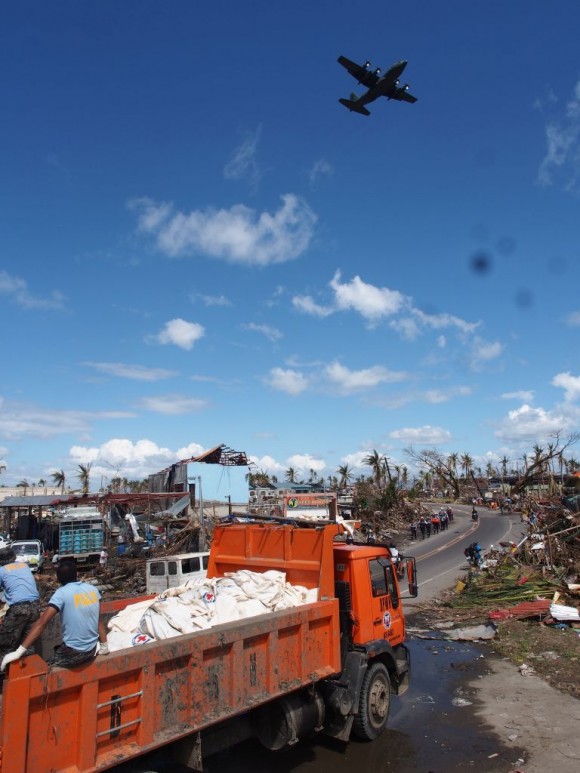
A lot of things have been puzzling me about this typhoon and in particular my experience of it. And yesterday, I had the chance to talk to a couple of journalists. Their questions brought into focus some of the details and brought back some of my memories of what had happened.
Considering the horrific aftermath of the typhoon, it’s been puzzling me why it wasn’t taken more seriously – why I didn’t take it more seriously. One journalist asked me if it was true that the day before the typhoon hit had completely clear blue calm skies. And I remembered that that was true. The typhoon hit on Friday morning, and Thursday had been a beautiful day. The skies were blue and clear all day right up until sunset. There wasn’t even a hint that a typhoon was on its way.
And this reminded me that many people didn’t expect the typhoon to arrive so early. A website I checked predicted the typhoon would make landfall in the morning. But people here were saying that the typhoon was going to arrive late Friday afternoon, maybe even not until Saturday. And that made perfect sense when you consider the beautiful weather on Thursday. I remember now that I went to bed on Thursday night thinking that I still had plenty of time to get ready for the typhoon, if it arrived at all. I figured things would develop during the morning on Friday and then it would be more clear what was going to happen. I certainly wasn’t expecting to be woken up by the typhoon bashing against my windows. A journalist from Malaysia was asking me for specific details about the timing of the typhoon, and I found I couldn’t answer him. I had leaped from my bed to try to close my windows tighter, and then I was involved with mopping up the flood of water pouring in. Then it became a frantic race to pack up my stuff in case I needed to evacuate. I don’t remember ever looking at my watch, so I don’t know what time I got out of bed. I also didn’t take note of how long the worst of the typhoon raged and when the flood waters peaked and began to recede. I didn’t note any times at all. I guess I definitely don’t have the instincts of a journalist.
These realizations have made me feel better about my stupidity – in particular about leaving my bicycle down in the courtyard. Of course, I wasn’t expecting a thirty- to forty-foot flood. I wasn’t really even expecting a typhoon. There just seemed to be the chance of a typhoon, In any event, there seemed to be plenty of time to move my bicycle up to my room on Friday.
There is also the question of evacuation warnings. The journalist that climbed up on the fire truck with me asked about this in particular. She mentioned that in a similar situation in India, the government had forced an evacuation, and it had saved thousands of lives. The journalist from Malaysia also asked me about evacuation warnings, and he said that he had heard that the local government had broadcast warnings. If they had, I didn’t hear them. I certainly hadn’t seen any trucks roaming around with speaker systems. I didn’t hear any sirens. And none of the Filipinos in my world had said anything about evacuation other than referring to people from the coastal areas being able to evacuate to the schools. The way they talked about this gave me the impression that they were moving there to avoid getting really wet. It certainly did not seem like a life-and-death situation.
What occurred in San Jose also raises questions in my mind. I went out there on my bicycle yesterday, and I saw again one vast area in particular that had been swept clean. It was on the side facing the ocean where the typhoon and storm surge would have hit first. The houses there all had concrete foundations and concrete walls. These were not the flimsy wooden huts of the shantytowns around Tacloban. Yet, it made no difference. These hundreds of concrete homes had been flattened and torn to pieces just as if they were made of wood. This begs the question of what did this. The wind was powerful, but I don’t think it could have done that kind of damage. Could it have? And my sense was that the flood consisted of simply rising water. And rising water would not have done that kind of damage. It would have had to have been water on the move, like a tsunami. I’m going to ask people some questions today.
Yesterday morning was spent working on the bicycle. I discovered, to my intense dismay, that my front wheel was totally warped. Upon inspection, I found that there was a broken spoke. It wasn’t the spoke that broke, actually. It was the nipple threaded onto the end. I replaced the entire spoke with one of my spares and then tightened it up as best I could. The rear wheel was bent, and I adjusted the spokes there, as well.
I went first to city hall on my bicycle – being very careful not to run over any glass or nails or sharp objects. Then I stopped by the fire station. I hung out there for a few minutes and they gave me a package of tuna for lunch. Then I rode my bike up the main street intending to leave Tacloban and go to the airport. Traffic wasn’t as bad as the other day. I saw more piles of dead bodies in body bags at the side of the road.
The airport was a fairly busy place. It was badly damaged, of course. And there were lots of planes and helicopters arriving and leaving – passenger jets and military craft. There was a large camp of American military personnel. I was surprised to see them because I hadn’t seen any soldiers or American army vehicles anywhere in Tacloban. Yet, they were at the airport in force. I don’t know what their role is in the recovery or what they have been doing.
I also saw a big tent from the World Food Program and a very large camp from Malaysia. Some men were sitting in the shade in front of a tent and they invited me to come and sit down and join them. They were very surprised to learn that I had been in Tacloban when the typhoon struck, and they wanted to hear all the details. Most of the men were part of a medical team. Some were with the media, and one man introduced himself as a journalist. He asked me questions and emphasized that as a journalist he really needed solid facts. Unfortunately, I had few to give him. I only had my own comedy of errors to offer him as my experience of the typhoon. He assumed that I would be willing to be interviewed on camera, and he just asked me to wait a moment until he could set up his video camera. It had been recently packed away. I surprised and disappointed him very much by saying that I didn’t want to be interviewed. In general, I prefer not to be interviewed by TV people. I always refused in Taiwan when they wanted the “foreigner perspective” on some issue. There is no upside to being on television. Chances are you will look like a blithering idiot, and that is about it. There is no possible benefit. It’s not like he was offering me ten thousand dollars for my story. But I think it was his total assumption that I was eager to be interviewed and get on television that made me dig in my heels and refuse. I’ve noticed an almost unseemly air of self-promotion in the relief efforts. NGOs have arrived with ready-made banners proclaiming who they are and what they are here to do. These are professionally printed banners with the year and date and name of the typhoon and everything. Presumably it took time and effort to make these banners. My initial introduction to the NGOs from Turkey was when I saw their truck parked outside of Hayward. They were there for perhaps an hour trying to affix their signs and flags to their vehicles. They even borrowed a roll of tape from Manny to finish the job. And the Davao team, as effective and professional as they were, had almost a holiday air about them, and they took dozens if not hundreds of pictures of themselves posing as a group with all their signs and flags and banners before they left. It all seemed very odd particularly as they were pulling out early. It didn’t seem the proper time or place for high-fiving and picture-taking and celebrating. I half expected them to coordinate one of those jumping pictures where they all leap into the air and take a picture at that exact instant.
For all I know, the NGOs are doing very effective and necessary work, but as a casual observer, I haven’t seen any of it. I’ve seen a huge amount of effort being put into setting up their camps and generators and tents and other equipment and getting it to work. I’ve seen lots of banners and T-shirts and hats and special gear. But I haven’t seen any actual work from them. What work I have myself witnessed was all done by the Filipinos – by the Davao team, by the Bureau of Fire Protection, by the barangay councils, by the city government, and by local construction and electrical crews.
And in an odd twist, I sometimes wonder who is left in the city of Tabloban to need help. The overriding concern of people here seems to be to get out. I don’t know the numbers, but it appears that a high percentage of the population has fled to Manila and Cebu and anywhere else they can get. There were hundreds and hundreds of people at the airport baking in the hot sun yesterday as they waited for a chance of a free spot on one of the many C-130 planes. Those planes have been running all day every day taking load after load of people away. Then there are the navy ships that have been carrying loads of people away – perhaps 1,500 at a time. Others have left by motorcycle and jeepney and van. Who is left behind? The people here do need help, but for the most part what they want is a way out. Failing that, it would be great if someone would build them a new home to live in. But the NGOs aren’t here to do that. They are here largely as search and rescue and medical teams, and there isn’t much for them to do. My sense is that there weren’t many injuries. People either drowned or survived. Few were simply injured.
My personal story has gotten a bit more complicated with the broken spoke on my bicycle. My bike clearly needs some TLC – and I may not have the skills and tools to provide it. While I’ve been writing this morning, I suddenly heard a sound that wasn’t far off a gunshot. And it was right inside the room! I realized almost instantly that it had to be the sound of another spoke breaking. I leaped out of bed to check, and sure enough, another spoke was dangling loosely. As before, the spoke itself was fine. It was the threaded nipple on the end that split in half. That told me that for some reason, the wheel was under tremendous pressure. It seemed like I hadn’t a moment to lose, and I frantically got out my spoke wrench and began loosening the tension on the spokes. I gave every single spoke on both the front and rear wheels a good two or three full turns and loosened them all completely. That makes the bike completely unrideable, and I don’t really have the knowledge to retrue the wheels and tighten the spokes again. That makes cycling out of Tacloban more problematic. I might be able to do it, but it would be a big risk. It might be wiser to get to Cebu by ship or plane and have my bike overhauled before I do any cycling. Even if I true my wheels properly, my sense is that all the nipples on the spokes have to be replaced. I might even have to replace all the spokes.
In fact, I have begun to think in terms of leaving Tacloban – specifically of leaving this pension house. The reason is typical for me – a sudden influx of children. A super-typhoon, 300-kmh winds, 40-foot floods, food shortages, water shortages, and thousands of dead bodies were not sufficient to drive me out of Tacloban. But add some noisy and annoying children to my world, and I am more than ready to move on. There are nine of them in the pension house now – all children of various friends and relatives of the pension house owners, I assume. And they are a noisy bunch to say the least. It’s like we are about to run out of words and these kids have to use them up as fast as possible. They begin shouting and screaming and yelling at 6 in the morning and continue non-stop until late at night. They never, ever stop shouting and yelling. It’s exhausting just listening to them.
They also find me a source of endless fascination. They are actually very nice kids and very friendly. Still, I now can rarely leave the room and sit outside on the verandah. They surround me in an instant and pepper me with questions and then begin pushing and shoving and fighting and screaming amongst themselves. I need to cook out there and work on my bike out there, and it is becoming very difficult to do so with such an audience. They also – and this is odd for Filipino children – have little sense of personal space and private property. They pick up everything I am using – all my tools, etc – and play with them no matter how many times I tell them not to. The other day, I was annoyed to find that while I was cooking, they had taken some candle wax and melted it all over the outside of my pots and windshield. It was a big game to them, and now everything sticks together with melted wax every time I cook. And they all have their own personal flashlights. In the dark, these are an awesome toy for them and the result is that I have these bright lights shone directly into my eyes all the time. I stick it out long enough to cook my dinner and then I escape into my room and hide. I honestly don’t know how anyone ever has kids. How do parents put up with that endless noise and demands for attention? I took Typhoon Yolanda on the chin and survived. But these children are too much for me to handle.
Tags: bike, Philippines Bike Trip 2013, Super Typhoon Yolanda, Tacloban, typhoon