
Day Thirteen – Super Typhoon Yolanda
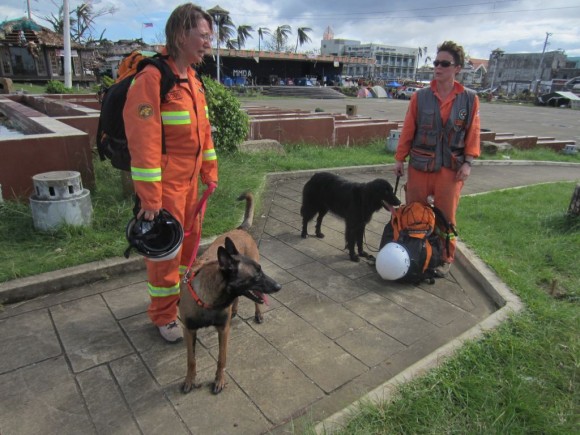
I finally encountered my first Canadians among the relief organizations. They consisted, to my joy, of a group of four people with cadaver-sniffing dogs. The four dogs are large, beautiful animals of all different breeds. I was sitting with the BFP team when the Canadians returned from a mission with their dogs. They are part of a larger team effort and were assigned to work with the Korean group, and they came back in a vehicle with the Koreans.
I did not rush over and start babbling at them. I restrained myself and waited for a proper moment. I let them settle in and get their gear organized and covered with a tarp for protection from the rain. Then when I saw that they had settled down and were relaxing, I made my way over. I also prided myself on simply ignoring the dogs and not inflicting myself on them by petting them and playing with them. My idea was that they were working dogs and their handlers would not want people touching them. It turns out that that isn’t true at all. It is true of guide dogs, I guess, but not of sniffer dogs. In any event, one of the dogs came up to me and pushed its beautiful snout and face into my chest asking for affection. I asked the handlers if it was okay to pet the dog since it had approached me. They were totally fine with it and even laughed about my question. They said that the dogs will probably climb right into my lap, so it will be difficult NOT to give them love and affection.
It’s interesting that I was somewhat uncomfortable around these people – my fellow Canadians. I feel quite at home and welcome and accepted whenever I approach a group of Filipinos, Malaysians, Turks, or anyone else. You’d think I’d be even more at ease around Canadians, but I wasn’t. I was quite concerned that I was bothering them with my presence, and I didn’t pester them with questions, though I was desperate to. They seemed, in fact, to be quite out of place and unprepared themselves. I noted that they were drinking water from a couple of tiny bottles, and they made a comment about having to get enough water for the dogs, as they were overheating in the unusual Philippine climate. I saw a chance to be useful (I thought), and I went across the street to Hayward and bought three 5-liter bottles of purified water as well as a big bag of chocolate wafers and plain biscuits. I bought the biscuits because the Canadians were eating out of these space-age aluminum pouches containing something like the infamous Meals Ready to Eat. It didn’t look appetizing at all. It was the type of food you would eat to stay alive while marooned at the top of Mt. Everest, not the type of food to maintain body and soul while working hard in a disaster area. I thought the biscuits, at least, would be a nice treat.
Of course, I had only managed to make a partial fool out of myself. I found out later that they had vast quantities of water. In fact, their luggage turned out to be mostly water. Each person had a personal large duffel bag, and when I saw one duffel opened, I saw that half of it was filled with bottles of water. They also had large black crates. When they lifted the lid on one of these, I saw that it contained a huge bottle of water and nothing else.
I hung out with them for a while, but I felt quite out of place and a nuisance. I eventually returned to the BFP team and sat with them and watched the Canadians and their dogs from a distance. There was definitely a different tone to the Canadians versus everyone else. This team, for example, is the only one I’ve seen that didn’t immediately put up a huge banner with flags announcing their identity and country of origin. I admire that. They were all business. They were here to do a job and everything else was incidental – including food. That is so different from the Asian approach, which often seems to be all about food.
There is also a distinct difference when it comes to visitors. To be honest, I think I’ve come to take the Filipino sense of hospitality and generosity for granted. It’s good to experience the standard Canadian approach and see the Filipino style in the good light it deserves. I’m not saying that the Canadian approach is bad. It’s just different. Had I approached a team from any other country, they would have instantly offered me a chair and gotten me some water and even offered me food and coffee and asked me questions. This group of Canadians pretty much ignored me until I went away. And that’s fine. They are here as a specialized and professional team to do a job and do it well. They came here prepared to do that job, and they organized themselves for it. They don’t have the time or the resources or the inclination to act as gracious hosts to some random person that just shows up unannounced. I understood that perfectly, and I immediately switched roles, too. I was trying to be helpful to them by getting them water and some snacks. I offered to act as grunt labor and volunteer help if they needed anything. Apparently, they didn’t. I actually felt kind of sorry for them sitting on the ground with no chairs and eating out of MRE pouches, Every other team I’ve seen has come loaded down with gear – immense tents, comfortable chairs, generators, lighting systems, and food. These Canadians had nothing, and they struggled to rig up some thin material (it looked a bit like a tent fly) over their gear to keep it dry. They had to tie the corners of this material to some random posts that were planted in the ground there. They’d first tried this with a tarp, but it turned out to be too small. Now they were putting up this tent fly. I couldn’t help but contrast this with the giant and comfortable tents arrayed by the Koreans behind them. These tents were in addition to their own personal sleeping tents. They were army-style mess hall tents and the Koreans were nice and dry inside them sitting around tables on nice chairs eating hot Korean food.
Later on, I came across the Canadians setting up their tents on the grass in RTR park. It seemed odd to me that they were there in this rather remote spot with no security. I wasn’t sure what they were going to do about bathing water and bathroom facilities either. I think there had been accessible facilities across the road, but I wasn’t sure if they were still there. I remember the Davao team saying that.
This Canadian expedition was definitely on the small size. They had four or five camping tents with them – tents that were no different from those you would take on a hiking trip. They were nice tents, and I instantly started assessing them with a professional eye. One tent had to be used for all of their gear. That left the other tents for four people and four very large dogs. It would be pretty crowded in there, as they told me that the dogs slept in the tents with them.
I hung out on the edges of the activity and jumped in when I could grab the edge of a tent fly and help put it in place or pick up the end of a heavy crate and help carry it. I kept trying to think of ways to be of use to them – getting them food and drinks from Hayward or from Kokoy’s Grocerette (which had just reopened), making them hot water for coffee on my camp stove, inviting them back to the pension house later for a bucket bath, getting them chairs, offering to stand guard over their tents when they went to work. In the end, I didn’t do any of these things. I couldn’t judge if they really needed any of these things or would even appreciate them. Besides, once they got settled, they would have access to the resources of this vast relief effort that was underway. Surely, there was a flow of stuff out there that they could tap into. They hardly needed me to run down to the store to buy them a can of pineapple juice. When I last saw them, they were walking off with their dogs to go back to the Korean camp at the fire station for the afternoon shift of sniffing out cadavers.
My main personal concern was my bicycle, and I was glad to find that Dan was at home when I walked past his place. He and his whole family were busy cleaning up their bottom floor. He invited me inside and I was surprised and pleased to learn that he not only was an avid cyclist but dabbled a bit in selling bike gear. As such, he had some spare parts, and he set me up with two tubes (with wonderful Schraeder valves). One tube was newish and the other had a couple of patches on it, but they will serve very well. He also said that he had a bag of spoke nipples somewhere. He didn’t know where they were, but if he found them he would let me know. That would be great news, because I think I should replace all the nipples on both of my wheels if I can. He also had a variety of new and used tires, so if I decided to change my tires, I might be able to buy two from him. Finally, he has a friend who is an experienced bike mechanic. He said he would find out if he was still in town. I could use an expert to true my wheels, so finding him would be wonderful.
Tags: BFP, bike, fly, job, Philippines Bike Trip 2013, Super Typhoon Yolanda, tent