
Days Fourteen & Fifteen – Super Typhoon Yolanda
Dan did manage to contact his friend the bicycle mechanic. This fellow works at the Bohol bicycle shop, and Dan arranged to be the very first customer on Monday morning when they plan to open their doors. He offered to go there with me and help me get my bike into the system to be worked on as soon as possible. The plan is to replace all the spoke nipples, re-tension the spokes and true the wheels, clean and repack the hubs, and perhaps also open up and clean the headset and bottom bracket. Dan is far more experienced in these matters than I am, and he even has the specialized tools needed to disassemble these technical parts.
While I was visiting with Dan, I had a cup of coffee and some biscuits and we chatted about this and that. He also showed me his camp stove. He has an MSR Whisperlite. He gave the very useful information that lighter fluid for cigarette lighters is almost exactly the same thing as white gas for our type of stoves. This fuel is available in the Philippines, and Dan had some in his fuel bottle. He offered to give it to me so that I could use it on my stove. I can’t express how grateful how I am to Dan for all his help. Meeting him that day on the street after the typhoon was a very fortunate occurrence for me. I don’t know how I would have managed without him. I haven’t tried the new fuel yet. I want to look into cleaning my stove’s fuel line first. My stove’s instructions have no information about how to do this. His Whisperlite has a very simple system whereby you just pull out a cable. I’m not quite sure how that cleans the fuel line. Doesn’t the cable being in the fuel line actually block it? But that is how it is done. I can’t see a simple way to clean the X2 as yet. I’ll have to examine the instructions and the stove again this morning.
In the afternoon, I grabbed my camera and went for a walk. I first made my way to the sports complex. I’d learned that this was the official headquarters for government reps, for the military, for big NGOs (like the WFP), and UN organizations, and it served as another media center.
This sports complex was situated in and amongst Leyte Normal University and a couple of other large schools. I found it easily and even though the small gate was guarded by heavily armed soldiers, I was able to simply walk in unchallenged. Once inside, there wasn’t much for me to do except take a quick look around. There was a great deal of official busywork going on with lots of important-looking people getting into and out of fancy cars. There were lots of soldiers standing guard or walking around briskly and bristling with guns and ammunition. There were no large tent cities of NGO personnel, so there was no one there to chat with. The media center was interesting to see. The journalists crowded around the two or three tables staring intently at their laptops and were an appropriately tough-looking bunch. I would have loved to talk with them and learn more about their world, but no opportunity presented itself. Short of just marching up to one of them and introducing myself, there was no way to make contact. The strange thing was that they probably knew far more about the typhoon than I did.
Once outside the sports complex, I made my way through some side streets to get to the shoreline once again. I found myself on a narrow road that was still completely blocked with a pile of debris about five or six feet high and a hundred yards long. A group of men were digging around in the debris looking for clothing. Their own clothing had all been lost in the storm surge, and they were replacing it with whatever they could find. The clothing in these debris piles was covered in mud but otherwise in good condition. It just needed a good wash. While I was there, one man was very happy to find a practically new pair of orange heavy-duty fire-fighting pants. His friends dove for the pockets as they joked about finding money in them. The man who found the pants stuck his hand in the pockets and then pulled them out with the flair of a magician to reveal that there was nothing in them.
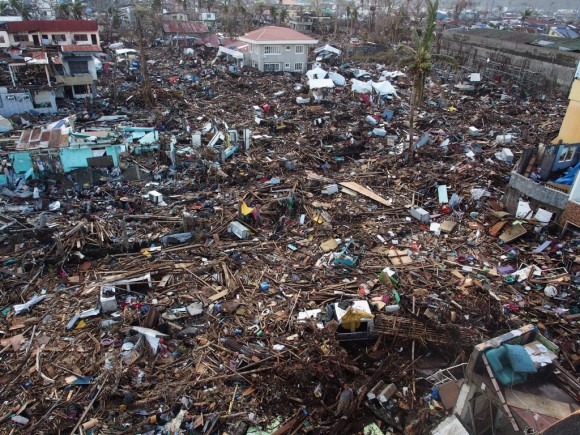
I picked up my walk along the shoreline at the exact spot where I’d ended it last time. As always, I was stunned by the scale of the destruction. You’d think that after fourteen days, I’d be used to the sight, but I’m not at all. It is a shock each and every time.
Whenever people greeted me, I stopped and chatted with them and tried to get their story. One woman was washing some clothes in a bucket out front of a school. She said that this was an evacuation center and she and her family had come there during the typhoon. For a regular typhoon, this school likely would have served well as an evacuation center. However, being right on the shoreline, it was right in the path of the storm surge and offered no more protection than the houses did. All the people who had evacuated to this school had to evacuate again, and they headed for the hills above the city. I can only imagine what that was like. Those hills are completely exposed and would have been struck with the full force of the wind.
Another man gave me a tour of what was left of his home. The entire roof had been torn off and the front wall had collapsed. All that remained were the walls of a couple of rooms at the back. All their possessions had either been washed away or covered in wet mud. They were currently staying at a nearby church and returned to the remains of their house each day to keep at the monumental task of cleaning and rebuilding.
Many people had begun the process of rebuilding their homes. These are the homes built on stilts out over the water. I’m sure there were a thousand better ways to go about it. With time and planning, they could make a much better area in which to live, but they have no choice but to simply get to work and start hammering bits of wood together. The water below them was black with contaminants and filled with garbage, but there was no time or resources to clean it out. They simply plunged their stilts down into the thick muck, drove them in with a rock and then hammered cross pieces to them, and slowly, their houses rose up. I could easily see someone from the outside looking at these shacks and seeing a house that had been badly damaged by the typhoon. In reality, they are brand new houses built after the typhoon. At this rate, the entire shantytown community will be rebuilt in a couple of weeks to a month.
The weather continues to be irregular, and I was constantly hit with sudden squalls as I walked around. I had to be quick with my umbrella and raincover for my pannier bag. One powerful squall caught me way out on the end of a cement and stone seawall. I had to take shelter on the leeward side of a brand new house. This house was quite small – perhaps ten feet by ten feet square – and was on stilts on the ocean side of the seawall. I stood there hiding from the rain when I was startled to hear voices. I looked up above me and saw two teenage boys lying on mattresses between the ceiling and the roof. I hadn’t seen them at all until then.
One boy was very engaging and outgoing with a brilliant smile and a quick laugh. His name was Edwin, and this was his house. His brother (a year or two older) was the master builder. Edwin would eventually live there with his brother and mother. The wind and rain of the squall was turning out to be a difficult thing to contend with, and the boys encouraged me to go inside the house for shelter. I stepped through the simple door, but I found that the rain came through the roof and walls to such an extent that it was much wetter inside than outside, and I retreated. The simple building shook and moved so much in the wind that I was afraid it would topple over right then and there.
At one point, a tiny woman with a pleasant wrinkle-filled nut-brown face appeared. She was a very small thing, and I was startled to learn that this was Edwin’s mother. I would have guessed at least grandmother if not great grandmother. Her body hardly seemed big enough or strong enough to produce a baby. I found her face very expressive, and I told Edwin that I liked her face very much. This sent Edwin into a two-minute fit of violent laughter. I think he thought this giant foreigner was hitting on his mother.
I was stuck there for quite a while as the squall raged, and I learned that Edwin’s brother was the breadwinner of the family and drove a pedicab to make money. Edwin was still in school and often slept at his aunt’s house rather than in their tiny shack with his mother and brother. Edwin asked me how much it cost to stay at my pension house normally. I told him that it cost 700 pesos a night, and this figure astonished him. I imagine that his brother would be lucky to earn 250 pesos a day at his job, and that is probably what his family has to live on. Of course, it wouldn’t be that simple. Their economic life would be tied in with all their relatives. Witness how Edwin said that he often lived at his aunt’s house. Still, the sight of their little house on its stilts over the water – exposed and vulnerable – was quit arresting.
I took hundreds of pictures as I walked along. I had the 45mm lens on the camera and used it almost the entire time. I was extremely thankful that my camera body had largely survived my fall and its brutal crash on the rocks. I felt this urge to take pictures of people enduring and rebuilding in these harsh conditions, but it was still the destroyed buildings themselves and the debris that truly caught my eye. I commented later on to someone that it reminded me of photographs I’d seen from World War II. I continued to come across poignant and funny and interesting sights, such as a cement staircase going nowhere at all, bunches of family photographs, a teddy bear lying face down in the muddy water just like the corpses, a porno DVD titled “Barely Legal Volume 4”, and a small plastic model of the Incredible Hulk lying face down on a piece of wood as if doing pushups. I stuck the Hulk in my pocket intending to take him along as a mascot and souvenir of Typhoon Yolanda. I’ll see if I can attach him to my bike’s handlebars.
On my way back, I came across an older woman sitting on a chair in the middle of an isolated stretch of clean cement. Her family had cleared this little area in front of their house. I chatted with her, and she offered to let me climb to the top of her five-story house to see the view and take some pictures. I eagerly took her up on her offer and her grandson showed me up the many stairs to get to the very top. The view was spectacular, and I shot a bunch of pictures with my 45mm lens before switching over to the 12mm wide angle. Then I used the filters, and I found the dramatic tone filter really captured what the area felt like. I set the camera to the dramatic tone only and took a whole bunch more pictures as I walked along. There were just enough clouds in the sky to make the pictures interesting.
It turns out that the Koreans and the Canadian team had been busy working in this same area, and I came across a row of about fifteen bodies in body bags. At the top of the row, there was a single severed arm and hand sitting inside a plastic container – all that was found of one body.
A man was taking pictures with a huge Nikon camera – probably a D4 – and another man stood nearby. I started up a conversation with this second man, and found out that they weren’t journalists. They worked for a German NGO and were documenting the disaster. The photographer was an old hand at this and had been one of the first on the scene in both Haiti after the earthquake and in Aceh after the tsunami. For the second man, the one I was speaking with, it was his first disaster. He asked if he could record my story, and I agreed. I’m not sure why I said yes to him and no to the Malaysian journalist. I think it was because it was for an NGO and it was just a voice recorder. I find having a big camera lens just inches from my face to be a bit off-putting. I don’t know where to look. With the voice recorder, that doesn’t matter.
The Canadian team was inside the shell of a nearby building, and I went inside to say hello and snap a couple of pictures. The dogs apparently had done very well despite the heat and extreme conditions. One problem was the presence of large numbers of small white biting insects. They were worried that these had gotten onto the dogs and would infest their fur. I think I knew what they were talking about. One time, I had put down my camera to change the battery, and when I picked it back up, it was crawling with tiny white insects. I have no idea what they were, but they appeared to be everywhere – probably millions upon billions of them.
I made my way back toward the pension house slowly, stopping at the fire station to plug in a battery for recharging and at Hayward to buy a bottle of Coke and some coffee. I cut across RTR park and found the Canadian team just settling down at their tents – cleaning their dogs and preparing their MREs.
I’d heard enough names being exchanged by this point that I knew their names were Sylvie, Karen, Richard, and Jen. Sylvie appeared to have something of a sweet tooth, and I gave her my bottle of Coke. I then offered to walk one of them over to Hayward just to show them where the store was in case they wanted to buy something. Hayward was just around the corner, so I knew it would be pretty convenient for them.
To my surprise and delight, there was talk of putting together a beer run. Richard was the only one who had managed to change money and had some pesos. The others wondered if they would take US cash at Hayward. This surprised me, but it makes sense. This team travelled fast and light, and getting local currency wasn’t high on their list of priorities. They brought their own food and water precisely for that reason – so they could function independently and get right to work. Having local currency wouldn’t be, strictly speaking, even necessary. It seemed that Richard had changed money in the airport just so that they could get some pizza there. But then before their pizza was ready, their flight was called – much earlier than they expected – and they left without their pizza.
Richard produced 200 pesos and handed it to Karen, who went with me to Hayward. Manny was there, and I managed to introduce the two of them. I was very happy when Manny invited Karen inside the gated fence to see the cooler of beer for herself. This would be easier than peering through the fence in the growing dark. Manny went even one better and produced five chilled bottles of San Miguel Light from a cooler containing ice. I was glad that I could make this tiny contribution to the team. The price of beer had gone up as Manny’s costs had risen. One bottle of cold San Miguel was now 65 pesos, and Karen didn’t have enough money. I covered the rest, of course, and was very glad to do it. One of the five bottles was for me, and I sat down with them near their tents. I discovered that the MREs were not nearly as unpleasant as I’d thought. They had their own built-in heating system. I don’t know how they work, but they simply had to open the packages and stuff them inside a plastic bag and wait. In a few minutes, the meals were piping hot. Jen showed me the contents of her favourite – vegetarian lasagna – and it looked delicious. I commented that one problem with the MREs would be that there wouldn’t be enough food in them. It looked like I could eat five or six of those lasagna pouches. Jen, however, said that that was not really the case for them. She never managed to finish a complete meal that came in one MRE.
It was great to sit there enjoying a cold beer and listen to them talk about their experiences. Unfortunately, the weather was not cooperating and rain began to spit down. I hoped it would go away, but it got stronger and stronger until they had no choice but to retreat into their tents. Jen stayed outside for a while to finish her meal, and I kept her company while covering us both with my large umbrella.
Getting back to the pension house was a small adventure, as it was now pitch dark and the rain was pouring down. I had been out walking around most of the day and was quite hungry and tired I tripped over a big piece of wood and slammed my hurt toe into the wood in the process. It hurt like blazes. Like a dummy, I hadn’t brought along a flashlight. The pension house was dark and quiet when I got there, and I had to bang on the front gate for a long time before I got anyone’s attention long enough for them to come open the door.
The full BFP team wasn’t back yet. There were just two members sitting out on the verandah. One of them amused and annoyed me with a sudden “Filipino attack”: Where is your family? Why aren’t you married? Why don’t you have a girlfriend? Aren’t you lonely? Why don’t you live with your loved ones? Etc. I made a cup of coffee, and then later I made spaghetti in the wonderful solitude of my room.
Today, I hope to do a bit of housekeeping. I want to see about doing some maintenance on my stove and getting it to work with Dan’s lighter fluid. I’m hoping that using this fuel will clear out whatever is blocking the fuel line. If not, I will try to dismantle it and somehow clean it. I might also clean my room and bathroom. I want to get in a large amount of water and perhaps see if at the end of the day, any of the Canadian team want to come over for a bucket bath. In between all this, I hope to go out and do some more photography.
1:45 p.m.
So far so good on this fifteenth day of my typhoon experience. I swept and mopped the floor of my room and washed down the entire bathroom. Then I brought up as much water as I could. After that, I cooked up a batch of oatmeal with condensed and sweetened cream on top. I had wanted to cook this oatmeal with my Trangia X2, but I failed. I spent a long time cleaning the X2 and draining what gasoline I could out of the fuel line. I tried to dismantle the fuel line and other parts, but the bolts were on so tight that I couldn’t loosen them short of applying a very large amount of force. I was afraid that I would break something. And with my luck, I probably would. I decided to just fire up the stove using the new fuel and see if that somehow cleared the fuel line. But after all of that work, the final result was a dismal failure. No fuel came out of the jet. There was a complete blockage somewhere. I guess I was REALLY not supposed to use leaded gasoline. I got out my trusty alcohol burner and used that instead. It is soooooo much better than these high-tech super-charged stoves that never work when you need them.
Once breakfast was over with, I set out into the city to run a couple of errands. I needed to pick up my recharged battery from the fire station, and I wanted to buy some more food from Kokoy’s Grocerette. With my usual luck, the heavens opened and the rain came pouring down as soon as I left the gates of the pension house. As I walked along, many helpful people told me that it was raining. My walking in the rain even with a large umbrella is not viewed with pleasure here. I finally gave in and I ducked underneath an overhanging shelter. A woman there was trying to open the steel shutter door to her daughter’s little shop. She sold fancy jewellery and snacks to the students at a school located across the street. With the school closed and with no plans to reopen in the near future, the daughter had relocated to Manilla. The mother just wanted to open the door to check on the interior. Unfortunately for her, the padlocks had rusted up in the saltwater, and she couldn’t get them open. She said that she needed oil, but since all the hardware stores had been “looted and ransacked” there was no chance to get any oil.
I didn’t even bother to argue with her and try to convince her that not all the stores had been looted. This belief was something of a religion among the Filipinos here. They seemed eager, if not desperate, to believe the absolute worst about the situation and about Filipinos in general. I continued to believe that only a few of the stores had been looted, and I was very happy when Kokoy’s Grocerette opened up, and I saw that it clearly had not been looted. This vindicated my view that people’s claims about the scale of the looting were vastly exaggerated and, in most cases, completely untrue. This had come up a number of times when I’d tried to make the argument that it was unfortunate that businesses did not even try to open. People were denied essential items and this led to panic. The business owners refusing to open struck me as a very ungenerous act. But when I tried to develop this argument, I was shut down instantly by everyone claiming that all the stores were empty anyway. They’d all been looted and had nothing to sell, they said.
I knew this was nonsense. The stores’ steel shutters were all down and locked. I told people this, but they insisted that this made no difference. Filipinos, they said, could get into anything. This still made no sense, because it meant that a rampaging mob had broken through the steel shutters, stolen everything, and then had carefully rolled the shutters down and relocked the padlocks when they left. Clearly, if the store had been looted, it would be smashed open and would stay smashed open. The evidence was clear to me. Some stores, such as Gaisano, had clearly been looted. I had seen it with my own eyes and the store fronts and interiors of both Gaisano outlets were in ruins. Robinsons Mall had also been looted. I’d seen the smashed windows and the empty shelves. Even the National Bookstore at the mall had been completely emptied. And there were a smattering of other storefronts that had either been broken up by the storm or by looters. But the vast majority were still intact, and that included places like Kokoy’s. When Kokoy’s opened its doors, I could see for myself that it not only had not been looted but had also suffered little flood damage. My precious M&Ms were still there on the display case exactly where I’d last seem them two weeks ago before the typhoon. (I bought one package that first day. When I went back today, they were all gone. I should have purchased more and stocked up.)
With these thoughts on my mind, I decided to take a walk through downtown Tacloban and see if any of the hardware stores had reopened. I was already running low on denatured alcohol, and with my X2 refusing to work, I was soon going to be going hungry.
Most stores and businesses were still closed, but I did see a few that looked to be getting cleaned up and organized to open soon. And I was delighted to see a water purification business and a hair salon both already open. That means I don’t have to worry about getting water anymore, and I can get a haircut. I can feel the need for a haircut coming on.
I made my way to my favourite hardware store – Acme Hardware – and was pleased to see that its steel shutters were down and completely intact. That meant that even though it wasn’t open, my wonderful Flying Tiger brand denatured alcohol was still in there and perhaps will become available soon. However, I noticed that a side door was open and a man was standing there. I could hear the sound of a big generator. Taking a chance, I went up to him and asked if he was connected to Acme Hardware and if the store could be expected to open soon. He said, to my dismay, that the store wasn’t expected to open until 2014. But when I explained what I wanted and why I wanted it, he said that I could buy some. Then he asked me how much I wanted. “One gallon? Two gallons?” My jaw almost dropped. One gallon of denatured alcohol! It seemed too good to be true. I almost pulled an Elaine and asked for as many hundreds of gallons as they had in the warehouse. But I kept things under control and kept my expectations low and said that one gallon would do me just fine. This would cost 165 pesos ($4), and I was invited to come inside and take a seat while an employee was sent into the warehouse to get it. They had a makeshift system in place for making out receipts on little pieces of paper, and my transaction was duly recorded, and I was given a copy. Then I sat and waited to see what transpired. Inside, I was mentally preparing myself for disappointment. The alcohol would not be available. It would be the wrong type of alcohol. There had been a misunderstanding, and he would bring one 450cc bottle instead of a gallon bottle. Something would go wrong. But nothing went wrong, and to my joy, a man came out of a back door with a one-gallon jug of denatured alcohol. As a bonus, I got to pet a big, beautiful dog. He was a bit of a tease, but he occasionally got close enough for me to manhandle him a bit.
I was in a spectacular mood as I walked along swinging that heavy jug at the end of my arm. It would have been better to have tracked down that jug days ago, but it probably wouldn’t have been possible anyway. I was just glad to have it. It’s the little things that make me happy, clearly.
While walking to the fire station, I’d come across a long line of panel trucks operating as mobile stores. This was a relief project by some kind of commerce association in combination with the armed services. Personally, I’d be embarrassed to be a local business owner and have to have trucks like that come in and sell products to the local people that I’m supposed to be serving. The shopowners have little community spirit, it seems.
While I was watching this activity, I spotted a group of three soldiers walking my way. One of the soldiers was carrying a brand new Nikon D7000 with a Nikon lens on it. My experience with the D7000 was very bad, but it certainly is a gorgeous camera. The soldiers were very glad that I approached them and they posed for a picture with me. I did my best to dissuade them of the notion that I was there with a relief organization, but that information did not get through. They continued to shake my hand and thank me for caring about the Filipino people and coming to help. I had them take a picture using my little camera, and I hope it turned out well. I walked back to the pension house, and I snapped a bunch of pictures as I went. There had been little improvement in this street. All the debris and vehicles and trees still blocked the road. In some ways, it looked worse since people had brought their damaged furniture and other possessions outside.
Tags: fire, NGO, Nikon, Nikon D7000, Philippines Bike Trip 2013, Super Typhoon Yolanda, Tacloban, typhoon, umbrella