
18 – Fixing My Bike and Other Gear in Sigli
Monday August 13, 2019
6:30 a.m Ramshackle Room, Wisma Dian
Sigli, Sumatra
I was woken up by the call to prayer this morning at around five a.m. I felt like I should sleep longer, but I wasn’t able to. So I got up and went about my early morning routine. That involves taking down my mosquito net and setting it aside, plugging in my kettle for hot water, preparing a cup of instant coffee in advance, turning on my computer, and turning on my phone. Then I brush my teeth and take a very quick shower. I decided not to shave or wash my hair this morning, so my shower was very fast, and the water had just started to boil as I emerged from the bathroom. I poured the boiling water into my Tim Hortons mug. I proofread what I wrote yesterday. That always takes a long time, and it refreshes my memory about what is going on and what I’ve already mentioned so that I don’t repeat myself. And, finally, I start typing out my new thoughts for this morning.
Yesterday was a housekeeping day for the most part. I had four immediate things to take care of. First on my mind was the problem with my rear wheel, but I decided to save that for last. I also had a slow leak in one of my trailer’s tires. I assumed there was a tiny puncture, and I had to fix that. One of my bike mirrors had broken, and I wanted to fix that. Finally, I had run out of chain lubricant, and I needed to go on a shopping run to buy some more.

The exposed freehub on my rear wheel.
Even though I planned on working on my wheel last, the very first thing I did was some online research. It turns out that I already knew everything I needed to know. I just forgot that I knew it, and I needed a refresher. In particular, I quickly remembered how a freehub works. The hub itself consists of the axle and the bearings. And the freehub is a separate unit that screws onto the hub itself. The freehub consists of two halves. One half has a series of teeth. The other half has groupings of levers, which are called pawls. Different brands of freehubs have different numbers and sizes of pawls.
The mechanism itself is very simple. The pawls are forced out by a simple leaf spring and they engage with the teeth when you are riding forward. And when you stop pedaling or you pedal backwards, the pawls simply click past the teeth. This is hard to describe in words, but it is instantly obvious how it works when you see it in action. And this knowledge confused me terribly because based on how the freehub works, it is impossible for it to do what mine seems to be doing. Put simply, the pawls can’t jam into place while going backward. It’s just not physically possible. It makes me think of the old trick of attaching a baseball card to the frame of your bike so that it makes a clicking sound as it hits the spokes of your wheel. That’s pretty much how the freehub operates when you are coasting. The spokes hit the baseball card and just push it out of the way. It’s impossible for the card to jam with the wheel turning in that direction.

Trying to fix my broken mirror mount and failing miserably.
In fact, when a freehub fails, it causes the exact opposite to my problem. What happens is that the leaf springs get covered in dirt and grease, and they no longer push the pawls out. Therefore, the freehub doesn’t engage at all when you pedal forward. In this case, the cassette spins freely in both directions. You can pedal all you want and nothing happens.
It’s a big difference. Normally, when a freehub fails, the main symptom is that the cassette spins freely in both directions. That is always the case, and that is what everyone talks about when they post about their freehub having problems. But in my situation, the cassette won’t spin in either direction. And, for the life of me, I can’t see how that is possible or how it could be related to the freehub. Yet, it has to be. It’s very confusing.
The only even remotely possible explanation that I found online is that sometimes one or two of the pawls will snap in half. Then you have a chunk of metal floating around inside the freehub, and this piece of metal will jam the other pawls and not allow them to click past the teeth. It’s kind of like having the teeth of a sprocket break inside a geared machine. The tooth that broke off will get caught in the gears and the whole machine grinds to a halt.

All these rings with teeth are called the cassette. They mount onto the freehub, which is shown here in the middle. I don’t know for sure, but I think the problem is inside the freehub, and there is nothing I can do to fix that short of replacing it.
Doing the research online was such a familiar yet frustrating experience. Every time I have a problem, it is never the normal problem. No one ever has the problem that I have. My problems tend to be unique and have no explanation. So if I Google phrases like “freehub jamming” or “freehub problems” I find no one on the planet earth has ever had a freehub jam the way mine does. There are thousands of results for freehub problems, but these are always based on the freehub spinning freely in both directions. That is the common failure. No one experiences a freehub NOT spinning in ANY direction. Yet, that is what happened to me. I always seem to have the problem that no one has and which, on the face of it, seems impossible.
At this point, I hadn’t actually looked at my wheel again. This was just online research, so it would have to wait until later in the day for me to see if anything I’d learned could help me diagnose the problem. I also decided to put off the other repairs until later. I wanted to go out on my bike and explore the town a bit and buy some oil. I was particularly interested in finding some oil because the only maintenance recommendations I got for the freehub was to remove the cassette and the lock ring, lay the wheel down flat and then dribble some oil into the freehub and let it seep down into the mechanism. This, however, was meant to correct the problem of the freehub spinning in both directions. I couldn’t see how lubrication would fix my problem. But a bit of oil never hurt, and I needed oil for my chain anyway.

I’m also having trouble with my computer’s keyboard. The keys keep popping off, and I have to carefully put them back while securing them in place with super glue.
There are small hardware stores everywhere in Indonesia, and I quickly came across my first one. I also wanted to buy a small clamp to try to fix one of my bike mirrors. The swing arm that the mirror arm screws into had split, and it could no longer hold the screw insert in place. This happens all the time, and I was tired of buying new mirrors. I wanted to see if I could wrap some electrical tape around this swing arm, put on the clamp to tighten it, and then reinsert the screw insert with a bit of super glue. It seemed like a good plan. Unfortunately, when I tried it later in the afternoon, I found I had gone one step too far. I should have tried just the tape and the clamp first. The superglue was overkill. I put in so much superglue that it seeped inside the screw holder and I was completely unable to put in the screw anymore. I had made things worse, and now it was a total wreck. There was no way to fix it at this point. So I just took it off the bike and threw away the whole mounting assembly. I can keep the mirror and use it as a regular mirror for shaving or other grooming tasks. Luckily, I still had a mirror on the bike. I like to have two of them – one on each side of my handlebars – and I had broken just one of them.
This hardware store didn’t have any oil, so I continued my search. I hadn’t seen any bike shops in Sigli, so I didn’t think I’d be able to find actual oil meant for bicycles. Motorcycles are everywhere, of course, and it is easy to find cans of chain lubrication. But these are generally far too big and heavy. I just needed a plastic tube of simple oil. My idea was to buy a bottle of Singer oil. This oil is a general purpose oil meant for everything. It’s not high-tech. It’s cheap and comes in a little plastic bottle. I would normally see it everywhere. Every time I went out on a shopping run, I’d spot Singer oil on the shelf. But, of course, now that I needed some, I couldn’t find it anywhere. It always goes that way.
While looking, I passed a small motorcycle shop, and a friendly person called out a cheerful hello. It was one of those types of hello that I mentioned before. It was more meaningful and delivered with more intent than the norm. It sounded like it was coming from someone who really meant it, who probably spoke some English, and who probably wanted me to stop and actually talk to them.

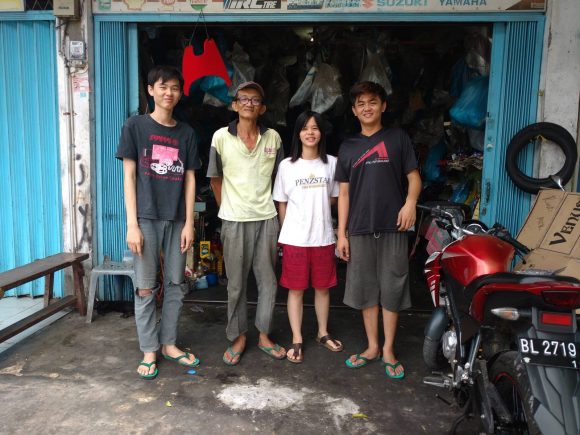
While searching for oil in Sigli, I met this friendly family at a motorcycle repair shop. The son on the left and the daughter both spoke excellent English, and they invited me inside to sit down, chat, and drink tea. The family’s hope is for their youngest son to go to Canada or some other English-speaking country to live and work.
I turned my bike around and drove up to this shop and found that I was right on all counts. The owner of the shop was an elderly Chinese man (funny aside: I learned later that though I thought of him as an elderly Chinese man, he was actually three years younger than me), and the person who shouted “hello” was his young son. The son spoke a very impressive amount of English, and I ended up spending a lot of time there. The father had a dream for his son to move to a Western country like Australia, Canada, or the United States. And he felt that a white dude passing by on a bicycle was too good a chance to pass up. While I chatted with the son, the father kept interrupting and urging him to ask me very specific questions about how one gets a job in Canada and whether I could help him in any way. My answers to his questions weren’t surprising. I couldn’t offer much in the way of guidance beyond the obvious steps of just doing the work – going to the embassy and applying for a visa and all that stuff. I don’t know of any magic trick to help someone get from Sigli, Sumatra, to Vancouver, Canada, and start working and living there. In fact, when pressed, I could only offer rather negative input about the current refugee crisis around the world and the overall anti-immigrant and anti-refugee mood of many governments. And, as I always seem to end up doing, I offered a cautionary note that moving to Canada might not even be the best idea. Compared to a place like Sigli, anywhere in Canada would be quite boring and extremely expensive.
Other than feeling guilty that I couldn’t really do anything to help this son achieve his dream, I enjoyed chatting with this family very much. They were very nice people. The father even started doing some maintenance on my bike. When I asked about oil, he got out a big pressurized can of motorcycle chain oil, and he started spraying my chain and gears. He then took out a big rag and started wiping down my bike and cleaning it. He suggested that this can of oil would be good for me, and I had a tough time explaining that (even for me) it was a bit big and heavy. It was the kind of can you keep in your shop or your garage. You don’t toss it into a toolkit on your bike.
I told them that I was looking for Singer oil, and the son instantly got some money from his father and said he would go get some for me. He was gone for about two minutes, and he returned with the familiar green bottle. I don’t know where he got it, but it was easy for him. And they wouldn’t let me pay for it no matter how much I insisted. Later on, back in my hotel room, I remembered why Singer oil wasn’t the best choice either. I had purchased some before, but it turned out that the bottle doesn’t close properly. To open it, you have to cut off the very top of the plastic nozzle. And then the cap just fits over that nozzle. But it doesn’t screw on or make a tight seal. It’s meant to just sit on a shelf upright. So if I put it inside a bag, it would just leak out over everything. Luckily, I still had the empty tube of the fancy and expensive bicycle lubricant I had purchased in Kuala Lumpur. I simply poured the Singer oil inside this tube. It has a screw on cap that provides a tight seal. So it worked out perfectly.

Sticking with the trend of everything breaking, even my handy light bulb fixture fell to pieces.
In terms of errands, that was about all I had to do. I got the clamp for my bike mirror and I had oil. Later on, I stopped at a convenience store and bought some milk and a loaf of bread. Other than that, I rode my bike all around Sigli to see what there was to see. Interesting sights included a very cheerful prison. The front of the prison looked like a children’s daycare center. Only when you looked up at the high walls and noticed the rolls of razor wire did you realize that it didn’t house children but prisoners. I also came across a large and very popular water park. I think this was the only park like this that I’ve seen in Sumatra. It wasn’t a large park with eight-story slides and that sort of thing. It was really just a series of wading pools. But with this heat and since it was Sunday, it was very crowded. It was clearly the most happening place in all of Sigli.
I also rode around the waterfront again, and I was surprised that it was so quiet. There were dozens and dozens of small cafes and restaurants – all of them empty. Perhaps the heat of the day was keeping people away and it would be more popular in the evening. In fact, I’m positive that would be the case. I often miss out on the most active times in Indonesian towns because I’m so reluctant to go out at night. I’m out exploring during the worst heat of the day – the whole mad dogs and Englishmen thing. That’s just how my body and brain clock works. By the time the sun goes down, I just want to stay home. Yet, I think that is when Indonesians go out. In any event, the waterfront area was a ghost town. I would have stopped for a fruit drink, but I was badly overcharged for my fruit drink on my first day here. So I did not want to return and give them any more business.

I also had trouble with one of my water bottles rubbing against the front tire. So I tried rearranging things so that the smaller fuel bottle for my stove sits underneath the bike frame and next to the tire. I doubt I will continue to do this because the fuel bottle in this position ends up getting quite dirty.
With all my errands done, I turned my bike back to my hotel to begin repairs. The repair to my trailer’s tire went easily enough. Before I even started the repair, I put the entire wheel into the water tank in the bathroom, and I saw a tiny bubble of air pop up every couple of minutes. It was the slowest leak imaginable, but it was still a leak, and my tire went soft every day and had to be pumped up. So I set about removing the tire and taking out the tube. I had a lot of trouble doing that again. In the past, I don’t remember it being so difficult to get tires off and back on tire rims. But now I find it very hard. It takes a lot of work and all the strength I can muster from my noodle arms. Eventually, I was successful, and it was a simple matter to find the hole. I also found the culprit that made it. There was the tiniest piece of thin metal wire you can imagine sticking out of the tire. It was so thin that you could hardly even see it with the naked eye. I only discovered it because as part of my flat-fixing routine, I run my fingers along the inside of the tire to check for anything sharp. I’ve learned to be very gentle doing this because if you go too fast and your fingers encounter a shard of glass, it can rip right through your skin. And as I moved my fingers around the tire, I felt the telltale prick of that razor-thin wire. It was so small it’s astonishing that it managed to work its way all the way through the tire and then puncture the tube. But there it was, and I managed to work it free with my Leatherman needle nose pliers.

My rear view mirror can’t be mounted on my bicycle anymore. But maybe it can have a new life as a grooming aid.
The other trick I’ve learned over the years is to never assume that there is only one puncture. You feel really stupid when you fix a flat and then put everything back together, pump up the tires, and then find out that there is a second or even a third puncture that you missed. So once I fixed this tiny puncture, I waited until the patch was completely dry and secure. Then I pumped up the tube and put it back inside the water tank to check for more leaks. Luckily, there were none, and I just had to put the tube back in, re-seat the tire, and then pump it up. I checked this morning, and it seems to be holding its air just fine.
I suppose I could log this as a true (though small) disadvantage of the trailer. I’ve noticed that the trailer tires lose air pressure much faster than my bike tires. This could be because they are so much smaller and even a small air loss means the tires go very soft faster. In any event, I find myself pumping up those tires much more often than my bike tires. I haven’t had any trouble with flats, though. People who argue against trailers say that having two more tires doubles the number of flats you get. My theory, however, is that with the weight distributed over four tires instead of just two, you actually get less flats, particularly pinch flats. My practical experience bears this out as I get pretty much zero flat tires. But I don’t know if the weight distribution angle really makes sense. When I think about just the weight of the gear, it makes perfect sense. I don’t have accurate up-to-date numbers, but if I have sixty pounds of gear in the trailer, that is sixty pounds NOT on the bike. Sixty pounds of gear are resting on the trailer tires and not on the bike tires. There is no arguing with that. And there is also no arguing with how this makes the bike feel much better – more maneuverable and more nimble. It feels like an actual bike instead of a tank. BUT does that sixty pounds actually make a difference to the bike in terms of stress on the wheels and the resulting broken spokes and bent rims and flat tires? I just don’t know.

It’s fairly standard for bathrooms in Indonesia to have large, square water tanks. Most of them, however, develop leaks over time and are difficult to clean. To fix that problem, hotels simply place plastic garbage cans inside the water tanks. This hotel turned on the main water pump for only a short time each day in the morning, so I had to be on my toes and rush to the bathroom to fill up my garbage can when I heard the pump running.
It occurred to me recently the issue isn’t as simple as just weighing the gear. For example, there is this Korean woman, Jin, cycling around the world with a traditional heavy load of pannier bags on her bike. But I’m sure Jin herself weighs at most one hundred and twenty pounds. I probably weigh two hundred pounds. So right there, her bike is carrying eighty pounds less than mine because her body weighs eighty pounds less than mine. She could carry eighty pounds of gear on her bike, and that would just bring her up to the same level as me on my bike without ANY gear at all. So does the weight of the gear have an effect when it is actually just a fraction of the body weight of the rider? I don’t know. I do remember back in the Philippines when I was using a full set of pannier bags, I was unhappy. I was horrified when I tried to pick up the rear of the bike and swing it around or something. It was so heavy that I couldn’t budge it. Of course, that is the combination of all the weight – the gear, the water, the pannier racks, and the bike itself. It’s not just the weight of the gear that I was feeling. It was the weight of the gear AND the bike. All that weight rests on the rear wheel. Even so, it felt awful. It felt so heavy that I pictured the rear wheel simply pancaking under the strain. But when doing these calculations, I forget that when I simply get on the bike myself, I’m adding two hundred pounds right there. And that body weight is far more than all the gear weight combined. Anyway, it’s food for thought.
Once my mirror was in the garbage and my trailer tire fixed, I turned my attention to the rear wheel. Based on my previous experience and what I had learned, I couldn’t think of any reason why removing the cassette would help the situation, but I figured it couldn’t hurt either, and I’d get a closer look at the freehub in the comfort of my hotel room instead of at the side of the road in a sun-blasted desert.

This is the young son that has dreams of living and working overseas. I think this picture is a bit misleading. He is tall, but not that tall. I just happen to be standing down on the street and he is standing on the curb. Optical illusion…
I have to say that ever since my eyesight tanked in the Philippines and I had to start wearing reading glasses, doing anything on the bike is twice as hard. Wearing glasses is such a pain, especially because I’m still using cheap glasses from a convenience store. They don’t fit that well, and they constantly slide off my nose and fall off when I lean over. So it was much harder than it should have been to use my special tool and remove the cassette. But it was eventually done, and I was able to get a close look at the freehub.
The freehub was working fine at this point. It spun freely in one direction and then engaged the teeth in the other. That’s how it was supposed to work. I fiddled with it for a long time trying to recreate the conditions that led to it jamming, but it never did. It just worked flawlessly. I shook it, listening for any loose bits of metal inside, but I couldn’t hear anything. It seemed to be in perfect condition from the outside. My only concern was that the freehub components looked rather exposed once I got the cassette lock ring off. It looked open to the elements. I couldn’t help but feel that a seal was missing. Shouldn’t there be a rubber seal over the inside to keep out rain and dirt? Not having examined a freehub from this point of view before, I couldn’t remember if I ever saw a seal on one. Maybe they just don’t have seals there. Or maybe mine was missing a seal because the dudes in Bangkok forgot to put it on when they built my wheels. I don’t know.
Once I had removed the cassette, examined the freehub, kind of cleaned it, shook it, and fiddled around with it, I was at the limit for what I could do. Without specialized bike tools and without taking the whole hub apart, there was nothing else I could do to examine the freehub. So I just lay the wheel flat on the ground and dribbled in some Singer oil. I spun the freehub around for a long time to work the oil into the mechanism. I didn’t see how this would do anything beneficial because this was normally done to free up the spring-loaded pawls in a freehub that was not engaging. My problem was the opposite – it engaged in both directions. But I figured a bit of oil couldn’t hurt. And it was the only thing I could do.

I had no idea what this building in Sigli was. I just thought it looked cool. Later on, I found out that it was the Tsunami Museum.
I let the wheel sit there for a couple of hours while I did other things. And then I remounted the cassette, tightened the lock ring with my hand dandy tool, and then I put the wheel back on the bike and pumped up the tire. While I had the bicycle upside down, I turned the pedals to spin the rear wheel and then stopped to see if I could get the cassette to jam. But it wouldn’t jam on command. I put the bike in the highest gear possible and spun the pedals as fast as I possibly could. The rear wheel was revolving so quickly that it sounded like it was going to take off and go into orbit. But nothing happened. The freehub freewheeled merrily just as it was supposed to. I changed gears and pedaled slow and then fast and changed direction and banged it around, but nothing happened. It just worked flawlessly. That was everything I could do, and now I just have no choice but to ride the bike as it is and see what happens.
As for the future, I have a couple of options. Freehubs are replaceable, so I could buy a brand new Shimano freehub and put it on. When I first thought about this, I had it in my head that I would have to buy a complete hub and rebuild the wheel. But after my research session, I realized that the freehub is a separate unit. I’m pretty sure that the cost of a freehub alone will be more than the cost of an entire hub set, but it would save the hassle of rebuilding the wheel.

Interesting architecture in Sigli.
Another option is to have a bike shop dismantle and service my hub. They can check everything over once they have it disassembled and see if any of the pawls are broken or otherwise diagnose the problem. It could be a simple fix.
Finally, I could buy a brand new hub from a different company. This option is appealing because in my research, I discovered that Shimano XT hubs are notorious for this kind of failure. I had no idea this was the case. I’m actually very far behind when it comes to all forms of technology. Back in the day, I developed this idea that Shimano XT was among the best you could buy. In fact, I never did jump up to the XT level because it was too expensive, and I wasn’t worried about the slight extra weight of the LX model. I just have this feeling that I’m “hot shit” because I have Shimano XT hubs. But it turns out that Shimano XT hubs are now among the cheapest options available. And most people consider them to be too crappy to put on a touring bike. What the heck happened? How could I be so wrong? Anyway, there are far superior and more durable hubs out there, but they are expensive. Velo Orange, for example, makes a great rear hub for touring, but a single hub costs $160. And the flange is so large that I would probably have to buy all new spokes. My current spokes would be the wrong length. So that isn’t a very cost effective route to take.

River in Sigli.
Or I could just find the nearest dump, throw my bike into it, and hop on the next bus. At times like this, that seems like a very reasonable option.
After writing all this and drinking two cups of instant coffee, it is now eight thirty in the morning, and the brutal sun is high in the sky. Since nearly all of yesterday was taken up with errands and bike repairs, I’m going to spend another day here in Sigli. If I do follow through with my new plan and cycle down the coast instead of through the mountains, I have lots of time. I can hang out for many days in any town I like when I find a cheaper hotel. No need to rush.