
17 – The Coast Road and a Construction Camp
Sunday August 12, 2018
6:20 a.m. Ramshackle Room up the stairs at the Wisma Dian
Sigli, Sumatra
(100,000 rupiah per night; big room, two single beds with hard wood frames and hard mats; junky table; plastic stool; no sheets or blankets but supplied towels; private bathroom with occasional water flow; very dirty)
The skies looked perfect when I woke up in Banda Aceh for my planned departure. The owners of the Griya Arida hotel get up very early to prepare breakfast for their guests, and they were awake almost at the same time as me. I had had Corn Flakes and milk in my room. (I’ve found, by the way, that Corn Flakes is the only food that consistently calms down my insanely angry stomach. I’d eat it regularly if I could find it. I wonder what magical ingredient in corn has this effect?) But I also got a large serving of spicy rice with fish from the hotel owners. Spicy rice with fish doesn’t sound appetizing, but it was very, very good. For me with my Western sensibilities, it is more of a lunch or dinner meal and it’s a bit hard to enjoy it for breakfast, but with my large appetite and the need for energy for the day, I ate it quickly and happily.
Leaving Banda Aceh was relatively easy. If I wanted to take the main highway, it would have been very easy since I was already located on the outskirts of the city. But I had my sights on a small coastal road, and to get there, I had to ride all the way downtown turn right, and then cross a major river in order to meet up with this coastal road. The traffic wasn’t the easiest to deal with, particularly at major intersections, but it was early and cool, I was full of energy, and I was quite content with my full stomach.
There were a couple of beaches in the early stretch that I covered, and I turned my bike down the access road to check them out. They weren’t nearly as nice as the beaches on the west side of Sumatra, but they were still nice, and I could see Pulau Weh out in the ocean. As the skies became more and more blue, I wondered if I should have gone to Pulau Weh anyway. I probably should have, but I was more in the mood to continue my bike journey and actually do something. At Pulau Weh, one hangs out in bungalows and goes on day trips to go snorkeling and scuba diving. That would have been fun at the end of my journey to get to Banda Aceh, and I probably should have gone straight out there rather than stay in the city. But now that my visa run was over, I was eager to continue my journey rather than start with two or three days of more just sitting around.

A short distance from Banda Aceh, I crossed this river, and I noticed this unusual style of boat. It was essentially two boats with a platform across them. And there are long poles on different sides. I don’t think it’s a big mystery what this boat is all about. It’s a fishing boat of some kind, and it probably uses those long poles to spread out large nets. But I don’t know exactly what type of fish or sea creature it is used for.


At one beach, I caused quite a stir as three separate men wanted selfies with me. One man in particular seemed to fancy himself to be a fashion photographer. I lost track of the number of selfies we took together. He had us strike different poses. And then he posed me separately at a variety of slides and monkey bars in a small children’s playground. It was starting to get weird, and then it got even weirder. This guy was very physical, and I found his hands moving over my body a bit intrusive – it was a bit much. Then he faced me and launched into a long and passionate speech in Indonesian. He kept insisting that I can do something if I want. He kept repeating the word “bisa”, which means that I can, it’s possible. He used his finger to draw something on my stomach, but I didn’t know what he drew. Then he removed almost all doubt by reaching down and giving my junk a nice, friendly pat. “Bisa!” he said. I’m not sure if he meant that I could bisa with him or with some female friend of his, but that was clearly my signal to leave. Posing in front of a children’s playground was weird enough. The friendly pat on my crotch made this whole encounter too weird for me, and I got out of there.

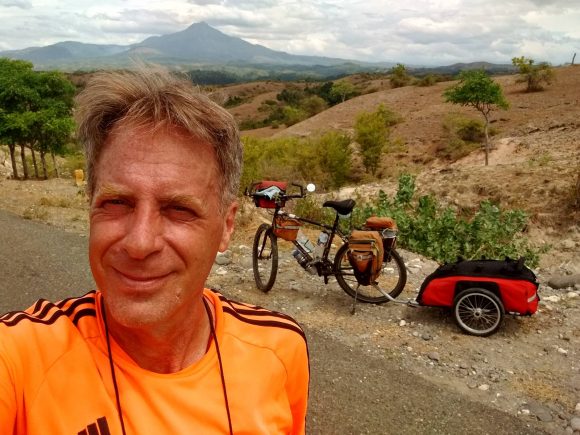
Climbing up a low hill on the outskirts of Banda Aceh, I stopped for a selfie with my bike and awesome trailer.
In a relatively short time, the terrain changed dramatically, and I found myself in a desert environment with brown hills and sparse vegetation. It reminded me of the California coast. The road began to deteriorate, traffic thinned out to almost nothing, and the road’s gradient up and down the hills got steeper and steeper. I lost cell phone reception early on, and as the sun climbed in the sky and began to beat down with the power of a thousand blow torches, I started to wonder if this coast road was right for me. I’m no hard core adventurer. I don’t need to go far into the wilderness until all traces of humanity are gone in order to be content. Sure, the local small road is preferable to a highway, but I still like that local road to go through villages and farms. I like to see people about their daily business. I like to shout “Hello my good friend!” to all and sundry as they greet me. I like to pass by small cafes with the local men drinking coffee and smoking. This coast road offered none of that. I was well and truly in the wilderness.

It became hot and dry very fast as I left Banda Aceh and headed down a small coastal road. I stopped here to get a cold drink.
To make things far worse, after covering forty or fifty kilometers, my bike decided it was time to act up. I’m still not totally clear on the problem, but the cassette on my rear wheel suddenly decided to seize up. Normally, of course, when you stop pedaling, the rear cassette freewheels. There is a ratchet mechanism in the rear hub. It engages when you pedal forward and then it releases when you stop. That is the quiet ticking sound you hear from the rear wheel. It is the ratchet allowing movement and waiting for you to pedal forward again.
But my cassette suddenly stopped freewheeling. There was now essentially a solid connection between my pedals and the rear wheel. As the wheel turned, the pedals had to turn as well. The first time it happened, I was taken totally by surprise and it was a near disaster. The chain whipped forward as the slack was taken up and the whole derailleur was pulled forward with an almighty bang. The rear wheel locked up as it fought with my legs and I could hear things snapping and cracking, and I hit the brakes hard and skidded to a halt. I was practically in shock because this had happened while I was going at some speed downhill.

I’m half-smiling here, but this picture represents a real problem. Out of nowhere, the cassette on my rear wheel started jamming. I’d never experienced anything like this or even heard about it before, and it was not something I could fix myself. The problem was clearly in the freehub, and I didn’t think I could do anything about it except replace it. And I ended up having to change my plans dramatically for the rest of this cycling trip.
When I got off my bike to investigate, I found that I could not pedal backwards. The ratchet in the hub had jammed in place, and I could not turn the pedals at all while standing still. I have so little experience with hubs and the freewheel mechanism that I was completely at a loss as to what to do. I certainly don’t have the tools or the knowledge to dismantle a hub out in the middle of a desert. I quickly resigned myself to returning to Banda Aceh. I don’t know that a bike shop there could help me out, but it was the closest place to go to for help. First, however, I thought I should at least investigate. So I removed the rear wheel and went over the cassette carefully. Just as when it was on the bike, the cassette was stuck in one position. It would not turn at all.

The terrain along the coast reminded me of California – a dry, scrubby desert. It was very different from the terrain on the other side of Sumatra. I felt like I was suddenly in a different country.

Interestingly, though, there was the tiniest bit of play. It wasn’t like the bearings had seized up. The wheel would turn on the axle just fine. And the cassette would spin freely maybe three eighths of an inch in either direction. That’s normal for the forward direction. You turn the pedals forward until the drive mechanism in the hub engages. But now, the same thing happened when I spun it backwards. The cassette could move about an inch back and forth easily, and then it slammed up against an internal barrier of some kind. It is supposed to do that when moving the bike forward, but it is NOT supposed to do that when going backward.
In order to investigate further, my only option was to remove the cassette. I didn’t know that it would help in any way. All it would do is reveal the freewheel mechanism on the hub. I think it is generally called the freehub. But it is pretty much sealed. It’s not like you can take it apart at the side of the road and see what the problem is. But it was my only move, so I took out my handy cassette removal tool, and with some fumbling around and problems, I removed the cassette. I went over it carefully and examined the freehub as best I could, but I could see nothing out of the ordinary. I kind of banged around on the freehub and shook it and listened and did a variety of things, but I was like a monkey working on a nuclear reactor. However, something changed, and when I next grabbed the freehub, it spun easily and gave out the familiar ratcheting sound. Whatever had locked it in place had let go.

The road was under construction, and there was almost no traffic. It felt wild and remote here. This feeling was increased by the hundreds of monkeys I passed.
Doing all of this in the intense heat was challenging, to put it mildly. I could barely see because the glare from the sun was so strong. I had to use my reading glasses to examine my bike and work on it, and they were covered in steam and dirt. They also fell off my nose constantly because I was drenched in sweat. And simply staying put for that long meant that any metal became red hot to the touch. When I took a drink of water it was not so much refreshing as scalding. It was like drinking hot tea. This was not an environment friendly to human life, and I needed to get out of there.
I was also a bit stressed out because the obvious next move would have been to contact my guide and helper in Banda Aceh – Aan. Perhaps he could arrange for a truck to come pick me up or something. But in addition to the heat and isolation, there was no cell phone reception out there, and I was cut off from the world in general. With all of that going on plus my freehub suddenly working again, I decided to just continue riding. I did not want to return to Banda Aceh and pay those expensive hotel prices again. Besides, Banda Aceh had more of the feeling of a large village than an actual modern city. I wasn’t convinced that I would be able to find a good bike shop there, particularly if it turned out that I needed to replace the freehub or the entire hub assembly. That would mean re-lacing the spokes and rebuilding the whole wheel, and I wasn’t thrilled at the idea of an amateur in Banda Aceh doing that.
So I painstakingly put my wheel back together, mounted it on the bike, and pumped up the tube. I think the whole process had taken about an hour and half from start to finish, and I was a bit of a sweaty, dirty wreck when I started pedaling again. Things went along fine for a while, but then, out of nowhere, the cassette jammed again. It didn’t come as quite as big a shock this time, but it was still bad. This time, the cassette stayed frozen, and I eventually figured out that I could, if absolutely necessary, still ride my bike in this condition. All I had to do was pedal constantly. I could never stop turning the pedals. Whether I was going uphill or downhill, going over a rough patch, or whatever, I had to keep the pedals turning at exactly the same pace as the rear wheel was revolving. This was much harder to do than you’d think because it is such an ingrained instinct to stop pedaling from time to time. I would generally stop pedaling momentarily whenever I went over a large bump in the road. I’d do that, of course, so that I could stand up on the pedals, raise my butt off the seat, and absorb the shock of the bump with my knees and elbows and allow the bike to go over the bump more smoothly. But if I did that, BAM!, disaster. I had no choice but to keep pedaling.

This was particularly challenging when going downhill, because I would normally just coast downhill. I’d stop pedaling and coast to the bottom of the hill. I would apply the brakes from time to time to control my speed because I never wanted to go super fast. It’s just too dangerous here to do that. But now, I could never stop pedaling, and that meant I was driving my bike forward faster and faster. I was helping gravity to make me go even faster downhill. And that was the last thing I wanted because it was dangerous but also because I would soon reach a speed where I couldn’t keep up with the rear wheel. Even in my highest gear, I wouldn’t be able to pedal fast enough to match the revolutions of the rear wheel. And if I lost control, stopped pedaling, and the rear wheel locked up at that speed, it would be the end of me and my bike.
The only way to deal with this problem was to put the bike in the highest gear I could, pedal slowly, and apply the brakes the entire time. So I was pedaling to drive the bike forward constantly but applying the brakes just as constantly to hold me back. It was crazy and really hard to do and really tiring and stressful. It would be like driving your car with the gas pedal pressed to the floor while also applying the brakes to slow you down. It’s totally non-intuitive.
While doing all of this, I eventually forgot to keep pedaling, and to my surprise and relief, there was no disaster. At some point, the freehub had become free, and it was ratcheting again. However, this could change at any moment. I spent the rest of the day in a panicked state as I waited for my rear cassette to lock up at any time. I never knew when it was going to happen and I never knew how long it would remain frozen.

My handlebars and handlebar bag.
On the positive side, the area I was cycling through was quite beautiful in a rugged and desolate way. I was occasionally offered up views of distant volcanoes, and I had large troops of monkeys everywhere to entertain me. The rugged terrain never let up throughout the day. In a way, it got worse because I entered a long region of road construction. The road surface was torn apart, but they hadn’t finished grading it or putting down the new surface. So I was banging and bashing along on rocky roads. It reminded me of Ethiopia (before the Chinese rebuilt all the roads, of course).
I was inland for much of the mid part of the day and the afternoon. For the end of the day, I had my eye on a point when the road came down out of the hills and rejoined the coast. I thought I could end my day there by camping on or near the beach. The saltwater of the ocean wouldn’t help me much in terms of drinking or cooking, but it would be nice to go for a swim to clean up. And there are generally flat areas of land near the ocean where I could camp. If I was extremely lucky, there would be a rest area or a picnic area or some kind of public beach with shelters, and I could camp there.

I stopped at this construction camp to ask if I could camp somewhere nearby. Clear, flat ground for my tent was in short supply, so it would be convenient to camp here. One of these men was a driver for the construction company. He spoke a bit of English, and he helped me communicate and get permission to set up my tent here.
Just before I reached this exact point, however, I passed a temporary construction camp. I happened to see a newish car parked there among the trucks and giant machines, and I saw some men that looked to be dressed for the city. I thought they might speak a bit of English, and I pulled into this camp to see if they would allow me to camp nearby. I didn’t know what I would benefit out of this arrangement, but it was worth checking out. The construction workers were all very happy to see me, and we posed for selfies as they checked out my bike and trailer. Unfortunately none of them spoke a word of English, and it was slow-going at first. Then one of the young men from the car showed up. He was a driver for the construction company, and he was a bit better educated and spoke enough English that he could help me communicate. I indicated that I was looking for a place to camp, and everyone quickly said it would be fine.

It’s worth noting how easy this was and how differently it would have gone down in Canada. I can only imagine the reaction if a cyclist showed up at a construction camp in Canada and asked to camp there. The answer, obviously, would be a LOUD and clear “NO!!!!!”. It would be impossible, of course, due to security and liability concerns. And even if they entertained the request for half a second, no construction worker would have the authority to do anything. The request would go up the chain of command, and the manger or supervisor or whoever it is would then say no. But in Indonesia, it is all laughs and greetings and a quick answer of “Sure, come on in! Sleep anywhere you like.”
I knew, however, that things would get far more complicated and difficult once the English-speaking driver left for Banda Aceh, so I made my arrangements through him as quickly as possible, and I established firmly that it was okay for me to camp there, and I picked out a spot and made sure it was okay. I also learned from the driver that they had a toilet and a shower building, and I was free to use them. In fact, the construction workers wanted me to stay with them in the building where they slept. As far as I could tell, they largely slept outside on a big wooden platform but with a roof over their heads. There was no electricity, but they had a generator, and they ran it for a few hours each evening so they would have light and could charge their phones.

This is the spot I chose for my tent. A lot of factors go into choosing the perfect spot. I think about how noisy it would be, how much light there is, privacy, security, flat ground, animals, sharp pointy things, etc. I also have to imagine what would happen if it rains heavily or there is strong wind. Is there drainage? Or will the rain puddle here and flood me out? It’s easy to pick a bad spot, and a lot of thinking goes into choosing a good spot.
The sun was getting low in the sky by the time all these arrangements were made, and when the driver left, I rolled my bike over to the spot I’d chosen and began setting up my tent. It was a fairly relaxed time because it wasn’t raining, it wasn’t windy, it wasn’t threatening to rain, none of my gear was wet, and, at first, none of the construction workers came over to watch. I attribute that to the fact that these guys work for a living. They had worked all day, and they had a brief window of daylight to get cleaned up and then cook their dinner over an open fire. They didn’t have the time or the energy to worry about what some dumb white guy with a bicycle was doing.
In the end, only one man came over to watch, and by the time he showed up, I had already set up my tent and begun the process of unloading my trailer. I was not feeling stressed or panicked, so setting up camp went well, and I didn’t make too many mistakes. I had also reorganized some gear while I was in Banda Aceh, so the switch from hotel life to tent life was not as drastic, and I had a better system in terms of putting valuables inside the tent first and keeping them hidden and somewhat safe.

First, you lay down a ground sheet and then peg out the corners of your tent body.
This one man was a bit of an annoyance, however, because he clearly coveted my possessions. I didn’t really understand what he was saying, but he wanted to know exactly what each of the things in my trailer was for and, more importantly, whether I had more than one of them. So, for example, when I pulled out my Thermarest mattress and blew it up, he was very impressed. After all, he slept on a hard wooden floor, and I didn’t see any mattresses up there. He eagerly grabbed the Thermarest to pinch it and see how soft it was, and then he was very reluctant to let go of it. He wanted to know how many of these I had and whether he could have one.
These men – and all the people in Aceh province – were eager to assure me that I didn’t have to worry about thieves. In places like Medan and Jakarta, they said, there were many thieves and a lot of danger. But in Aceh, they said, everyone was honest, and I could leave my bicycle anywhere I wanted, even unlocked, and no one would touch it. I believed them to an extent, but, of course, I had to balance the risk. There might be just a one percent chance that someone would steal from my tent while I went down to the shower room. But if that one percent occurred and someone grabbed my handlebar bag from my unprotected tent, my life as I knew it would be over. I’d lose everything, and because of the high risk involved, I still brought my handlebar bag with me to the shower room. That still left my computer and my camera and other valuables unguarded in my tent, but there was nothing I could do about that. If I lost those, I would lose money. It would be a hassle. But that would be nothing compared to losing my passport, bank cards, travelers checks, and cash all at once.

Next, you insert the tent poles, making sure that there is enough room on either side of the tent for the vestibules. This is a Big Agnes Rattlesnake SL2 tent, by the way.
I had a full supply of spaghetti and spaghetti sauce with me, and my original plan was to make spaghetti for dinner. I probably should have because, as I found out later when I weighed it, my spaghetti bag alone weighed over five pounds. What kind of maniac goes on a bike tour with nearly six pounds of spaghetti and spaghetti sauce alone? This kind of idiot apparently.
But it was quite dark when I finished my bucket bath shower, and I wasn’t in the mood to break out the stove and start cooking. With the mechanical breakdowns of the day, I was in no mood for more fidgety work. I also had two loaves of bread and some cheese with me. I had also managed to replenish my water supply just a bit earlier, and I had four and a half liters of drinking water. I decided to just munch on some cheese sandwiches, drink a ton of water, and that would be my dinner. According to my map, I was looking at two or three hours of cycling in the morning to get out of the wilderness and then I would be rejoining civilization, and I could get a cooked meal then. My cheese sandwiches would get me through the night. Then I’d wake up before dawn, hit the road, and by eight or nine o’clock, I’d probably be able to buy breakfast somewhere.

Finally, you put on the tent fly for protection from the rain. And for privacy.
I ate my sandwiches inside my tent, and I read a book on my Kindle. My Kindle is another frustration, by the way. This is my second Kindle, the first one having been snapped in half by a rambunctious kid in the Philippines, and this Kindle was on its last legs. For whatever reason, the letters on the page are so faded that I can barely read them. It is dying. I assume it is being affected by the heat here. The heat destroys everything. I don’t know what the point is of owning anything anymore. It’s all garbage and it all falls apart before you get any use out of it.
I was left alone to enjoy my book and sandwiches in my tent. I presume the construction workers were too busy with their own lives to worry about me. I found out from the driver that these men made, on average, two million rupiah a month. That’s $180 Canadian a month or about $2,200 Canadian a year. That’s a typical salary here for a basic worker. These construction dudes also get a small amount per day for food. When I learn facts like that, I get even more confused about the local economy. I find Indonesia to be expensive and very poor value for money. And I’m constantly surprised at how expensive hotel rooms and meals are. And I’ve noticed the prices of everything going up steadily. Given those facts and the low salary, how are any of these men surviving? How are they affording the smartphones and the motorcycles they all have? And how are they supporting their families? They are all married and have multiple children. How can they do all that on two million rupiah a month? I feel like everyone must have access to more money from sources that I don’t know about.

My home for the night. One item I would love to carry with me is a lightweight stool or chair. It seems ridiculous at first to bike tour with a chair, but it can make all the difference in the world as far as comfort and convenience goes. Once you set up your tent like this, what do you do? Just sit on the ground? Go inside and lie down? With a chair, you can relax and enjoy yourself more and inject a bit of civilization into the place. I’ve often thought that human civilization is all a direct result of the invention of chairs and tables.
Eventually, I got tired of staring at the dim letters on my Kindle screen, and I turned it off, turned off my light, and lay down on my Thermarest. It was pretty early still, but I was happy to just lie there until I fell asleep. I felt a bit guilty that I wasn’t over at the building with the construction workers, but I had spent a fair bit of time with them earlier, and with the language barrier, there was literally nothing for us to do. All that happens is that they say something in Indonesian, and I have to smile awkwardly and reply in Indonesian that I don’t speak Indonesian and I don’t understand what they said. Then they say something else in Indonesian that I don’t understand, and I smile awkwardly again and say that I don’t understand. They explain what they meant with more Indonesian, and I can only stand there and smile and apologize with my eyes and body language that I have no idea what they said. To be honest, I thought I knew a bit of Indonesian. I seemed capable of fielding the most basic questions before. But in Aceh province, I haven’t understood anything that anyone says. I even have trouble with the numbers, and I’ve had to get out my phone and ask them to type out the figure on my calculator app. With that experience, I wasn’t interested in just sitting on the wooden platform with these men as they spoke to me in Indonesian for hours and I could understand nothing.
After some time, one of the men came over to my tent. I unzipped my tent door to chat with him. As always, I had no idea what he was saying. None at all. It was a good bet that he came down to invite me to join them up at the main building. Yet, he didn’t seem to be saying that. I just wasn’t sure. And there was an awful lot of touching going on again. He reached through the tent door and put his hand on my bare leg and made a playful jabbing motion with his finger against my arm. He could have been talking about mosquitoes getting inside the tent and biting me. He could have been wondering how strong my legs were from all the cycling. But I really didn’t know, and since he wasn’t making any strong gestures with his hands to wave me toward the building – like an invitation to come with him – I really didn’t know how to react, and I just continued to smile awkwardly and say that I didn’t understand. I was just waiting for him to give up and go away. It took a long time, but eventually he did, and he was my only visitor for the night.
Back when I was trying to lighten the load on my bicycle, I traded in my old full-sized Thermarest for a smaller, thinner, and lighter one. And every time I tried to sleep on this new one, I regretted the switch. I wish I still had my old one. It was a much more comfortable bed. The extra weight was probably a reasonable price to pay for the amount of comfort it offered. Some of the changes I made were successful, such as changing my mosquito net and my tent to smaller and much lighter models. But I should have kept my old Thermarest.
I was awake and ready to go pretty early the next morning. I think it was four a.m. when I checked the time and decided to start packing up. I used the red light on my flashlight in order to attract as little attention as possible, and I quickly packed up my stuff. My double vestibule tent is very handy from that point of view because, as I always do, I had my trailer inside one of the vestibules. While remaining in the tent, I could open the door on that side and start loading up the trailer just like I had a suitcase beside my bed. It was a bit awkward because when the trailer is not attached to the bike, it isn’t level. It tilts down, and so when all the stuff I put in the trailer slides forward. It’s hard to get it organized. It could really benefit from a kickstand on the front to keep it level for packing.

Setting off early in the morning.
It hadn’t rained the entire night, so everything was dry, and it was a simple process to pack up the tent and put everything away. The only challenge was that the sun was nowhere near emerging over the horizon. It was pitch black, and I had to move slowly and deliberately so I didn’t lose things or trip over things. Once my trailer and bike were packed up and ready to go, I made my way down to the shower room and the toilet. I was a bit worried that this would be a tough journey in the dark, and I was worried that I would wake up or bother the construction workers. I would have to walk right past where they were sleeping to get to the toilet. But whether they were awake or not, no one spoke to me.
I had a good, refreshing shower, changed into my cycling clothes, and then made the slow walk back to my bicycle and trailer. It was difficult to push my bike through the sandy area in the dark, but slowly but surely I made my way out of the construction camp and back onto the road. I felt guilty that I wasn’t able to say goodbye, but I also didn’t want to hang out at the camp for hours as they made breakfast and that sort of thing. In the morning, I just want to get on the bike and go. I can’t stand hanging out and wasting those precious early-morning hours when it is cool and the roads are quiet. That’s the best time of the day. When I read the online journals from other cyclists, I’m always surprised at how late they leave in the morning. They will sleep in, make a full breakfast, and finally get underway by 10 a.m. or something like that. For me, the cycling day is half over at 10 a.m. I couldn’t imagine leaving that late. If it was that late already, I’d just stay where I was. Even if I wasn’t on the road until 9 a.m., I’d consider the day wasted and a total loss.

I can understand the appeal of doing things differently, however. Mentally, I’m kind of stuck in this rhythm and style of cycling. But there is probably a better way to do it. In Indonesia, for example, if you resigned yourself to paying $22 Canadian a night for a hotel room, life would be a lot easier. You’d get air conditioning every night. You’d have no trouble finding a hotel. You wouldn’t need any camping equipment. You could wake up in a nice hotel every morning, take a nice shower, enjoy the free hotel breakfast, relax, use the WiFi, and then you could leave at 10 a.m. and plan to cycle to the next town that has a nice hotel. It wouldn’t matter that you arrived at this town late in the day and didn’t check into your room until 5 or 6 p.m. because you’d just take a quick shower and have a nice dinner in the hotel restaurant. Life would be a lot more comfortable. Of course, it’s an open question whether you’d have as interesting an experience. Following that pattern, I would not have taken the coast road, so I would not have had the wilderness experience, seen all the monkeys, or spent the night with a bunch of construction workers. But I seem to have this fixed idea that if I’m not miserable, hot, exhausted, and stressed out, I’m not doing it right. It’s pretty stupid when you think about it, but I’m mentally committed to this idea that if you’re not staying in the cheapest room possible, then the experience isn’t real.
I got on the main road and started cycling long before dawn. All the lights on my bike have long since been smashed or stopped working, so I just put my headlamp on my head and used that to illuminate the road ahead of me as best it could. The road was so rough that I couldn’t go very fast even if I wanted to, so it was safe to ride like this. In any event, there was zero traffic on this road. No one but me and the monkeys crashing through the trees overhead were awake yet.

My breakfast spot.
The ride was quite beautiful, and I enjoyed the sensation of the lightening skies as more and more of the hills and the ocean and the beaches became visible. And then just as the sun fully broke over the horizon, I found myself in a small village at a small coffee shop. The place was full of the local men (no women, of course) having their first of many coffees of the day. There was also a series of plastic containers with various baked goods in them. I have no idea what any of them were called, but I grabbed a large selection and brought them over to my table to enjoy along with my coffee. I had no idea what they cost or how the system worked, but I showed the man who ran the place all the baked goods I’d picked out so that he could remember what to charge me.
Not surprisingly, all of the things I got were quite sweet. There was a pancake type of item that was loaded with sugar. I also had two long pastries that turned out to be filled with a sweet paste. Even the items that were deep fried and which I hoped were packed with vegetables had a sweet pink filling. That and the extreme amounts of sugar in my two cups of coffee gave me a sugar overload. It’s a wonder that Indonesians aren’t all overweight. Maybe they are heading in that direction as the economy develops.
As I sat there, I had time to ponder the language barrier. Until you find yourself in a situation where you can’t talk to anyone, ever, you really can’t understand what it feels like. And it feels weird. It’s logical, of course. They speak their own language here. Everyone speaks that language. The outside world for these farmers is just a vague, distant concept. It has no reality for them, and they have no reason to learn English. It has no purpose here at all. And I shouldn’t be amazed at this. I’ve spent tons of time overseas in places where they didn’t speak English. But it feels different now. Maybe it’s the Internet. Maybe it’s the growing influence of English as the international language and the language of business, of software, and of popular culture. I think at some level, I’ve gotten used to the idea that English is always present in some form. And when I find myself in areas where English is 100% nonexistent, it feels strange, even to me.
The men and the children in this coffee shop were clearly very interested in me. It was easy to tell that ninety percent of the conversation was about me and my bicycle and speculation about who I was, where I was from, and what I was doing there. But other than establishing that I was from Canada, very little communication between us took place. I became glad I had arrived when I did and snagged all that breakfast food, because it was quite popular and it soon all vanished. A lot of men roared up on their motorcycles and then pulled a face when they saw that they were too late and all the food was gone. Certainly, the cyclist from Canada took more than his share. With my sparse dinner the night before and total lack of breakfast, I was very hungry and I powered through enough snacks to feed four men.
My bill came to 15,000 rupiah, and that was for two special coffees with condensed milk plus all the snacks. That’s about $1.35 Canadian.
My goal for the day was to reach the town of Sigli. I knew nothing about Sigli other than that from Google Maps, it looked to be on the coast and it was large enough that it probably had some kind of hotel. I should mention that because of the trouble with my rear wheel, I had begun to change my plans. My original plan was to follow the coast for a couple of days and then turn inland into the mountains and climb up to the city of Takengon. From there, I was going to ride through the mountains all the way back to Lake Toba and then go down to the coast once more to catch the ferry back to Malaysia.

As in many countries, the cargo carried on motorcycles can reach epic levels.
But with the breakdown of my rear hub, I didn’t think I could risk the mountain route. Chances are the hub would fail completely and I would be stuck truly way out in the middle of nowhere. Plus, the mountain route would have me going up and down constantly, and there is no way I could do that with my hub on the verge of seizing up at any moment. It would be courting disaster. I have to get this fixed before I can go coasting down dozens of mountains in a row.
So I was thinking that it would be better to stay on the coast and just ride down to Medan. I can get the bike checked out in Medan, or I can keep going all the way back to Kuala Lumpur and have the repairs done there. With this rather drastic change of plans, I think I have more time to play with. The mountain route would have been very, very difficult and slow. I’d likely have had to extend my visa for another thirty days to make it comfortably. Taking the direct route along the coast should be much quicker. My original idea was that it’s always better to go to the remote areas or take the remote local road. I’ve learned, however, that in Indonesia, even the main road might qualify as a difficult remote road in Canada. So even though it looks like a highway on the map, it could still be a narrow, steep, and tough route. And when you pick the thin line on the map representing a smaller local road, it could actually be pretty much a goat track. So I shouldn’t dismiss the flatter coastal route out of hand. Considering that most of the people live on the flat land, it could actually be more interesting than the mountain route.

River and boat in Sigli.
Even if I rode all the way to Tanjung Balai to catch the ferry, I’m looking at about 650 kilometers and very little climbing. My visa expires on September 5, which gives me twenty-five days including today. Even at a relatively slow pace of fifty kilometers a day, I’d only need thirteen cycling days. I felt upset at having to change my plans at first. But now I’m thinking that it isn’t such a big deal. Did I really want to nearly kill myself with 15,000 meters of climbing in remote mountain wilderness? And did I really need to spend another two months here? I’ve pretty much got the Indonesian experience figured out. Leaving here within three or four weeks would be just fine in terms of my mood.
So I think I’m content with the new plan of following the coast roads down to Medan. I might even be feeling some relief because the mountains were scaring me. These mountain roads aren’t your grandmother’s roads in Canada. They’re tough and steep, and I don’t know I could do it even if my bike was up to the challenge. I even had the chance to go up and over a pretty significant climb yesterday, and I bailed on it. It was confusing, though. According to Google Maps, my beautiful coast road kind of petered out about thirty kilometers before it reached Sigli. Then I’d have to go inland about seven kilometers and join up with the main highway from Banda Aceh for the final distance. But when I opened up a different mapping site, Maps.me, it showed this coastal road looking good all the way to Sigli. It was represented by a thick line, indicating a good and large road, while the road going up to the main highway was a tiny squiggle, like a path. So which was right?

My hotel room up on the second floor.
When I got to the intersection where I’d have to make a choice, I stopped at another coffee shop. I didn’t really want more coffee, but I wanted to do two things. One, I wanted to charge up my main phone. It had gone dead during the night, and I would need it when I arrived in Sigli to track down a place to stay. I figured I could charge it for half an hour in the coffee shop, and that would give me enough power to find a cheap hotel. And two, I wanted to ask people about this road to Sigli. To my surprise, I got one fairly good informant. I actually met him on the road before I pulled in to the coffee shop. He didn’t speak any English, but he indicated with his hands that there were two ways to get to Sigli. And he was very clear that only one route was suitable for a bicycle – the highway route. He demonstrated with his hands that if I continued straight ahead on the road I was on, I’d be encountering a huge mountain with a long and hard climb. In other circumstances I might have only half believed him or even looked forward to the climb. But in my bike’s current condition, the flat highway sounded pretty good, and I went in that direction when the time came.
The heavy traffic came as a bit of a shock when I arrived at the main road. There was not only a lot of traffic – trucks and cars and motorcycles – but it was moving fast. I reflected that I had made the right choice – difficult as it was – to cycle along the small coastal road. To ride all the way from Banda Aceh on that highway would have meant hugging the shoulder all day while massive trucks roared past blaring their air horns. The coastal road was a cycling paradise full of interesting things by comparison.

Over the years, I’ve become very skilled at carrying bicycles up narrow stairways like this.
However, the highway did offer some compensations in the way of a constant supply of cold drinks at roadside shops. I stopped twice to get a cold drink poured over ice. These cold drinks do very little in the way of quenching my thirst. They are far too small to do anything about that. I need multiple liters of water to even make a dent. But the ice cold nature as I slurp it up through a straw is heavenly.
Traffic got heavier as I approached Sigli, and then I had a marvelous encounter with a young man on a scooter. He pulled up beside me to chat, and then he indicated a plastic bag hanging from a hook on his scooter and asked me if I wanted a cold drink. And he handed over a large bottle of ice cold Pocari Sweat straight from a convenience store fridge. It was incredible to put that to my lips and suck it down. And then this man offered to bring me to a cheap losmen. And to my surprise, he really meant it. Most of the time when a local person offers to show me a cheap place to stay, they bring me to an expensive hotel. But this guy actually brought me to a losmen that I had already found on Google Maps. In fact, there were two of them there. Unfortunately, the owners said that they were completely full. I have nothing to base this on, but I got the feeling that they were lying to me and just didn’t want the hassle of a foreigner on a bicycle staying at their place.

I don’t need two beds, but it’s sometimes nice to have them. I take over one and my gear gets spread out on the other.

If you look closely, you can see a bottle with a green cap on the table. That bottle of water was provided by the hotel. Normally, I wouldn’t drink water like that. Who knows where it came from? But I had run out of my own purified water, and I was extremely thirsty. So I drank that entire bottle. And in a very short time, I was extremely sick. Was it this water that caused my illness? I’ll never know for sure, but it is a strong suspect.
From there, I said goodbye to my Pocari Sweat friend, and I went on my own to check out a couple of other places that I’d found on Google Maps. There were no prices listed, but from the pictures, they looked to be on the cheap side. The first place I came across was a short distance away from downtown across a couple of rivers. It was called the Wisma Dian. One of the guys at the first two losmen said this place charged 300,000 rupiah a night. That seemed outrageously high when I first rode up the driveway and saw the old and dilapidated buildings. It took me some time to find anyone to help me, but I found someone and they showed me the price list. As always, they skipped right over the cheap rooms and started pointing at the luxury rooms and mentioning prices. I pointed at the cheapest room going for 100,000 rupiah, and I fully expected them to say these rooms didn’t exist and were full. That is the typical pattern. However, they did have these rooms. The problem was that they were up some difficult stairs and not on the ground floor.
I followed the woman up the stairs and I noted how steep and awkward they were. It wouldn’t be easy getting my gear up them. The room itself was about what you’d expect. On the positive side, it had its own bathroom. That surprised me. It also had a working fan. The furnishings were simple and old. I think most people would have rejected this room because of how dirty it was. It was surprisingly dirty even for Indonesia. But I was quite pleased with it. It was large, had two beds, and had its own bathroom. And the price was as good as I was going to find.

The view from my room on the outskirts of Sigli.
I told the woman that I wanted to check one other place, but I’d likely be back. This other place was just up the road and was called the Wisma Suelawah. The advantage to this place was that it was motel style and all the rooms were on the ground around the central courtyard. The room looked nice – much nicer than at the Wisma Dian. The man said it cost 150,000 rupiah and that included a TV, air conditioning, and really nice beds. For the convenience of being on the ground floor, I was willing to pay a bit extra and I agreed to take the room. However, when I tried to pay, the man asked for 250,000. I guess I had misunderstood. That was too high a price when there was the option of paying 100,000 elsewhere. I thanked the man and left.
It took a few minutes and several trips to get my gear up into my cheap room. I could have carried the trailer in one trip, but there was no need. I opened it up and carried up armloads of bags until the trailer was practically empty. Then I picked up the now very light trailer and carried it up.

The shoreline at Sigli.
I didn’t bother with showering or anything right away. It’s tempting to do that before heading out again, but I knew I’d be hot and sweaty again in no time. So I grabbed my water bag and I got on my bike and went back into town. Before getting water, I rode down to the waterfront, and I was quite pleased with what I found. Sigli was turning out to be my kind of town – busy and traditional and with lots going on down at the waterfront. With a somewhat cheap room, I quickly made up my mind to stay at least an extra day if not two days. I can explore the town and relax and check over my bike at my leisure.
At night, I made spaghetti in my room, and that was the end of my day. It began at four in the morning at a construction camp on the beach and ended in Sigli among the cockroaches of my new room. It hadn’t been a bad day at all.
Tags: Banda Aceh, Indonesia, Sigli, Sumatra