
“Want to see dead bodies?” Day 25 Super Typhoon Yolanda
“Want to see dead bodies?”
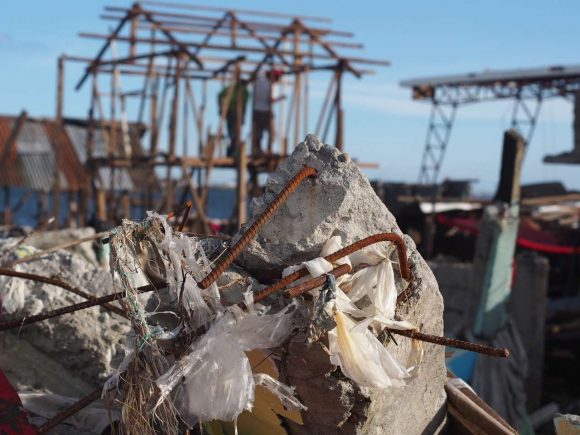
I hear this question a lot as I walk around Tacloban. You’d think that nearly four weeks after the typhoon, we’d come to the end of the dead bodies, but you’d be wrong. There seems to be no end to them. As people remove debris and move back into the areas where they used to live, they keep uncovering more of them. The BFP teams are still recovering bodies in large numbers as they move farther out into the region around Tacloban city itself. I would normally report the location of the bodies I come across, but yesterday there was no reasonable way to do that. I was walking along the shoreline on the peninsula where the airport is located. It’s relatively remote, and there are no streets there or anything else that can be used to give a location.
Actually, the first time I heard that question yesterday, I did not go to see the bodies. The person asking me the question was a young boy, and there was a gleeful and vulgar tone to his voice. He was delighting in offering to show me something that he thought was disgusting and exciting. I didn’t want to gratify that feeling, and I walked on.
The next body was simply pointed out to me. It was floating in the water about sixty yards offshore. Without my previous experiences here, I doubt that I would even have recognized it as a body. By now, though, I’m familiar with the strange and extreme things that happen to bodies floating in seawater. This body consisted of thin stick-limbs pointing out in an X from a giant distended belly. The belly was so bloated and round and stretched so tight, it looked from a distance more like a floating container of some kind.
The two boys who pointed out the body there were young toughs that had come to the water to smoke a few cigarettes. They made crude comments about the body and laughed themselves silly with their jokes. This, unfortunately, is also a common experience for me here. Many people have shown a disturbing lack of sympathy for the poor dead people. They point them out to me with glee and make crude jokes and laugh. It’s usually young and teenage boys who do this, of course.
Another body I was shown was a complete contrast to the bloated still fleshy one on the water. This body was lying on the shore in amongst a thick growth of tree roots and branches. It had been lying there for 26 days and now consisted of little more than a skeleton. The man who showed it to me said that it was a boy. I assume he had seen the body from the beginning and saw it when it still had distinguishing features. As the skeleton it was now, it would take an expert to say whether it was male or female. I could not say, though the few rags still attached to it had a somewhat masculine feel to them.
I pondered that poor skeleton for quite some time. It was lying on its stomach with its limbs spread out and its face pushed down into the roots and mud. With the exposed ribs and other bones and the bits of cloth, it had an almost artful quality to it – as if it was a posed part of a pirate’s buried treasure exhibit. It looked exactly like you would imagine it would look. I almost expected to see one arm draped over a half-opened pirate chest full of gold.
I doubt this body will ever be officially recovered. There were no roads anywhere nearby – just a couple of small wooden shacks being hammered together on barren ground. Even if the body were recovered, the chances of it being identified were essentially zero. It would simply be tossed into one of the many mass graves that have been dug. Better, perhaps, that it remained where it was. The local people might eventually bury it. If not, the elements will reclaim it, and it will sink further into the ground as the tides go in and out.
I’m surprised sometimes that bodies like this are allowed to just remain in place, that there was no attempt made by the local people to move it or bring it to the attention of the authorities. But that is thinking from a Canadian perspective. These people had their own, much bigger, problems to worry about. They had no homes, no food, no water, no clothes. They had lost everything to the typhoon and faced the unenviable task of simply rebuilding a shack where the old one used to stand and beginning life anew. The dead would have to take care of themselves while the living went about the business of life.
I had gone walking in this direction with the general idea of ending up at the airport and revisiting the Malaysian relief team. I had met them long ago while riding out there on my bicycle, and I thought it would be interesting to touch base with them and see what they had been up to. I hadn’t gone out there earlier because of the mechanical problems that developed with my bicycle.
It was a long, hard, hot walk to the airport from Tacloban, and when I got there, I found that I was too late. The Malaysian team had packed up and gone home. The Americans were also gone. I heard that the Americans, being a military presence, had experienced some conflict with the local military and government. The Filipinos seemed not to want them there at all. So the Americans just packed up and left. The only large group remaining that I saw were the Australians. They had a significant medical base set up there on a big patch of cement near the airport proper. I understood that they had rented this space from the Chinese businessman that owned it.
I spoke at length with a member of the Australian team. I was pleased to learn from him that their medical team had, in fact, done a lot of good. I had been wondering if all these medical teams were even needed. I was not aware of a lot of injuries resulting from the typhoon. This man said that they had actually treated many people for gangrene. Even small wounds had become infected because of the rather dirty conditions prevailing since the typhoon. He said that the Filipinos were so tough that it worked against them. They stayed home for a very long time and tried to just deal with the wounds themselves. By the time they got medical help, it was too late. Gangrene had set in and the medical team was kept quite busy cutting off limbs. This was the first I’d heard of anything like that.
This man had arrived in the Philippines quite early – on November 12, just four days after the typhoon – and had experienced and seen a lot. He was normally based in Laos, and he found that he quite liked the Philippines and the Filipino people. He said that a lot of members of the relief team had expressed no desire to visit the Philippines, but now that they had seen the place for themselves, they loved it and all wanted to return at some point.
It was interesting to get this man’s take on the typhoon and the ensuing relief operations. He was operating at very high level and was aware of so much more than I was. He knew about all the politics and the stuff going on behind the scenes with the various NGOs and the local government. Chatting with him confirmed my idea that there were a lot of stories to be told about that and few of them would be complimentary to the Filipino officials.
I have no direct experience with any of it, but throughout all the typhoon aftermath, I just had this feeling that the relief effort would be viewed by many local officials as a way to put money and resources in their own pockets. And when I walked around the major centers of the relief effort, I could begin to understand that. The Americans, for example, had simply left behind a vast field of giant high-tech tents with their own portable air conditioning units and generators. For rich countries like the United States and Australia, taking their material home was often more trouble than it was worth and they would just leave it all behind. The Australian I was talking to mentioned there was also the problem of decontamination and quarantine. Even if they went to the trouble of packing up all their tents and other gear, it would all have to be thoroughly cleaned and decontaminated. It was easier and made more sense just to donate it to the local government for their own relief efforts. I imagine this would be viewed as Christmas come early and there would be a scramble to get some of this material. Being (in a very small way) a typhoon survivor myself, even I wasn’t immune to this feeling. I had run out of drinking water back at the pension house, and I was lusting after the massive quantities of mineral water stacked up at the Australian compound. The Australian man said that it would all, of course, be left behind. I pointed at a few hundred 5-gallon containers of drinking water underneath a nearby awning and I joked that he could pack that up and deliver it to my pension house. I was only half-joking. I was actually extremely thirsty having run out of drinking water on my long hike, and I was sending telepathic signals to this Australian man to break open one of the thousands of boxes of bottles of mineral water and offer me one. It was so strange to be standing there amidst this ocean of plenty stacked up under these dozens of huge tents while I was still living in a world where I was going out daily to scrounge up some more water and cans of food and cooking fuel.
The Australian, of course, did not view me in that way at all. I was a typical white guy just like him, and it never occurred to him to offer me any water or food. And he’s right, of course. I am not his target market for the relief effort. I am still in Tacloban by choice. I could have left long ago if I’d wanted to. And I have the cash to buy whatever I want – if I’m lucky enough to come across it in a shop somewhere. If I ran out of water, well, that was my problem, not his. I could fly to Cebu City any day I chose, so if I was still here, then it wasn’t his problem. Still, there’s something to be said for the contrast with Filipino generosity and hospitality. While walking along the shoreline, I had passed many, many huts and crude shelters containing families of the poorest of the poor. It was about lunch time, and many of these Filipinos had asked me to join them and share their meager lunch. Other Filipinos had wanted to chat and called me over and instantly produced a chair in the shade for me. This never happens when dealing with the typical white guys from Western countries. It’s just not in our cultural make-up.
Tags: Philippines Bike Trip 2013, Super Typhoon Yolanda, Tacloban, typhoon