
A Neighborhood in Downtown Cebu
 This morning, I came into the 7-11 to find the place almost completely empty. Unfortunately, there were four customers in line at the counter – worse, they were 4 senior citizen customers! Oh, man, did the 7-11 clerks take a long time to finish dealing with them. They used not only ID to get the senior citizen discount but also some special 7-11 discount card. To make matters worse, they were ordering meals and drinks – things that had to be microwaved and prepared. I’ve never seen anything like it. The staff are so slow and disorganized. Taiwanese staff would have whipped the orders together in seconds. This woman took forever. The crazy thing is that you can’t really be annoyed with them. They’re too nice and sweet.
I thought I’d toss down some more thoughts about my neighborhood this morning. One interesting feature is the large number of men making a living by carving rubber stamps. You see them all over Cebu, but this area is known for this service, so there are many such stands. It’s actually too much to call them stands. These men work at rough wooden boxes, which serve as a kind of desk and work station. They sit on a plastic stool and ply their trade. I chatted with one of these guys a couple of days ago and took a closer look at their work. I was curious how these stamps could be so popular. I had no clear idea what they were even for. His answers were interesting. A third of his business was making novelty stamps – a stamp with a child’s name on it and a funny picture. A lot of these say ‘Happy Birthday” and have a clown or something like that. They are used to put a stamp on birthday balloons. Another third of his business was for teachers. The teachers use these stamps to grade homework and tests. They might say “Good job!” or “A+++++” on them. The last third of his business was for small businesses. He made stamps that said things like “Paid”, or “Invoice” or “Past Due.” It’s an interesting portrait of economic life here and shows how people in poorer countries can still survive. There are hundreds of little niches like this where people can make a small but adequate income. In Canada, of course, we buy those stamps in stationery stores. You couldn’t pay a person ten dollars an hour to make these stamps by hand. They are mass produced and sold ready-made in stores. But here, you can control your cost of living to the extent that you can survive on earning $5 or $7 a day. Families stick together as economic units, so a whole bunch of people live crowded together in one small apartment (or shack) and every member makes a little bit of money and contributes to the family economy.
I often think about these things as I compare life in Canada to life in a place like the Philippines. I wonder which is reasonable or fair. I remember riding along a road somewhere for several hours and passing hundreds of little wooden shacks or huts, each one containing a complete family. I tried to imagine each family raised up to the economic level of a normal family in Canada – a complete house with yard and driveway and vehicle. It was almost impossible to even imagine. In Canada, one pretty much takes that level of life – a house and car – as a human right. That’s our base level. Everyone deserves that just because they are alive. But that base level is unimagineable luxury for many people here. To be honest, it often strikes me as obscene. I mean, the level of luxury in Canada.
I also often wonder if it is a good thing. Another local niche job is the selling of candles outside the cathedrals. This is the job of very old women. They are outside the cathedrals for twelve or more hours a day holding bunches of cheap candles. People buy them for a few pesos and then take them into the cathedral to light them and pray. Women that age in Canada expect to be retired and living in quiet comfort in a nice house or apartment. All these elderly women here are still working – out on the hot and dirty street all day just to make enough money to survive that day. If they have double vision in one eye (as I’ve been suffering from lately), too friggin bad. They aren’t going to shell out thousands of pesos for an eye exam and special tests. They’re certainly not going to spend 30 pesos on a cup of coffee at 7-11. Thirty pesos would buy them a couple of simple meals.
I could go on and on about the dozens of little street jobs – the boys that collect money and gather up passengers for the jeepneys, the fruit sellers, sock sellers, etc. They fascinate me and I wonder constantly how much money they make and how much they work and where and how they live.
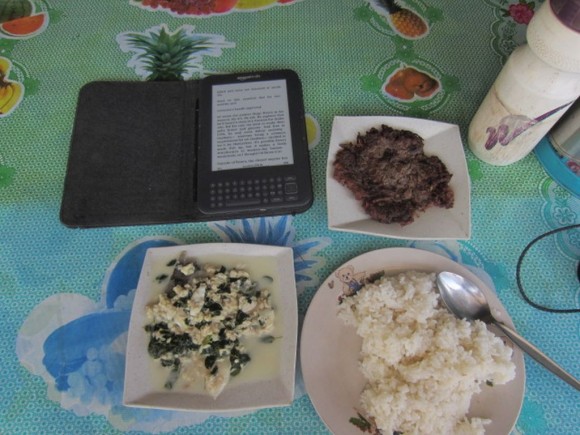
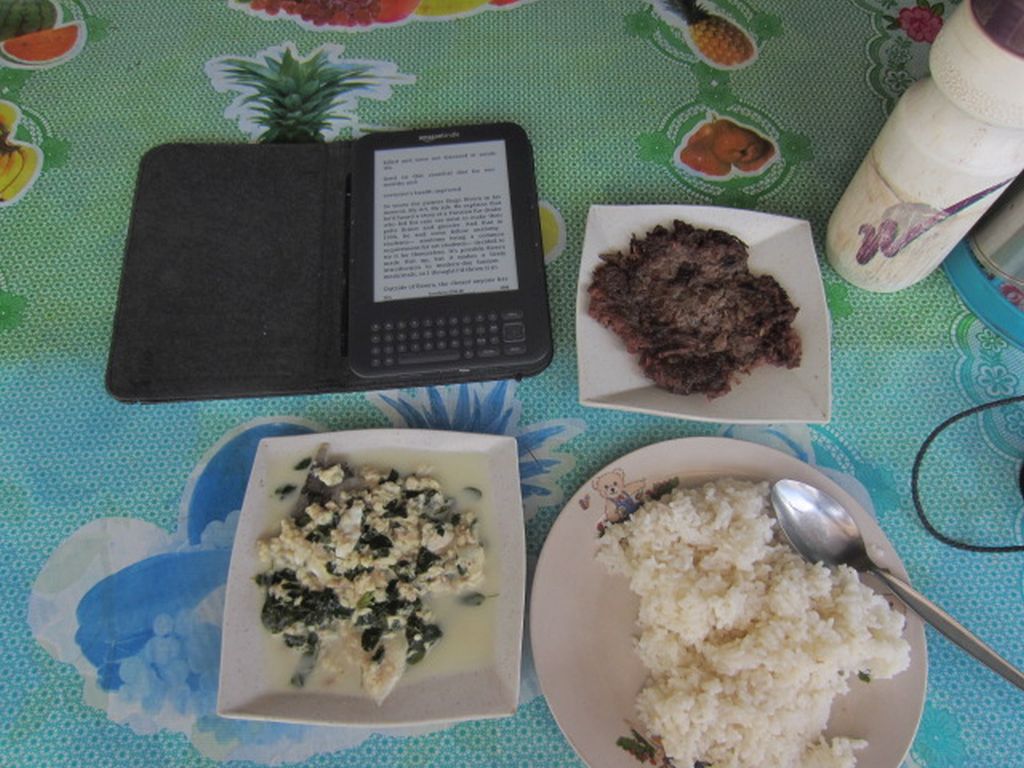
My favorite place in this neighborhood is where I eat 90% of my meals. It is a typical Filipino eatery called the Golden Crust Bakery. There are many such businesses in the Philippines, and I eat my meals at them most of the time. There is no equivalent in Canada, I don’t think. These places have a very interesting economic life. The longer you stay at one place, the more complicated they seem. They don’t satisfy themselves with having one business – selling food – and then doing just that. Instead, they jam in as many businesses as they can into that physical and economic space. Over time, they find more and more tiny income streams. This place does have a bakery. They sell baked goods out of dirty glass cases (with cockroaches crawling on the inside) on the left side as you walk in. They don’t, as you might expect, order the baked goods from somewhere else. They bake it all right there in the bakery in the back. On the right is a long glass case containing all the food. It’s buffet style. Most of the dishes are meat based. There might be one vegetable dish. I never see two there. And usually there are none.
(A quick side-note about another local street business: pickpockets. While writing, I noticed a young boy just hanging out. He was surprisingly well-dressed for someone just hanging out. And he didn’t, as most young boys do, come up to the window and stare at me or bang on the glass. I became curious about him, and I just noticed that he is a pickpocket. He walked by the window again at a very fast pace. So I turned around and watched him. He walked quickly to get right behind a woman carrying a purse over her shoulder. I saw him reach out, and then he was out of sight. A minute later, he came back. I couldn’t see his hands, unfortunately, but he was clearly looking down and counting something or examining something. He got a few dozen feet away and tossed something into the gutter and pocketed something else. It’s always good to see the pickpockets at work. It reminds me to be vigilant. One sees signs everywhere in businesses telling people to be wary of pickpockets and not to leave their valuables unattended. It’s easy to get complacent and forget. Seeing these pickpockets at work is a timely reminder.)
The other somewhat seedy street job here is prostitution, of course. Prostitution is common in this neighborhood. I don’t know what percentage of their customers are Westerners and what percentage are locals. But certainly many are westerners. I see the western men all the time. The largest group consists of Americans – either tourists or retired military. The second largest – probably equal to the Americans – consists of Germans. I’m no expert on languages, but they certainly sound German and they look typically German with the little mustache. A lot of these men end up hooking up with a woman for the entirety of their vacation. I assume, though, that these long-term escorts are classier than most of the street prostitutes I routinely see here.
Most of the local people have come to see me as a regular fixture, which is nice. I’m sure they have no idea of who I am or what I am doing, but they have realized I’m not a typical Westerner. The prostitutes ignore me for the most part, as do the most common street beggars. I got tired of giving out money, and I just stopped. I disliked it that a group of five children would be working together as beggars spread out over the streets. When I gave money to one of them, they would all come running over and pester me endlessly. Even when I gave money to one child, that child would come back a minute later to try again. And why not? And they would come right inside the Golden Crust Bakery and go up to tables. So I quit giving them money. It took some time, but they now realize approaching me is a waste of time. Most of the time, anyway.
While I was in the Golden Crust yesterday, a very young girl came in carrying a small baby. They were regulars on the streets and part of a large community of what I would call gypsies. They dress totally differently from other Filipinos. They wear long flowing skirts with colorful flower patterns and wear scarves and things in their hair. I swear they look like a cliché of gypsies from Europe. I have no idea who they are. But they clearly are professional beggars for life. This girl came up to my table and pawed at my arm and pointed to the baby indicating that they were hungry. Being a big meany, I just gave a curt negative shake of my head and she went away. I noticed that every table of Filipinos was watching me to see what I would do. I don’t know what they thought of what I did.
This young girl with the baby eventually went up to a table with two attractive Filipinas there. They were clearly finishing up their meal, and instead of giving the girl money, they said that she could have the leftovers. They had actually left a lot of food on their plates uneaten. They had both also had a cold Coke, and there was about two inches of coke left in each bottle. The gypsy girl sat down at the table and ate some of the food. She also fed some to the baby. (The baby looked to be in a bad way. It just seemed floppy and not very alert or strong. Not thin, though. Just weird.) Not surprisingly, the food was not a big draw for this girl. She ate only a mouthful or two and left the rest. She didn’t even pack it up in a plastic bag to take it away. The Coke, however, was definitely not left behind. She drank it down as fast as she could. The baby also had its share. I guess you can’t really call it a baby, then, since it was able to drink through a straw. A toddler, then? But it was very small and floppy. That scene, by the way, is a very common one. It has begun to seem to me that the young beggars here live on a diet of fast food and soda.
Meals at the Golden Crust Bakery are inexpensive. A really big meal with two meat dishes might come to two dollars Canadian. A simple meal would cost about a dollar. Everyone also gets a cold soda with their meal. The clerks at these types of eateries push the cold drinks on customers. They definitely make a lot of their profit from those drinks. They always seem a bit annoyed or disappointed (or confused) when I don’t ask for a soda. You can have regular water for free there. Or you can get purified water from a cold water dispenser. This dispenser is an interesting thing. It is clearly very old – a rickety, tilted wooden case – but it works very well. It is electrical and somehow chills the water. People generally get their water in plastic bags – like the old plastic sandwich bags we used to use. They go through hundreds and hundreds of these plastic bags every day. It is nearly a full time job for the shop clerks to prepare these bags. What they do is put the bags over the top of a plastic bottle full of water. Then they put a plastic bag over that one. And so on until there are a couple hundred plastic bags over the bottle. Customers just pull off the topmost bag and wrap it around the spigot. You put a one-peso coin into the slot and a spurt of cold water goes into your bag. People bite off a corner of the plastic bag and suck the water into their mouth. The plastic bag is then tossed to the ground. The Philippine economy seems to be driven by the production and use of plastic bags.
These eateries have a complicated system for paying for meals. You order at the counter and the women write everything down on a tiny square of paper with a piece of carbon paper. These squares are just scraps of old paper that have been cut up and stapled together. You then take your piece of paper over to a dilapidated counter where you pay. The woman there has two pens – one blue and one red – taped together. She goes over your bill with the blue pen and crosses out the items one by one and checks to see that the price is right. She then checks the total. She adds up the total on a calculator. If the total is wrong, she gets quite upset and yells at the women doing the serving. She then changes the total or marks it as correct with her red pen – by just switching the pen around in her hand. Then she writes down the total on a numbered pad of paper. My original bill is put in a plastic basket along with my money. The basket is handed to a second woman, who handles the actual cash drawer. She processes my payment and puts the change in the basket along with the bill and gives it back to the first woman. She checks it and then hands it to me. I have to take my marked bill back to the women at the counter and give it to them. They go over the bill carefully and compare all the items on it with the items they had put on the tray. If everything looks good, they let me take away the tray. It’s a very complicated system and it is clearly meant to keep employees from stealing – a very big concern in the Philippines. But as complicated as it is, it really works. They are very fast and organized. They put the 7-11 clerks to shame.
The tables at this place are rickety plastic pieces of junk. The chairs are either decades old and falling apart or newish plastic stools. Everything is wide open and it would be savagely hot except that they have a number of fans running. While eating, I am entertained by the number and size of the cockroaches running around the floors. The restaurant cats are also fun to watch. They ignore the cockroaches. I assume their diet consists largely of mice and rats. The cats aren’t friendly, of course. They are employees as much as everyone else – not pets. But at least people aren’t mean to them and the cats aren’t scared. They are just careful and keep to the sides and the corners as they walk around.
Behind the eating area is an open space containing the dreaded karaoke machine. People are back there singing pretty much all of the time. Early in the morning until late at night. They also serve beer, and it gets quite rocking at night on the weekend. The sound, of course, is horrific. I often make eye contact with someone and grimace to indicate how horrible and funny the singing is, but no one ever responds. No one seems to notice how savagely awful the sound is. To them, it is heavenly, I suppose.
The Golden Crust Bakery also runs a large range of street stalls. These stalls are kept in a storage area in the back. In the afternoon, they are all pulled out and rolled (if they have wheels) or pushed or carried out onto the streets and set up. They sell everything you can imagine – food and snacks, household items, clothes, toiletries, etc. I don’t know if people just rent storage space from the restaurant or if the stalls are part of the restaurant’s business. They also sell credit or “loads” for cell phones. This is done with an equally complicated system at the cashier counter. The side businesses they run are pretty much endless. It’s interesting to watch. I’ve chatted with the women from time to time to try and understand how everything is connected and who the owner is, but I never understand the answers. I don’t think they really understand my questions. They don’t see anything special in the Gold Crust Bakery and so can’t see it through my eyes.
Other things in my neighborhood: The insane homeless men are very common here. There are so many of them. One has to wonder where they all come from and what their stories are. They all have unique physical twitches and behaviors. One guy intrigues me in particular. He is fascinated with the black gooey mud that congregates in the sewer pipes. He pulls aside the gratings that are loose and then pulls out handfuls of the black goo from inside and piles it up in the gutter. Once he has a really big pile, he sorts through it carefully with his fingers. He is clearly looking for something. He looks like someone looking for gold or diamonds. He never finds anything or sets anything aside that I can see. He just likes to look through this mud. Another guy is unique in that despite being an insane homeless man, he shows up in new T-shirts almost every day. He appears to have an endless supply of clothing. These shirts are not new from the store or anything. They are old shirts. But they aren’t the usual dirty black and torn things. It’s like he has a secret wardrobe somewhere and gets a clean shirt every day. I’m not sure that I’ve ever seen him in the same shirt twice. It’s totally bizarre. He sleeps on the sidewalks along with everyone else, so that deepens the mystery.
Another fascinating group (if disturbing) are the puppy sellers. People here sell young puppies on the street. They have baskets of them and walk around with them in their arms. I’ve never spoken to them, so I have no idea what the puppies cost, but they are very popular. They sell out pretty much every day. Who can resist a puppy? Of course, this is probably part of a horrible system of puppy mills. I’m sure there are dogs out there being used to produce puppies constantly and they are kept in horrible conditions. A big puzzle, though, is how docile these puppies are. I keep wondering if they are drugged to keep them quiet. Otherwise, they would tumble out of the baskets and run around or they would struggle in their arms. But the puppies just lie there unmoving. And they just sit in their arms like they are asleep. Yet, their eyes are open and they look around and look cute. Either they are so young that they don’t really move yet, or they are drugged to keep them quiet.
Another interesting feature of the local economy is the cell phone charging stations. These are relatively new, I think. There is one here in the 7-11. It is a small wooden box with three coin slots. Beneath each slot is a grouping of about fifteen or twenty connectors – one for every type of popular cell phone or electronic device. You put 5 pesos into the slot, plug in your device, and you get ten minutes of charging.
A beautiful, young prostitute is actually sitting at the charging station in front of me. As far as I can make out, she is only pretending to be charging her phone. By doing so, she can come inside the 7-11 and sit down in the air conditioning for a while. She’s unusual for this neighborhood because she is so young and attractive. The Filipino men are fascinated with her and they just stand and stare at her.
Time to quickly wrap this up. That’s all for my neighborhood this morning. Yesterday, I watched a couple of VICE videos from South Sudan on YouTube. They made a big impression on me, and I’m still thinking about them. If I were a VICE reporter, I guess I’d interview this young prostitute and get the inside details of her probably interesting life.
The second video I watched was called “Sudden Ambush” or something like that. It was fascinating. A young tattooed reporter from Vice was in the Sudanese capital city of Juba to get a story. He was allowed to accompany a military convoy as they went south to deal with some rebels near another city. I don’t know if anyone had the slightest clue what they were doing, but I think they believed that the rebels had been driven out of the city, and they were just going to solidify control of the city. But it was a complete and ridiculous disaster. Someone shot at the convoy at one point and the entire operation fell apart. The officers just turned and ran. There was no organization at all and the entire convoy just fell to pieces. No military strategy or system or discipline. They looked, frankly speaking, like a big joke. Like they were children, not soldiers in an army. It was ridiculous.
An interesting aspect to the first video I watched was that the VICE reporters brought one of the Sudanese “Lost Boys” with them. He had been living in the US for years after going there as a teenage refugee from the Sudan. He was very excited to be going back to the Sudan with the idea of helping people and saving the country. He was devastated by the chaos and savagery and stupidity that he found upon his return. If someone made a movie that depicted the Sudanese people like this, it would be heavily criticized for being racist or for being totally unrealistic – a fantasy. I don’t think I’ve ever seen anything like it. Yet, based on my brief experience in Guinea and Ethiopia, it felt right. It felt real and probably how things really are. Again, it reinforces my idea that international aid is often pointless. There is nothing you can do for a country like South Sudan. Hopeless.
Tags: Canada, Golden Crust Bakery, job, Philippines Bike Trip 2013, South Sudan