
Days Six & Seven – Super Typhoon Yolanda
This day began without my usual pounding heart. The hotel has filled with people – including several children and 14 fire fighters – and life is beginning to feel not normal but something similar. I can hear the children playing outside and I can hear some neighbors building a fire and washing pots. I can even hear the engine of a motorcycle going past on the street.
Yesterday did turn out to be a housekeeping day – a major one. The reason for that was the weather. Dark clouds moved in and it poured rain for much of the day. It rained so heavily that the roads flooded again, though with only about five or six inches and not ten feet. Having so much water pour down for so long made it easy to do some cleaning. All the eavestroughs of the hotel are broken in one fashion or another and the water pours down off the roof in certain spots. I could lean over the balcony with a bucket and within seconds my bucket would be filled with water. I also placed a large plastic barrel underneath the waterfall to fill with rainwater. Using this water, I sluiced down the full length of the veranda on the second floor and all the stairs. I then got down on my hands and knees with a scrub brush and soap and scrubbed the entire area. The mud was as thick as an inch in places. The point of this was to make the veranda more comfortable, since we do most of our living out there now, but also to keep my room clean. It’s useless to clean the floor of my room of mud and then track new mud in from outside whenever I come up the stairs. Cleaning the veranda and stairs wasn’t easy, but I kept at it until it was all done. Once it was all clean, I made steps to ensure that it stays that way. The entire courtyard is still a giant mud pit, so I built a walkway out of scrap wood, doors that had been ripped out off door frames, and plastic. Now we could walk from the well to the steps without having to slog through the mud. I was very pleased with my efforts and rewarded myself with a good cup of instant coffee. The Trangia X2 continues to work well as long as I clean the jet regularly, prime it carefully, and adjust the flame with slow steps. The problem for me is that since I am the master of the only stove, I naturally boil water for everyone to have coffee. I certainly don’t mind my stove being used that way. My concern is water. Making coffee for everyone all the time will use up all of my water in a day or two. And at the moment I have no way of getting more.
This experience has made me reflect on survivor stories and the character types that emerge in them. In movies, there are always heroes – those that selflessly help others. And there are the hoarders – those who look out only for themselves and keep their food and water hidden and don’t share it. The realities of this situation don’t match up with that at all – particularly the heroics. It is easy to want to be heroic, but it is not so easy to follow up on that urge. What, precisely, can you do? It would give me great pleasure to go into my warehouse of thousands of sacks of rice and distribute it to those in need. I’d also love to take out my portable water filtration center and set it up in the worst hit areas and provide clean drinking water to thousands. It would be great to take my tens of thousands of tarps and extra tents and distribute those as makeshift shelters. And, of course, I’d love to have my work crews with their front end loaders and dump trucks go through the town and clear the rubble. But I have none of those things. I walked through some badly-hit neighbourhoods yesterday and many people asked me for water and for rice. I could only shrug my shoulders and tell them that I was sure relief aid was on its way. I had no water or food to give them. In an odd way, heavy equipment clearing the roads would hurt the local people more than help them. All that wood and metal and debris is what remains of their homes and community. They are currently going through it as best they can and using that material to rebuild. If it were cleared away and moved, they would have nothing to rebuild with. Luckily, people still have access to water for bathing. I’ve seen them getting water from their old wells – the ones that aren’t buried under tons of rubble. There are also certain places where a pipe coming out of the ground disgorges water from time to time. People gather around these pipes in large numbers with dozens of large containers and patiently fill them. The water can only be a dribble, but they will sit there for hours filling up a little scoop and then pouring the water from the scoop into the containers.
I also did a bit of laundry. I washed my sleeping sheet – a chore that desperately needed doing. I continue to come across damage from the flood and the seawater. I’ve found, for example, that the padlock on my bike is probably ruined. At first, it wouldn’t work at all. I used some oil to clean it, but now it opens only some of the time. I will have to get a new lock. I got out my Leatherman yesterday and found it rusted shut. That surprised me as I didn’t think it had even gotten wet. These conditions are very harsh, and I’m worried that my camera and camera lenses will also suffer damage. The air is practically toxic with damp seawater and that is death to all electronics. I was chatting about photography with a fellow named Brian the other day. He used to be an avid photographer, even a professional one, but he did not have the proper place to store his equipment. His lenses all grew green fungus or mould inside them and his cameras would just stop working. In this heat and dampness, my camera and lenses might suffer the same fate. Already, my point and shoot is showing problems. The lens won’t extend sometimes and it jams.
The heavy rain yesterday helped tremendously with the cleaning, but it also meant there was little chance to go outside and explore. It wasn’t until very late in the afternoon that the opportunity presented itself. I quickly got cleaned up and left for a walk. I went first to the shore just near my pension house. I was curious to see what the shoreline looked like all these days after the typhoon. I was surprised to find a very large Filipino crew at work removing the trees that blocked the road and raising up toppled hydro poles. I spoke with some of the men and I learned that they were trying to establish a line to reach the hospital. Getting electricity running there was a top priority. They said that it would take between six months and a year for Tacloban as a whole to have its electricity supply restored. I made a lame joke about how they would at least get lots of overtime pay. They shook their heads no and said that their salaries had been reduced. The city requires so many workers at one time that they can’t afford to pay them their regular salary and is paying them all less. Talk about a bad deal. These guys are the true heroes of this situation – those working to restore the basic services – and they are forced to accept less pay. In the West, such workers would be getting double time and triple time as they worked around the clock.
At the shoreline, I found things were little changed. All the debris was still there. The dead animals were still there, and, to my surprise, the dead humans were, too. This was seven days after the typhoon, and the bodies still hadn’t been moved. There was, however, a work crew down on the pier working to remove a pile of about ten bodies there. There were perhaps fifteen men in full body coverings, medical gloves, and face masks putting the bodies into body bags one by one. Then men would thread a long pole through the loops of the body bag and carry it away. Pictures were being taken of each body for identification purposes and a group of Red Cross volunteers were making notes. While chatting with one Red Cross worker, I looked down at her notes. She was writing on a normal blank piece of paper that had been folded over a couple of times. Her notes consisted of a simple numbered list (1. Male 2. Male 3. Female 4. Female 5. Male etc) and the location – Leyte Park Gymnasium. I was very surprised when this woman told me that all these bodies were foreigners. I had never gotten close enough to them to see their features. This pier used to hold a very large pontoon boat that served as a fancy restaurant and bar. This woman said that these foreigners were on the boat drinking the morning of the typhoon. They had gone there as kind of a lark – to experience the high winds and rain in a romantic and dramatic setting. And they all ended up drowning when the typhoon turned out to be worse than anyone expected. (Edit: I could not confirm this story later and heard nothing about a large group of foreigners dying in this way.)
From there, I walked along the main coast road to the downtown area. On the way, I passed by the hospital. I saw a tricycle there that had a unique gas arrangement. The owner had rigged up a Coca Cola bottle filled with gas and ran a tube from the bottle into his engine. I asked him about this clever arrangement and he said that if he put gas in his gas tank, people stole it. With this new arrangement, he could take the bottle of gas with him when he parked the tricycle. It was simple and ingenious. He was at the hospital to pick up his wife, who had given birth the day before the typhoon struck. She had been stuck in the hospital since then and he could now bring her home. His tricycle was loaded down with personal property – all the stuff that he didn’t dare leave at his house for fear of it being stolen.
I turned right at the hospital and walked down the narrow lane there to the water’s edge. I had been down that way many times during my time in Tacloban, and it looked, of course, totally different. The destruction there had been total. All the houses that made up the shantytown there were gone, and people had built themselves all manner of temporary shelters out of what they could salvage. Most were cooking over wood fires – pots sitting on three rocks with a fire underneath. One clever fellow had built a base of rocks on top of a table and then built the fire on top of that. This allowed him to cook in relative comfort while standing and not having to crouch over.
I chatted with a group of five or six men taking shots out of a big container of tuba (coconut wine). They invited me to join them for a drink, but I declined. I really don’t want to risk a bacterial infection at this point from badly-made tuba. They told me that their home had been along the water there beside the big hospital outpatient building. There was nothing there now but rubble. They were currently living in a makeshift tent they had built underneath a big blue tarp. During the typhoon, they had taken shelter on the second floor of the hospital’s outpatient building. They said that the water had risen so fast – like a tsunami – that they had had no chance to rescue any of their possessions. It was all they could do to get to the hospital in time and save themselves. I still find it hard to believe that during this critical period, I was inside my room mopping the floor and being annoyed about that. I never witnessed the initial arrival of the flood. The water was already about three or four feet deep by the time I opened my door and went outside.
As I left from this area, I spotted a little shack with some strips of instant coffee packages and other items hanging from a bar. It was the first reconstruction of a sari-sari store that I’d seen in Tacloban. I stopped to chat with them and asked how much the coffee was. I was expecting inflated prices, but they said that they cost 6 pesos each, the regular price before the typhoon. I had just run out of coffee that morning, and I bought all 14 of the packets that they had for sale.
There was some kind of a media center a short distance inland from the hospital. I didn’t have time to investigate it, but it looked to be a kind of command center with generators running and providing electricity. Lots of official vehicles were parked there along with white rented vans. Cameras and lights were set up all around. It appeared that press conferences had taken place there. I saw a few foreigners with big video cameras on their shoulders. It’s funny that I view all these people as interlopers to an extent. Not only are they invading MY city, they weren’t even here for the typhoon. They were reporting on the situation, and they probably knew nothing at all about it. I am intensely curious what I will find online about this typhoon when I eventually leave here and get back on the Internet. I wonder what information will be available. As I said before, I am a firsthand witness, but in some ways I know less than people in Canada do. I have no access to information other than what I see with my own eyes.
I finished my little tour with a quick trip to the harbour. The navy ship with Marie on board was gone. Considering the extremely heavy rain that had fallen all day, I was triply glad that I had decided to remain. All the people who had been on that boat would have been stuck on the exposed deck getting wet. It could have been a very uncomfortable situation – one that would continue for the long 24-hour trip to Cebu.
I found that security at the harbour had been tightened up. There were now two seriously armed men at the gate and they weren’t letting anyone in unless they had confirmed official business. My thought of just waltzing in and looking for water was abandoned. A new boat – number 550 – had replaced the one that had left. It looked identical. The guards, however, had no information about it. They had no instructions about letting people in to sign up for evacuation.
The sun was sinking rapidly at this point, and I quickly made my way back to the pension house. There was supposedly a 6 o’clock curfew in place, and I was going to miss that. I wasn’t that worried about the dark because there was a nearly full moon. However, the moon did not shed as much light as I expected and I made my way back to the pension house with difficulty – having to wade through mud and water and tripping over all manner of hidden junk and clambering over fallen trees, cables and wires. Staying out so late wasn’t turning out to be a very smart idea. I was the only living thing around as I made my along the coast road. It was extremely spooky and I quickened my pace a little bit. I do discount most of the rumours I hear about the dangers. However, even common sense would indicate that it wasn’t wise to be out there alone in the dark.
The pension house was a beehive of activity when I finally got back there. Some of the fire fighters had arrived – fourteen in all – and they were busy settling into their newly cleaned rooms and trying to light a fire to cook rice. Jeffery and Grace and Rene had worked all day cleaning some rooms and getting them ready. Jeffery is rather an astonishing fellow – very energetic and very accommodating and very considerate and nice. Without him, my typhoon experience would have been far less pleasant.
All the wood was wet from the heavy rain and it was difficult for them get a fire going. I hung out with them while they worked and I learned that many of them were from Tacloban. They had been born and raised here, but they now worked for the Bureau of Fire Protection in Manila. They had made the trip down to Tacloban by plane to help with the relief efforts. I asked them what their plans were, and it appeared they were somewhat vague. I thought they were here to retrieve bodies, but they weren’t. They were here to provide medical services, particularly to the other members of the BFP. It remains to be seen how effective they will be. When I was told that twenty fire fighters were arriving from Manila, I was expecting a rather more organized and powerful force. I was expecting vehicles loaded down with generators and water filtration systems and stoves and food and fresh water and other supplies. I was expecting clipboards and someone barking commands with military precision. The reality was a fairly ragtag bunch having nearly all they can handle just getting a fire started so that they can cook their own food. When I asked about their plans for tomorrow, one woman said some random things about having to complete a strategy assessment and things like that. Perhaps they are part of a much larger and more organized force, but my impression was of a group of concerned people wanting to help but without much idea of how to go about it.
This was in stark contrast to something that I had witnessed earlier that day. I was out on the veranda scrubbing and cleaning when the air was shattered with a powerful thumping sound. Rene called out to me to look up, and I saw two massive helicopters going by. They weren’t regular helicopters but had two immense rotors – one on each side of the craft. James Cameron could have sketched them for inclusion in one of his futuristic sci-fi epics. It was an awesome spectacle that would have fit right in on some distant planet blowing up giant trees and looking for unobtanium. (Edit: I’ve since learned that they were Osprey helicopters.)
Rene said that these helicopters were American. I did not see any markings on them, but that they were American was more than reasonable. From my position on my knees scrubbing away in the mud and muck, they looked to be from another world – a fantastic world of unbelievable power and luxury. In talking to people here, I find that there are some quite odd views about what life is like in places like Canada and America. Some of their information is quite accurate, but then some is extremely off. One of the fire fighters was asking me about life in Canada last night. He appeared to be thinking of some kind of fairyland utopia. He wanted to know if it was true that everything was free – housing, electricity, etc. He had this image of a land of fantastic wealth where everyone lived like Bill Gates. I had to disabuse him of this notion while at the same time not going too far. Certainly compared to some aspects of life in the Philippines, Canada is a great place to live. But it isn’t anywhere near as wonderful as people here often make it out to be.
Even after all my time here, though, I still find myself lacking most information to really understand life in the Philippines. I was told by Jefferey, for example, that the employees at this pension house were paid 1,500 pesos per month. This would include the girl, Joy, that worked the front desk most of the time. I didn’t even know this, but they also slept at the pension house. So they got room and board for free plus the 1,500 pesos per month. That seemed impossibly low to me. One thousand five hundred pesos is about $37. I was startled at this low figure and wondered how people could possibly survive.
While I was gone on my walk, Grace had returned to the pension house with a big tub of spaghetti and another of rice. Her mother at their house somewhere had prepared this meal and I was invited to share in it. In fact, I think the spaghetti had been made especially with me in mind. I’m astonished at their generosity and sense of community and how much they take care of their sole foreign guest. I was ready to cook up some soup and pasta of my own on my stove, but it was wonderful to be able to just sit down and enjoy a meal that was already cooked.
I do what I can to help out in return. My hours of cleaning and organizing today was done partially with the idea of making myself useful. My ability to boil water for coffee at any time without having to start a fire is also much appreciated. I have extra flashlights, and I’ve distributed those for other people to use. And I seem to always have this or that little tool or item that they need – everything from a sharp knife to pliers to a lighter to bandaids. So I guess I have been of some use. I feel like I don’t do enough though.
I was extremely tired last night and I went to bed early. My eyes were burning – perhaps with the leaded fuel – and I couldn’t keep my eyes open to read. I turned off my flashlight and went to sleep. I slept for a solid nine hours and I woke up this morning with extremely sore muscles and joints. I’m not at all sure that I’ll be able to follow through on my vague plans to continue travelling by bicycle. Something is clearly wrong with my body be it arthritis or something else. My knees ached as I hobbled over to the bathroom. I could feel my knee joints slipping from side to side and I nearly fell over. We’ll see how that goes.
The sun is out again this morning as I write this. My room is getting quite hot, and I should go outside and see what the fire fighters are up to. Perhaps they have left already. Funnily enough, about fifteen minutes ago, the entire pension house was filled with song. The children were singing and then all the adults joined in. Day eight of perhaps the worst typhoon in Philippine history and my pension house is filled with volunteer fire fighters and children, their voices raised in song.
4:00 p.m.
I have broken out of my pattern and have fired up the NEO in the afternoon rather than in the morning. Typing is exceedingly difficult for reasons that will come out directly.
In short, my name has been added to the list of the injured credited to this typhoon. I went out this morning with my camera in hand intending to walk along the shoreline as far as I could and eventually reach the astrodome.
I made it to the shore without a problem and found everything there much as it has been for the past eight days. The various pigs and dogs and chickens are still there and going through the stages of rotting away. They have reached a stage where the smell has been reduced and a vast colony of maggots have taken up residence. To my relief, the human bodies have been finally removed – at least those that were visible. I feel it can be assumed that there are many bodies in the rubble as yet undiscovered.
I took some more pictures of the destruction. The sky was bright blue and there were white fluffy clouds to give a dramatic backdrop to the scene. I eventually came to a spot I knew well. A section of ground underneath a culvert had given way, and the cement wall along the shore was broken. It is a particularly treacherous spot and on my previous walks, I had been very careful as I crossed over. This time, I made the unwise decision to step over a wide gap in one step. The lower flap of the sandal on my right foot got caught on a branch and I went for what could have been a serious fall. In any event, it was serious enough.
It happened so quickly that I had no conscious sense of knowing what was going on. I just fell. I threw out my hands in front of me to break my fall by reflex and was somewhat successful. I landed with some force on my right hand and left shoulder. I broke or at least badly strained a finger on my right hand – the injury that is making typing so arduous and painful. I bruised my shoulder, scraped up my legs and knees, and cut and perhaps broke the big toe of my right foot. Potentially worst of all, my lower face made contact with the exposed concrete and I suffered a deep gash on my chin just to the left and below my lower lip. That cut bled quite badly and without a mirror to see the damage I imagined the worst. The condition of my toe also was cause for concern. It was very bloody and painful and the toenail itself had been cut in half. I’m sure to lose the entire thing before this is done.
To make matters worse, my camera had been in my right hand. I could not keep it under control without risking much more serious injury and I had let it go. It smashed against the rocks and broke into pieces. One glance told me that it was a complete ruin.
It seemed a very heavy price to pay overall for a momentary lapse in judgement. Yet, one can view it easily with the standard lucky vs. unlucky cliché. People who suffer a tragedy almost always say that they were quite lucky. This always offends my sense of logic. A person who has a terrible car crash and breaks both legs will say that he was very lucky because he was not thrown through the windshield and killed. That’s nonsense, of course. He was very unlucky to have had the accident in the first place.
Applying this to me, I can easily say that I was quite lucky. I’ve suffered a badly sprained finger and toe, two deep cuts, bad bruising, and six smaller cuts. Yet, considering where and how I fell, it could have been far, far worse. It was a very bad spot and broken arms and legs could have been the least of my problems. That I just grazed my face and did not slam it hard into the stone and cement is something of a miracle. I could easily have fallen off the edge of the stone wall and down onto the pile of rubble below. Extremely bad cuts and a smashed jaw and teeth were also in the running. From that point of view, I got off very lightly.
Another, and a much more painful, way of viewing this incident is that it was not an accident at all. I had caused it myself with my usual procrastination. All the big problems in my life were caused by me. They could all have been easily avoided with just the slightest amount of common sense. In this case, the direct cause of the accident was the poor condition of my Teva sandals. They have worn away to almost nothing and the sole is so loose and floppy that it often catches on things – even the ground – and nearly sends me for a tumble. Time and again over the last few months, I’ve tripped over my own sandals and nearly fallen. Each time, I’ve thought that I really should get new sandals. Each time, I’ve postponed because I haven’t found sandals that lived up to my standards. So rather than fix the problem when it first appeared, I let it continue. And today was the result. The lower half of the sole had come loose completely and it caught on a cable that was stuck midway across this gap. Just that little thing threw me completely off balance and I went crashing down. Considering my age, it appears that I will never get over the habit of procrastinating. If I was going to overcome this bad habit, I would have done so by now.
The accident was the result of a deep stupidity that makes up a large part of my personality and character. But, at least, I can say that I cope well. I felt the blood pouring down my neck and watched it soak into my shirt. I saw the ruin of my big toe and all the other cuts on my legs. And I noted that my right hand was now next to useless and beginning to swell up badly. And there lay my priceless camera, shattered and broken, the lens ripped completely off and twisted out of shape. Yet, I did not despair. I did not scream and yell and get angry. I did not fling the camera into the ocean below. Nor did I leap to my feet and start to run to get help. No, I just shifted my body so that my legs dangled over the edge of the cement wall. I just sat there and looked out over the water and at the typhoon destruction around me. I thought, “Well, that just happened.”
I eventually gathered up the bits and pieces of my camera and put them inside my pannier bag knapsack. I had nothing in the way of cloth or toilet paper with me to stop the bleeding. The best I had were some large bandages. I got out the largest of these and held it to the open gash on my face to see if I could stop the flow. I eventually gave up. I would have to remain a bloody mess until I got home.
I was surprised that more people did not react to me in some way as I slowly shuffled and limped my way along the streets. Perhaps my bloody face and legs were hardly noticeable against the backdrop of the typhoon’s aftermath. Back at the pension house, I set about cleaning up. With my recent successes using alcohol as a disinfectant, I was intent on treating all my wounds as thoroughly as I could. The best solution I could come up with was to take out a clean white sock and soak it over and over with as much denatured alcohol as it would hold and then hold it against my various cuts. The pain was intense, and I welcomed it. The more it hurt, the more I felt it was doing its job. The cut on my face turned out to be quite deep. Pulling on the skin – even opening my mouth – opened the wound wide exposing all the flesh underneath. I made sure to get alcohol as deep into this gash as possible. I did it again and again, waiting until the pain had receded. Then I moved on to my other wounds. The one that concerned me most was the wound to my toe. It was a nasty-looking mess compounded by the sliced nail. The entire nail was loose on my toe and I could press down on it and squeeze out blood and what looked like pus. Considering the muddy ground around me, it seemed very possible for all manner of nasty things to get into that wound. I soaked it with alcohol and worked at the wound until it was as clean as I could get it.
As I walked back to the pension house, I considered again that I was “lucky” in that a full team of medical professionals had just moved into the pension house. I was hoping to get some professional care directly from them. Unfortunately, none of them were at the pension house at the time. In a short time, though, one returned and he offered to walk with me to the local fire station where they had set up an emergency medical assistance post. By this time, after examining my wounds more thoroughly, it seemed that the cut on my face would require stitches.
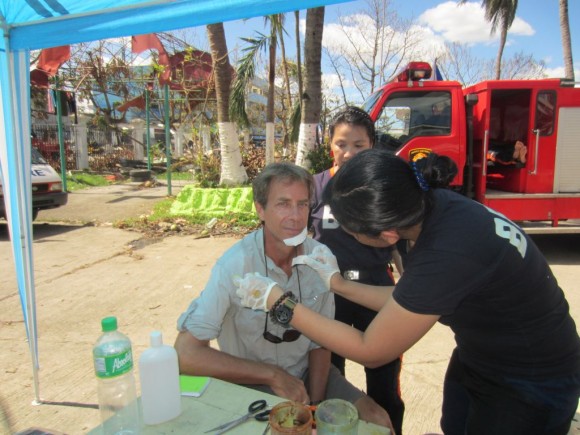
They say that you shouldn’t look a gift horse in the mouth, but the truth is that I was not at all impressed with the care I received from this team from the Bureau of Fire Protection. The woman treating me initially seemed so inept that I was prompted to ask her what her training was. She said that she had been trained in emergency medical treatment. Well, I wasn’t too sure about that. I could have done much better with my own bandaids back in my room. She also seemed very light on the assessment part of the process – the part that I felt was most important. She hardly examined the gash on my face at all. She simply applied some iodine and then tried to stick on a bandaid – a cheap little plastic thing that you would pick up in any pharmacy. This bandaid was too small and would not stick to my wet skin and the iodine. I kept gently hinting that perhaps stitches were in order. Was she sure that stitches were not required? This wound opened up like a horrible red mouth whenever I moved my own mouth. It seemed like something was required to keep it closed.
She then applied iodine to all the various cuts on my legs. The bandaids were equally useless there and simply got hung up on my leg hair and got nowhere near covering the cuts. She eventually just gave up and left the bandaids dangling there in my leg hair.
I was mostly disturbed with the casual way that my toe was dealt with. Some iodine was applied there as well, and then she attempted some kind of odd bandaid affair with one bandaid going around the front of the toe like a U. Most of the toenail was still exposed. It was the kind of bandaid job that any mother in Canada would be familiar with – the kind that simply falls off after the child takes two steps.
I had no choice but to let the treatment proceed as it was, figuring that I could apply my own bandaids later if necessary. Fortunately, the official team doctor made a sudden appearance just as I was about to be dismissed. Myself, I felt that the doctor was better called in before the bandaids covered up the wounds, but I am not trained in emergency medicine. I expressed my concerns to the doctor as politely as I could, focusing mainly on whether they were absolutely sure that stitches were not required. He removed the one bandaid on my face and looked at the wound himself and concluded that it would heal without stitches. The wound was very deep, but it closed naturally when my face was relaxed, and if I was careful over the next few days, it should heal on its own
I didn’t even have to direct his intention to my toe. He spotted the rather bizarre bandaging himself and concluded that it wasn’t quite going to do the trick. He got out some gauze and a roll of medical tape and set about covering up the toe in a full dressing. I still wasn’t convinced that a bit more poking and prodding wasn’t in order. To be honest, I only left things as they were because I knew all these people, including the doctor, were staying in the pension house with me and I would have a chance to consult with them later. They said that they would remove the dressings themselves the next day and re-examine the cuts.
I also tried to express just how much my finger and toe were hurting. I expected the doctor to at least grab my finger and manipulate it a little bit and ask me the usual doctor questions of “Does this hurt? How about when I do this?” But he did nothing but glance at my finger from quite a distance and dismiss it. It could have been broken in five places, and he wouldn’t have known it from his examination.
Still, it was one more layer of experience to be added to my typhoon saga. I made sure to snap a few pictures as this treatment took place so that I’d have a memory souvenir. I then walked back to the pension house, passing as I did so another, much larger, emergency medical center. This one was from the 911 emergency response team from Davao. I hovered around there for a few minutes chatting with people and telling them about my recent fall. I was hoping that a doctor would take an interest and decide to examine me and give me a second opinion. But I guess I wasn’t looking injured enough, and I was allowed to leave.
On my way out, I spotted a couple of large blue tarps held off the ground by a complex and precarious system of ropes. Many people were crowded underneath the tarps, and I wondered what in the world they could be doing there. It was shelter from the sun, but why sit there in the middle of nowhere? What were they waiting for? Then I heard someone call my name. I looked, and it was Liv, a woman I’d gotten to know in a neighboring house. I went over to talk to her and the mystery of the blue tarps was solved. Nearby, was a gas-powered generator, and all these people were charging their cell phones and other gadgets at a spider web of extension cords and powerbars. For all the world, they put me in mind of a group of cattle drinking from a refreshing stream, but the refreshing stream was electricity. It makes perfect sense, but it would never have occurred to me in a thousand years to predict that charging stations would be such an important part of a disaster relief effort. Yet, by wandering around the streets, you might come to the conclusion that charging electrical devices was more important than anything else – even food and water. I passed a number of these charging stations established by various NGOs, government agencies, and companies, and they were all packed with long lines of people waiting. The ability to text and call for free at certain times is also included in this service umbrella. A large truck drove through my neighborhood this morning broadcasting a message giving information about how people can text for free. Everywhere I went, people asked me for food and water. These were not yet available. But the ability to recharge your iPod was everywhere.
Back at the pension house, I was presented with a small piece of possible good news. I had the time to sit down and examine my camera in earnest. The lens that had been attached to the camera – my 9-18 super wide angle – was clearly a total loss. It had broken into multiple pieces and the two major portions that telescoped into each other for the zoom and focus mechanisms had ripped apart and bent at a sharp angle. I had thought that the entire front of the camera itself had torn out with the lens, but that wasn’t the case. The mangled metal that remained was not part of the camera but part of the lens that had been left attached to the camera. Therefore, there was a chance that I could mount another lens to the camera. I pushed the lens release button and twisted the mounting ring of the 9-18 lens free. It came right off as it normally does leaving the camera looking remarkably undamaged.
This fits directly into that lucky/unlucky scenario. Any other lens mounted on the camera would likely have delivered the full force of the impact directly to the camera. The 9-18 super wide angle is the only lens with two telescoping portions and this was extended out to its fullest extent. Therefore, the tip of the lens hit the rock first and the lens is so weak at its joints that it bent and nearly snapped there, absorbing most of the force of the blow. At least that is my theory.
Once I had removed the mounting ring, I tried a new lens and was delighted to find that it snapped into place easily. Then I hit the power switch and I was amazed to see that the camera powered up. I snapped a few pictures and tried out a bunch of dials and switches and settings and as best as I could make out, it was working fine. I’m certainly not out of the woods photographically speaking yet. There’s no way that a modern camera this sophisticated electronically can escape from a smash like that totally unharmed. Indeed, I found after further tests that the video function was damaged. It still shot video when I held the camera still, but when I moved the camera and panned even the slightest bit, the image wobbled and shook dramatically. So something in the complex sensor stabilization system was malfunctioning. It remains to be seen if this same flaw will appear in still photography.
I decided, in spite of my injuries, to head out into the city with my camera and try again to reach the astrodome. I didn’t even make it a full block before it became too painful to walk. I clearly wasn’t going anywhere. I stopped at the house of some people that I’d met earlier and they invited me inside for a rest and a chat. They were in the process of packing up and securing the house in anticipation of moving to Carigara where relatives lived. They listened to my story of my accident and they quickly rallied to assist me in any way they could. They said that with any wound, there was a high risk of contracting leptospirosis, and they gave me a short course of doxycyline to prevent that. They also gave me some canned pineapples, some canned corn, and a liter of milk so that I could maintain my nutritional level. They also gave me a large bag of instant oatmeal and a tube of toothpaste. It was wonderful generosity on their part and indicative of how well I have been treated by the Filipinos in Tacloban since the typhoon.
Tags: Canada, fire, job, Philippines Bike Trip 2013, Red Cross, Super Typhoon Yolanda, Tacloban, typhoon