
Day 47 Super Typhoon Yolanda – Suhi Body ID Site and San Roque
Despite the threat of rain yesterday (a threat that has become constant in Tacloban in this, the next in a long line of “rainy seasons”), I got on my bicycle and rode out to Suhi – the site where, presumably, the BPI is processing dead bodies to identify them. The initial part of the bike ride – that from Tacloban to the turn-off to the San Juanico Bridge – was as horrific as ever. It was, if anything, even worse than normal, as the heavy rains had left large pools of water everywhere and even flooded the entire road in places. Beyond the San Juanico Bridge, the frenetic pace of the traffic was reduced, and some beautiful pastoral scenes began to emerge. I even saw newly planted fields of green rice.
The Suhi site was easy to spot because of the long pieces of white USAID canvas that had been strung along the road in an attempt to shield the bodies from the eyes of passersby. It was a rather futile and pointless attempt, as the local people snuck over at night and cut away the canvas to take it home and use it to waterproof the shacks they’ve built since the typhoon. It was also somewhat pointless because the Suhi site was essentially a large field open on all sides to farms and villages. Even if people did not see the bodies from the road, they were all clearly visible from all the other sides. There were trails on all sides and people were everywhere walking past the field of bodies on their way to and from their homes. And, of course, even if their sense of sight was not offended by the dead bodies, their sense of smell would step in and do the job admirably.
There were two driveways leading into the site. The main one led to a large building that belonged to the Suhi department of health. I saw no movement there and only three motorcycles, so it looked like it was a day off for the BPI team. The other driveway led to a much smaller building. I can’t guess at the original function of this building, but it looked to have been used as a drop-off point for dead bodies. There was a cement ramp leading up to the building, and on this ramp were seven or eight stainless steel trolleys – the type you see in hospitals to move cadavers around. It was very unlikely that anything of use happened at this building now. The trolleys were sitting helter skelter all over the ramp and the ramp itself was blocked with puddles of muddy water and piles of dead bodies in body bags. The entire site gave the air of a place that had been casually set up for a certain purpose and then simply abandoned before anyone even made an attempt at doing anything useful or productive. It looked, if anything, exactly like a movie set – the classic image of the hastily abandoned hospital after a zombie apocalypse. I’ve seen this exact same scene in everything from “The Walking Dead” to “28 Days Later”. The only thing missing were the ambulances. This being the Philippines, that made sense, since during the zombie apocalypse here the ambulances probably won’t start.
That I’m being so lighthearted about a trip to see a thousand-plus dead bodies speaks volumes about the human ability to adapt. A month and a half ago, I was somewhat shocked at my first sight of dead bodies. Now, dead bodies are a commonplace part of my everyday life, and they barely warrant a second glance. I’ve seen them in all stages of decomposition, in water, on land, in marshes, on streets, buried in rubble, floating out at sea, under ships, in mass graves, in ceremonial graves, and even in buckets. Not many people in their lives have woken up one morning and decided to ride a bicycle to a field of dead bodies. I did that yesterday, and by the end of the day I had practically forgotten about it. I had to think back to remember what I had done during the day, it made that little of an impression.
I rode my bicycle down the driveway to the smaller building. It looked like there once had been a strip of yellow caution tape across the driveway, but it had long been torn away and there was no barrier of any kind. From that driveway, I could park my bicycle out of sight of the road and the main building. I didn’t think that any of the Filipinos belonging to the three parked motorcycles would care that I was there, but I couldn’t shake my Western sense that I was somewhere where I was not supposed to be. Of course, in Canada or the United States, the depository of a thousand dead bodies after a disaster would be very tightly secured. There would be no question of riding your bicycle up to the bodies and then going for a casual stroll. And taking out a camera – as I proceeded to do – would bring on a dozen shouting and yelling security guards. Here, at Suhi, nothing happened. The only sounds were of the millions of buzzing flies and an odd scraping sound that I soon realized was the limbs of grasshoppers moving against the body bags as they hopped from body to body.
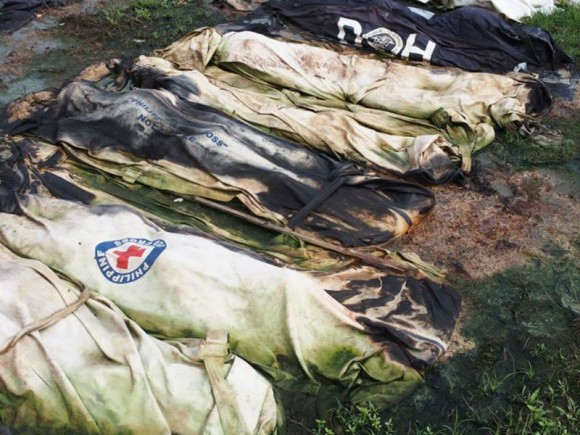
There were few surprises at Suhi. It looked pretty much exactly as I expected – like a place where nothing of any value was happening. From the point of view of common sense and proper procedure, it was, of course, a horror show. The bodies inside these body bags had been busily decomposing for 46 days without the benefit of refrigeration or even shade. There was no discernible order or system to their placement. They were simply scattered around the open fields amongst thickening undergrowth, large pools of mucky water, and rusting vehicles. There were so many that it was nearly impossible to walk among them, and I had to step over the bodies carefully as I moved around. (With a steady lifetime diet of horror movies, I have to admit to the passing thought that a hand would suddenly reach out from one of the bags and grab my ankle.) They had clearly been there for a very long time – long enough for the plant life to grow up and around them – at least a thousand bodies just lying there alternately soaking in the torrential downpours and baking in the hot tropical sun.
Slideshow of photos from Suhi:
[slickr-flickr tag=”Suhi Site for IDing Bodies”]
The body bags were of many different colors and styles. Most were of a thick black material and the stiffness of these bags meant that it was difficult to make out the shape or even size of the bodies inside them. Other bags were of a white canvas, and these had draped around the bodies revealing clear outlines of heads, arms, and legs. The most poignant were those bodies lying on their sides, their legs pulled up in a foetal position. They looked, for all the world, like people taking a nap inside a light sleeping bag. I reached down and lightly touched a body here and there. I did this out of simple curiosity (I also didn’t think they’d mind some simple human contact – perhaps they’d feel less alone and forgotten), and I wasn’t surprised when some of the bodies were as light as feathers and others were still heavy and solid. I supposed it depended on where the bodies had been recovered and how long they had been lying in the open and then inside these bags. Those in the water or wet areas would likely have bloated badly and absorbed moisture. My experiences with the body recovery teams taught me that dead bodies can become much, much larger and weigh far more than the person did in life. Other bodies trapped in rubble would have dried out and become light and dessicated. At Suhi, they probably regained some moisture. It would be hard not to in that wet field with the rain constantly pouring down and the liquids from the bodies seeping out of the bags and pooling around them.
Any suggestion that these bodies were here to be identified would be ludicrous. If that were the case, surely the bodies would be arranged in sections and lines based on the date and location of their recovery. But there wasn’t even the hint of a layout. The bodies were apparently dumped onto the ground at whatever random spot the vehicle had backed up to. Then they ran out of room and just dumped them anywhere there was space until all the gaps were filled up. In any case, by the time these bags would be brought inside and unzipped, there would be little inside them to even work with – just bone, liquid, and bits of rotting flesh, if that. I keep hearing people talk about DNA analysis, but that makes no sense to me. Even assuming they took DNA samples and sent them off to be analyzed, what good would it do? You would end up with a random assortment of DNA profiles with nothing to compare them to. Even assuming that by some miracle the bodies were identified, what would be the point? Under normal circumstances, a body would be identified so that it could be returned to the family and a proper burial arranged. Very few people here can afford or are interested in any kind of funeral or burial. All these bodies will eventually be thrown into the bed of a dump truck and then taken to a big hole in the ground and dumped into a mass grave. The families have long since given up on the idea of recovering the bodies of their loved ones. They would not have the financial resources to do anything with the bodies if they were returned to them in any event. So what was the point of bringing them to this site and leaving them to lie out in the open for weeks in the first place? There really could be no point to it.
While I was standing there pondering all of this, a large work truck pulled up at the main driveway. A group of workmen jumped out of the truck and began repairing the white canvas fence. A man came out of the main building to talk with them, and he spotted me out in the field of bodies with my camera in my hand. If this were Canada, I’d surely be lectured and then told sternly to be on my way. But this man simply stood nearby until I made my way out of the field. Then we chatted, and he told me that he was in charge of security at Suhi. He didn’t challenge me in any way or ask what I was doing there. I felt I should offer him something by way of an explanation, and I told him that I had gone out with the BFP on their body retrieval missions and that they had suggested I come out to Suhi to see the place. The man didn’t seem worried one way or another by my presence and my explanation didn’t appear to make an impression. In fact, the man rather than kick me out started answering all of my questions. He said that the BPI team was not there at the moment. He suggested that they might be there in the afternoon. This contrasted with what the BFP told me – that the BPI team worked in the mornings and not in the afternoons. It felt to me like everyone was skirting the issue that the BPI teams only rarely showed up and even then to do very little.
The security guard said that the BPI teams were taking the bodies inside the nearby buildings and performing autopsies (he knew that English word) and taking DNA samples. Once identified, the bodies were placed in a separate area for eventual burial. Indeed, there were a large number of bodies underneath a tarp outside the main building. These bodies had been processed and were awaiting burial. Therefore, at some point, things had happened here.
I eventually took my leave and walked back to where I had locked up my bicycle. I stood there for a while simply gazing out over the field of bodies one last time. It was one of the more bizarre sights of my life, and I wanted to give it a proper look and really try to see it, not just accept it as another odd angle of the typhoon. I was ripped out of my reverie by a sudden and sharp pain in my feet, and I looked down to find both feet (clad in open sandals) covered in red ants. The ants had finally made up their mind that I must be tasty and settled in for a feast. I hopped around and slapped at my feet in a mild frenzy while I unlocked my bicycle and then got out of there as quickly as I could. I supposed that I wasn’t fit for much polite human society at that point. I have a talent for getting dirty no matter what I do, and I saw that my feet were quite black and my toes encrusted with mud from my walk around the wet field of bodies. I hadn’t thought about it at the time, but I imagine that I had been stepping in the liquid that had been oozing out of the body bags. I couldn’t smell it, but I also imagined that my clothes now smelled of decomposing bodies. This smell is quite unique, and it gets into your clothes and stays for a long time. My sense of smell is quite weak, so I wouldn’t notice it much. I wondered if other people with more sensitive noses would smell the odor now embedded in my shirt and shorts. Luckily, the skies finally decided it had held off on the rain long enough, and the rain came pouring down. I put my valuables away and covered up my pannier bag with the rain cover, but I wasn’t too worried about getting wet myself. A dousing with fresh rainwater was probably in order.
On my way back to Tacloban (the ride out to Suhi had been perhaps fifteen kilometers), I turned down a few promising sideroads. One road led to the water’s edge not far from the San Juanico Bridge. The buildings here had been totally destroyed, and I took a few artsy pictures with the bridge in the background. While I was there, a young Filipino man showed up on a motorcycle and also took pictures of what remained of the houses. He told me that he was doing a survey for the Johavah’s Witnesses, and that they would be helping to rebuild these homes.
Another road took me deep into the low hills around the town of Diit and then on to San Roque, where the road pretty much ended. San Roque had a picturesque setting in a pretty valley and had clearly been heavily damaged. I rode my bike around the quiet streets and had an interesting encounter with a young local man named Jeffery.
Jeffery was sitting underneath a shelter, and he invited me to stop for coffee when I cycled past. I can never resist a coffee invitation, and I pulled over. Jeffery was coordinating a large construction endeavor by a Scandinavian NGO called the Children’s Mission Philippines. Apparently, it used to be called the Scandinavian Children’s Mission. Jeffery told me that this NGO had essentially built this village decades ago and had returned to help rebuild it after the typhoon.
The main goal was to rebuild the roofs at the elementary schools. The walls of the buildings were still standing, but all the roofs had been torn away. Large piles of lumber stood ready around the schools. This material had been purchased in Calbayog on Samar, and Jeffery was going to supervise four separate teams as they worked on the roofs of the school buildings. There was incentive to get the work done quickly because once the school was done, material would be provided to rebuild their homes.
Up on a nearby hill were the remains of the local high school. There was almost nothing left of this school. It looked like a large bomb had gone off in its center. It contrasted sharply with the elementary school, which was still largely intact. Jeffery said there was an obvious reason for this. The elementary school had been built by the Scandinavian NGO and therefore had much higher construction standards. The high school had been built by the local government and all cheap material had been used and the money saved gone into the pockets of politicians – the usual story of corruption in the Philippines.
Jeffery laughed heartily about this, but I found it far from a laughing matter. I’d heard this same story so many times that it now just depressed me. Later on, I rode my bike up the hill to take a closer look at what remained of the high school. The destruction was incredible. Just looking at the rubble, you’d naturally come to a conclusion about how powerful the typhoon was. Any wind that could cause this kind of damage would put the Wizard of Oz tornado to shame. But the reality might be something entirely different. I saw a pile of cinder blocks that were still intact and decided to test their strength for myself. I laid them flat and then stepped on them. To my astonishment, these cement cinder blocks turned to powder at even the lightest touch. I didn’t even put the weight of my leg let alone the weight of my body on the block. I just stepped on it lightly with my foot, and the whole block disintegrated. It barely had the strength of a sand castle. With construction material that shoddy, even a light summer breeze would have knocked down those walls. You hardly needed a super typhoon to do it.
This brings up the question in my mind of the ultimate value of all this relief work by the NGOs. Think about it. A few years ago, the government had decided to construct a high school. Rather than do it properly, they used all cheap, sub-standard, and shoddy construction material and the politicians kept the money for themselves. Now a typhoon has come along and destroyed the building. Rather than the corrupt politicians being punished and charged with a crime, they get to keep all that money and a Scandinavian NGO is happily going to build them a proper high school built to a high standard.
Jeffery let out many long belly laughs as he told all kinds of similar stories about the corruption and incompetence of government in the Philippines. He asked me to consider what would have happened in Tacloban if the Tzu Chi Foundation had not existed. I hadn’t really thought about that before, and the realization startled me. It’s true that without the work of the Tzu Chi Foundation, Tacloban would likely to this day still be just a pile of impassable garbage and debris. If they hadn’t brought in and paid for all that heavy equipment to clear the streets, the streets would likely still be filled with debris. The condition of the city would have been nightmarish.
But is this a good thing in the end? No local government agency had to take responsibility for the work. So it didn’t matter, and nothing will have been learned from this super typhoon. Next time there is a natural disaster, local government will just sit back once more and wait for international relief efforts to come in and fix everything.
Jeffery also cleared up another mystery for me – the sudden appearance of so many mountain bikes on the streets. Seemingly out of nowhere, many of the local children and teenagers are riding around on brand new mountain bikes. I wondered where all these bikes had come from, and Jeffery said that they were all purchased with Tzu Chi Foundation money – money “earned” through the “Work-for-Cash Cleanup Drive.” I put earned in quotation marks because of the high percentage of people who did no work at all to earn the money. Jeffery told me that his nephew earned 2,500 pesos per day. The going rate was 500 pesos per day, but his nephew had figured out a way to sign up for five different work crews. He did no work at all but spent all his time racing around the Tacloban area to appear to be in five different work crews and collect a salary five different times. With that money, he could buy himself a nice new bicycle and other luxury consumer items.
Jeffery, despite being a self-proclaimed very religious and moral and ethical man, seemed to have no problem with this behavior. He knew it was wrong, but he just laughed about it. “That scamp,” he seemed to be saying.
Jeffery and I also talked about taxes. He used to work in the government’s department of agriculture, but he got tired of paying such high taxes on his already small income. He saw a way to make more money by partnering with local farmers producing high-value crops like eggplants and bell peppers. He now makes much more money and as a private businessman has endless chances to evade taxes. The government has no way to monitor how much crop he grows and sells, so he can drastically underreport his earnings and pay next to no taxes. It’s a win-win situation for him. Whatever guilt he might have felt about this behavior is offset by his knowledge that if he did pay proper taxes, that money would just be siphoned off and end up in the pockets of corrupt politicians doing no good to anyone anyway. He commented that people in a country like Canada don’t mind paying high taxes because we get good value in return – good roads, good schools, medical care, etc. In the Philippines, those who pay taxes get nothing in return. Only the corrupt politicians benefit. I can’t think of anything sadder than this. It truly displays the evil power of corruption and how it can devastate the economic life of an entire country.
After going on at length with this ethical tirade, I should point out that personally, I don’t really get upset about it, about the dishonesty I mean. The end result is pretty disastrous for the country, but that’s just a logical outcome and that is sad. But I’m not personally offended by Jeffery’s nephew’s behavior in scamming the Tzu Chi Foundation. If pressed, I’d probably say “More power to him.” The point is that I’m from the West, and I know that in reality even the 500 pesos a day salary the Tzu Chi Foundation was paying is quite paltry. In the Philippines, it is far higher than the minimum wage, but we’re still only talking about just over $11. That’s not for an hour of work. That’s for an entire DAY of work. With tens (hundreds?) of millions of dollars of aid pouring into the Philippines after Typhoon Yolanda and helicopters filling the skies, who is going to begrudge a local schemer the chance to scam a huge foundation out of $50 and buy himself a mountain bike? I’m only too well aware that things in the Philippines that are out of reach economically to so many people represent nothing in terms of cost to people in the West. It’s scandalous – as every thinking person knows – that anyone in the world today goes without shelter or clean water or good food. People here work long hard days for $6-$7 a DAY and then face a long commute in a crowded jeepney back to their shack in the countryside – a shack consisting of scraps of wood and tin gathered up after the typhoon and just hammered together. That anyone has to live that way anywhere on the planet when there is such vast wealth is ridiculous. But that’s the way it is.
I realize that I’m contradicting myself. Earlier, I was implying that international relief work by NGOs did more harm than good. Now I’m implying that we should all join hands and spread the wealth. It’s a pitch that everyone in the West is familiar with: “For the price of one Starbucks coffee a day, you can transform the life of a child in Africa.” It’s a seductive pitch, and the simple math seems to work out. Many people here work for the minimum wage of $7 a day. Many don’t even make that much. Most people in the West wouldn’t even notice if that much disappeared from their income, so it would be effortless for them to help people here.
Tags: BPI, Mission Philippines, Philippines Bike Trip 2013, San Roque, Super Typhoon Yolanda, typhoon