
Fire Sweeps Through Neighborhood in Cebu City
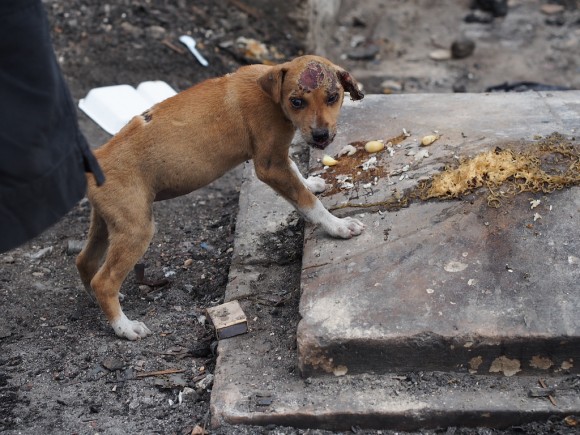


A fire broke out on Tuesday evening (March 18, 2014) in a tightly-packed residential area in Barangay Lorega in Cebu City in the Philippines. According to newspaper reports, 500 homes were destroyed, leaving as many as 7,000 people homeless. Not surprisingly, despite staying just a few blocks from this area, I was completely unaware of the calamity until a couple of days later. Disasters seem to follow me around in the Philippines, but I’m always only partially aware of them – at least until they come up and slap me in the face.
When I returned to my hotel on Tuesday evening, a man that hangs out near the entrance (a quasi-security guard) said something about a fire. I didn’t know what he was talking about and didn’t give it much thought. He often says things that don’t make sense to me. It wasn’t until Thursday that I stumbled across a story on the Internet about the fire. Then I understood what he meant. I wish that I had paid more attention. I likely would have gone to investigate that night.
Today, I walked over to where the fire took place to see for myself what was going on. It took only a few minutes to get there, and the scene felt instantly familiar. The destroyed homes were eerily reminiscent of the destruction in Tacloban after typhoon Yolanda. The difference, of course, was that there was little wood lying around. The wood had been consumed by the fire. All that remained was the concrete. I don’t know why this would be the case, but the concrete walls of the homes were largely destroyed and lay on the ground as rubble. It makes sense that the storm surge of the typhoon in Tacloban would topple the concrete walls. I don’t know why a fire would do the same. I had expected to see the shells of the homes still intact.
I had a feeling that I wasn’t seeing the entire area that was damaged by the fire. It seemed too small. It certainly seemed too small to contain 7,000 people. However, I walked around it and through it to all the edges where the fire seemed to stop, and I saw no evidence of fire beyond those points. So I concluded this had to be the main site of the fire. I’m not sure where 500 homes could have been located even considering how small and tightly packed the homes would have been. This seemed especially true considering that much of the land area was taken up by a cemetery.
It’s hard to imagine how terrible the fire must have been. Simply looking at the piles of rubble would give you no clue as to what happened there. However, it starts to come clear when you walk around the residential districts surrounding the fire. These types of neighborhoods are extremely dense. The houses are built one against the other and one on top of the other. The lanes between them are little more than footpaths, leaving almost no room. The roofs above come so close together as to almost touch in many places. A fire, once it took hold, would be an inferno. The homes and their contents would go up like a box of matches.
One side of this area is bordered by a very wide road. Here, the fire was contained and did not cross the pavement to the other side. It’s not clear to me why the fire did not spread on the other three sides. From what I read online, firefighters had difficulty getting into the area and fighting the fire. The roads and lanes were simply too narrow for their trucks. And there was low water pressure. Yet, the fire was contained within three hours.
As I walked around, I came across other scenes familiar from my months in Tacloban after the typhoon. Relief goods – food, water, and clothing – were being distributed at certain points. People were filling out forms in order to get these goods. As I walked past one such point, a woman gleefully handed me a bottle of drinking water. “It’s free!” she shouted. Another man picked up a plastic bag of canned goods and held it above his head and did a little celebratory dance like he had just won a prize on a game show. There was an odd atmosphere about these places. One would naturally expect gloom and perhaps desperation. Yet, the atmosphere was almost lighthearted. As I walked through the heart of the area that was completely destroyed, an elderly man invited me to share his lunch. His house and all his possessions had been burned up. He was currently sleeping underneath a makeshift shelter made of bent and dirty sheets of galvanized tin. He had cooked a bit of rice over an open fire, and he gestured to me to come join him and eat some of the rice.
Most people I saw were either scavenging or smashing concrete with hammers and crowbars. This smashing of the concrete might explain why there were so few walls standing. Perhaps the fire did leave many walls still upright but they were so badly damaged that people were smashing them to pieces with sledgehammers before starting to rebuild. Much of the cleanup and scavenging had clearly already taken place on Wednesday and Thursday after the fire. I saw a truck out on the street with a full load of sheets of galvanized tin being taken away to be sold for scrap. It was likely the last such truckload. People had now turned to collecting rebar and electrical wires. Here and there, I saw people with portable scales. They weighed the scrap material on these scales and came up with a price for them. Dozens of children and some adults were sifting through the ash looking for nails. These would eventually be hammered straight and reused as they rebuilt their homes.
I wasn’t able to speak to many people in English. This surprised me, considering that so many people spoke English in Tacloban. Even the poorest people in the areas hardest hit by the typhoon spoke conversational English. I haven’t found that to be the case in Cebu. I asked a few people about what had caused the fire, and no one had an answer. That is understandable. In a squatter settlement like this, the fire could have been caused by a dozen things. Faulty wiring would be the norm rather than the exception. People cook over open fires. Garbage is often burned in open fires. Children play with firecrackers. One man said the fire was started by children playing with matches. That could easily have been the case. Online articles talk about an explosion in one man’s home causing the fire. The question really isn’t what unusual event caused this fire. The real question is why fires don’t happen all the often. They do occur frequently as it is. There were three in Cebu city that I’m aware of in the past month, which, ironically, Fire Prevention Month.
Tags: burned, Cebu City, fire, homeless, Philippines Bike Trip 2013