
Days 26 & 27 Super Typhoon Yolanda
The term “squatters” almost never came up before the typhoon. But in these post-typhoon days, I hear it all the time. It’s generally used in the way you’d expect – in a negative way – and is used to describe the bad qualities of the people who suffered most from the typhoon, those living in the crude shacks along the shoreline and in the spaces between buildings.
It came up yesterday when I stopped by the house of one of my neighbors. I met the couple that lived there in the days right after the typhoon, and they helped me out a great deal by giving me some canned goods and some coffee and even some toothpaste. They have relatives in Carigara, and they went back and forth between here and there in the last few weeks.
Later on, I met their son, and it is this son that I chatted with yesterday. I forget his name at the moment, and I’ll just call him Howard. I like Howard quite a bit. He’s friendly and speaks excellent English, but more than that, he’s very funny in a dry kind of way. That’s a rare quality in the Philippines, where humor tends to be much more straightforward – like a freight train running you over.
Howard has a very droll sort of delivery. I can see him being the host of a late night TV show. He also speaks in full sentences and paragraphs and does so in the manner of a performer.
I saw him yesterday toiling over a big tub of laundry, and I popped in to say hello. (They also have two friendly German shepherds, and they are an added incentive for a visit.) I mentioned that I was on my way to the Bohol bicycle shop once more but that I didn’t have much hope of success because of the long lineup of customers. He agreed with me and said that no American can compete with a Filipino when it comes to waiting in line. Filipinos can wait for hours upon hours with no problem while Americans want everything done right away. (I’m an honorary American for all these sorts of discussions.) I’ve said and thought the exact same thing a number of times recently in various contexts. I generally don’t mean it in a positive way, though. I’m usually more puzzled by it, when, for example, Jeffery and Rene would wait all day at the airport in the pouring rain for a flight with little to no chance of success, when Mar would spend an entire day going from terminal to terminal and waiting for hours at each one for a seat on a van with no success, and when hundreds of people will simply sit at the side of the road and wait for hours beside their electronic gadgets as they charge. I charge my gadgets, too, all the time, but I don’t sit beside them and watch them charge for hours. I would go insane. There’s the old expression about a watched pot never boiling. Well, waiting hours for a red charging light to turn green would turn me into a raving lunatic. So I try to find a way to leave my gadget behind and pick it up the next day. But Filipinos can wait through the entire charging cycle and just sit there doing nothing the entire time. I can never compete with that. I’m particularly outclassed when it comes to waiting without information or any kind of guarantee of results.
At the bicycle shop, for example, I couldn’t wait in that line without knowing what time the bicycle shop will open, if it will open, and when they can do my repairs. Filipinos will wait for hours in that line and then not even be upset when the bicycle shop simply doesn’t open that day. Anyway, back to squatters.
I mentioned to Howard that I was very curious about the families staying in the pension house. I told him that I had no idea about what their true situation was – if they had enough food to eat, for example. Or if they had any money to buy food and other items. I told Howard that they were from San Jose and their homes had all been destroyed. Howard commented, “Oh. Squatters.” He then waved an arm at the community of people living in little wooden shacks in our neighborhood and said that they were probably just like these squatters, and they wanted everything for free. They didn’t want to work for anything and expected the government or relatives or somebody to just give them everything for free. He then said that they would go out stealing all the time, and that they had been stealing copper wire from the repairs going on around Tacloban and that some had been shot and killed.
I eventually left Howard, and to my dismay found over 60 people already waiting in line at the bicycle shop. The shop wasn’t open as far as I could tell, and I had no idea when it would open. And when it did open, all they would do is open the steel shutters just a tiny crack, and all the customers would be forced to shout their problem through the crack and then jam their bicycles and bicycle parts inside. I didn’t even have to think about it. I knew I was not going to become number 64 in that lineup and spend my entire day sitting in the hot sun on the pavement on the off-chance that “maybe” somebody at this bicycle shop could true my wheels professionally.
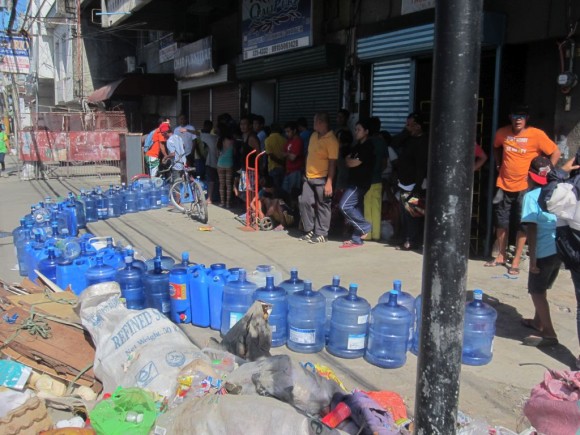
The day wasn’t looking good. On the way to the bicycle shop, I had also passed the only water refilling station in town that was open. I was out of drinking water, and I had intended to at least force myself to wait in that line. Unfortunately, it was almost as long as the lineup at the bicycle shop, and the lineup of water containers was even longer. I took a picture of it to remember the moment by. Some days in post-Yolanda Tacloban, I’ve wondered if this was how it was living in Europe during the world wars with all the rationing and long lineups for everything. It must have been horrible.
Seeing the bicycle shop lineup sent my feet towards the harbor once more to see if there was a chance to put my bicycle on a ship for a trip to Cebu. I would much rather cycle away from Tacloban, but a ship to Cebu was looking pretty good, too.
I chatted with the guards at the gate a little bit. I was amused to see a big display of mugshots on the wall of escaped convicts from the local jail. Some of them had “captured” written across them, but most were presumably still at large. They looked like a pretty rough bunch, and their crimes were no joke. There was, of course, a fair amount of theft and drug charges, but a large percentage of them had been convicted of murder, rape, and all manner of violent assaults. There was no definite pattern to the charges and some of them were worded in an amusing fashion. I took a picture of this, too.
(Edit: I learned much later that about 100 prisoners had escaped from the jail located just two blocks from my guest house. The typhoon had broken open the main doors to the prison, and in the confusion a bunch of prisoners had run out. At two other prisons on the outskirts of Tacloban, all – a couple of thousand – of the prisoners had escaped. At one, the entire roof of the prison was torn off by the typhoon. The prisoners all simply climbed the walls and got out. At the second prison, the guards simply opened the gates and let everyone out so they could go take care of their families with the understanding that they would return later. Nearly all of these “escaped” prisoners did return voluntarily to the prisons. Only a few remained “at large”, and the guards I spoke with said they fully expected all of them to come back eventually. This makes me think that when they plastered “Captured!” over the picture of one of these escaped convicts, it was a bit misleading. That convict had most likely just returned to the prison voluntarily.)
The guards just waved me into the harbor area and told me to go to the port building to ask about ships there. The port building and surrounding area was dominated by the Philippine navy. Even so, I was allowed to just wander around all the hallways and rooms and check everything out as I looked for a reasonable person to approach with my questions. I finally settled on a very young and friendly looking fellow tapping away on a laptop computer. He was inside a large room that had plenty of maps and charts on the wall including a list of all the previous ships that had departed, with the number of people on board. The first two ships had carried 1,555 and 2,500 civilians respectively. All the rest carried much smaller numbers – as few as 17 or 22.
The young man was an ensign and introduced himself as such. To my shame, I instantly thought of Ensign Will Crusher on Star Trek – the only association I have for the word ensign. This ensign was eager to help me, but he had no definite information about when a ship might be leaving. (There were no navy ships at the harbor at the moment.) He implied that no one really knew and there was no point asking anyone else. To my joy and intense surprise, however, he offered to take down my cell phone number and text me when a ship came in and had a departure date. He entered my cell phone number right into his smart phone with my name, and I left with some confidence that he would follow through on his promise. If not, I walk by the harbor all the time anyway, and I can just check to see when ships arrive. (Edit: I never did hear from him.) The navy ships are so large that I can see them towering above everything else from quite a distance away. Unless something happens with Dan, and he gets me to see his bicycle mechanic quickly, I think a ship to Cebu is in my future. I can tighten up my spokes enough to be able to wheel my bicycle along with my luggage on it. I wouldn’t want to ride it for fear of damaging anything, but I think I would be safe carrying my luggage. Then I’d be able to wheel it into Cebu and find a place to stay and then a bike shop. I’m not thrilled at the idea of staying in Cebu. I’d much rather avoid large cities like that, but I want to see a friend of mine there, and it is a great place to get organized and do some shopping, too.
Back at the pension house, I found that my water problems were largely solved. I made a strong effort to get information about the two different types of water pipes in Tacloban. One supply is apparently only good for bathing while another supply is good for drinking. I have been asking for information about how to tell the difference, but I’ve never gotten a straight answer. This time, I was told quite clearly that the water that flows into the cement tank here at the pension house was drinkable. A man walked me over to the tank and I saw that a new pipe and valve had been fitted. There was another valve nearby, and you turned the water on there. Then water flowed out of this pipe before it fell into the tank. If you filled your container right from the pipe, you got drinkable water – or as drinkable as it was going to get. It was a bit awkward, as the water sprayed up in an arc and I had to catch it in the mouth of a small bottle and then transfer it to a larger bottle, but slowly but surely I got it done. Once I had one of the large 5-gallon bottles full, I added some of the Waterine water purifier that the Davao team gave me. I only had to add 3.5ml to the bottle, which means that the Waterine could last a long time. The instructions were to let the chemical interact with the water for 30 minutes. Then you were supposed to open the container for 15 minutes to aerate it and then close it again. I did that, and apparently I now have 5 gallons of drinkable water, and I didn’t have to carry it any farther than from the pension house well. When the Davao team gave me the Waterine, I really lusted after more of it. I wanted to get a big supply so that I could abandon my Katadyn water filter and not have to carry it around with me. I might leave the Katadyn here in Tacloban anyway. There’s no point to shipping it to Canada, I guess, as I never really want to carry it around again. (Edit: Later on, other people said that they were surprised that I was still alive after drinking the water from the well. They said that it most definitely was not potable in any form. I’ve since asked questions about the water a dozen more times, and I’ve gotten a dozen totally different answers with most of them making no sense at all. Do other people have this much trouble getting basic and simple information?)
The final – and biggest – adventure of the day was emptying the two fish ponds of water. The mosquito population has been growing out of control, and after I purified my drinking water, I went over to the main fish pond to see if there were mosquito larvae in the water. And there were! The water was practically black with hundreds of thousands of them all doing their little dance – wriggling up to the surface and then going back down again. Probably millions of them. It was a shock to see, and I quickly got a bucket and set to work emptying the pond. The water was so disgusting and awful that I didn’t feel comfortable just dumping it onto the ground, but I had no choice. I wanted to carry it to the street and dump it down the drains there, but it was too far. If I had a trolley with wheels, I might have tried to fill up a big garbage can with the water and carry it that way. But I had no such tools, and could only use a bucket. To carry each bucket to the street would have taken days to accomplish. I had no choice but to just dump it on the ground and let it drain away inside the hotel courtyard.
I can’t emphasize enough how disgusting the water was. It was toxic and the smell was overpowering. Still, I wanted to get the job done, and with my usual flair for getting dirty, I got the black slimy goo all over my body and soaked into my shorts.
A Filipino fellow named David – the one who had helped me figure out the water supply – jumped in to help me, and we worked together for the next few hours. He was a very goodnatured and funny guy and made lots of jokes. He was quite pleased to be working with me and commented many times during the day that this was the first time his work partner was an American, a foreigner. He worked very hard, and he was quite thorough. I might have stopped just with emptying the ponds of the water, but he then stepped inside the pond and began pushing together the mountains of garbage and mud and debris. We then spent a long time shoveling out this gunk into buckets, and I carried the buckets out into the streets and dumped them there. In the process, I got even more covered in black horrible slime and goo. And even when that was done, David wasn’t finished. He then got fresh, clean water and rinsed down the fish pond and scooped that water out. He did a thorough job, and I was pleased about that.
While he was rinsing down the first fish pond, I moved on to the next. Our division of labor had settled into the pattern where I emptied the pond, and he then stepped in and shoveled out the remaining garbage and mud, and I carried the buckets to the streets. That left me with the lion’s share of the work by far, but I didn’t mind. It was important to me to do this and it had been my idea. Emptying the fish pond by the front gate was a much bigger job and my poor body began to feel the effects. My back in particular was giving me trouble, as I had to lean way over to fill the buckets and then straighten up to dump them over the side. I did this while straddling the fish pond for a while. Then when the water got lower, I had no choice but to step into the water and heave out the buckets from there. I shuddered to think of what I was standing in, and I hoped nothing evil was burrowing through my skin and into my bloodstream. A thick pair of rubber boots would have been nice to have.
Emptying this second pond took a long time, and I started having to take breaks as I got more and more tired. Then when I reached down to lift up the heavy buckets of mud and garbage, I found it was all I could do to straighten back up and lift them. A full day of labor like that would finish me off, let alone a full work week. It’s not really a reflection on my age, I don’t think. I’ve never been very strong and I have done next to no physical labor for years and years – other than the bits of cycling. I’m not in any type of shape.
The final job was to somehow drain the two large water tanks. I was pretty sure that mosquito larvae infested that water as well. David found a valve that when opened began to drain at least one of the tanks. I’m not sure about the other one. It isn’t possible to look down into that tank and see the water level.
It was a good afternoon’s work, and I hoped it would help reduce the mosquito population. To my surprise, there were far fewer mosquitoes in my room last night. Far fewer. There were usually as many as fifty, but last night I was only aware of two or three. It is unlikely that emptying those fish ponds would have such an immediate effect, but I suppose it’s possible. I guess it depends on the life cycle of the mosquito larvae. Perhaps, each night a fresh batch of mosquitoes would emerge to torment us, and by emptying the ponds, we forestalled last night’s batch. I can only hope.
And there we are. My bicycle is still a mess, but I have perhaps the option of taking the ship to Cebu.
4:35 p.m.
Not much to write about, as the day was fairly uneventful. Mar, the BFP guy who brought me the Flying Tiger alcohol, showed up this morning at the pension house. He was here for a memorial service for five BFP members that lost their lives during the typhoon. He was going to play the keyboard at the service, and he said that there was going to be a 21-gun salute. He warned me not to be frightened when I heard the guns. I listened all morning, but I never heard them.
Mar had hoped to stay at the pension house, but it wasn’t clear if there were any available rooms. I couldn’t help him with that because I have no idea who is in charge. I have no idea who is who. He seemed rather forlorn and lost about taking a bath somewhere, so I offered him the use of my room. I would have done it right away except that I had let things go and my bathroom was a disgusting mess. It was embarrassing to let him in here and see what a pig I am. But I had no choice and offered him my bathroom. He accepted my offer gratefully, and then he proceeded to unpack in the most meticulous fashion. His clothing and other stuff was packed extremely neatly and everything was super clean. He was so super-clean that it was even more embarrassing to have him use my dirty bathroom.
I’ve mentioned quite a few times how generous Filipinos are and what good hosts they are. The flip side, though, as is so often the case, is that they aren’t very good guests. This guy was so over the top with his gratitude and his desire not to cause me any trouble that he drove me up the wall. He insisted on replacing all the water he used even though that meant getting buckets from the well and getting all sweaty and hot right after he just took a shower. I tried really hard to get him not to bother, but he wouldn’t listen. Then I offered him a cup of coffee, but he insisted that he had his own coffee. I offered him what little I had in the way of food – a loaf of bread and some chocolate biscuits, but he made a big deal about turning those down. He said that he had a slice of bread while he was in Ormoc. But that would have been hours ago. Then he did this bizarre thing of offering the chocolate biscuits I had offered to him to a little boy. He was trying so hard to be a good guest, but it was pretty weird to turn down the food I offered him and then offer that food to someone else. It was like a Seinfeld episode, because the little boy then thanked him profusely for the chocolate biscuits. Yet, as George would certainly have pointed out, they were my chocolate biscuits. By the time Mar was finished his shower and was all packed up and ready to leave, it was a bit of a relief. And before departing, he gave me something new to worry about. He said that he had tried to visit my website, but there was nothing there. He tried using several different browsers, but he couldn’t get the page to load. That made me think that something had gone wrong in the time I’ve been here dealing with post-typhoon Tacloban, and I’d lost the domain name and all the content or something. But later in the day, I remembered that my Kindle has a rudimentary and very slow Internet browser. I keep forgetting that it has that capability. I fired it up, and I checked and the website was still there. So, as I originally guessed, he had probably just typed it in wrong. I’ve found that The Cycling Canadian is very hard to spell correctly when typed in as an URL. Even I get it wrong all the time.
After Mar left, I took a quick cool-off shower (one of about fifty I take every day) and then went out into the city. As is my habit, I strolled past the Bohol bicycle shop and stared in dismay and horror at the many people waiting in line. Today, there was a big truck at the front loaded down with new bicycles. I went right on past without even thinking about joining the lineup. My sense is that even if I did manage to get any service, it would be horrible and I’d have no confidence in the work they did. Better to wait until I get to Cebu.
Once past the bike shop, I continued downtown to check out the harbor to see if a navy ship had arrived. One hadn’t, and I just kept walking until my feet brought me back to the pension house. I wanted to take another stab at getting my stove to work. I had some success in that I managed to figure out how to dismantle the stove – at least the main bits that could safely be dismantled. This revealed one part that was almost certainly part of the problem. There was some kind of steel rod that was inserted into the fuel line right where it goes into the stove. This rod had three grooves cut along the side to channel the fuel and these grooves were quite dirty and filled with soot. This clearly wasn’t right, so I spent some time cleaning this up as much as I could. Then I tried to scrape out the interior of the pipe that this rod went into. That was harder to do, but I got out some dirt and soot.
Unfortunately, the stove still wouldn’t work. Fuel would not squirt out of the jet as it was supposed to. So then I went through a long and very frustrating series of steps to try to figure out where the problem was. Things didn’t make a lot of sense. I seemed to have pressure and the fuel would come squirting out of the jet at first for a second or two. Then it would suddenly just stop coming out. I had no idea why. Everything seemed to be in working order, but it still wouldn’t work. The only explanation I could come up with is that using the low-grade leaded gasoline had deposited gunk all over the place – in the fuel line, in the pump, in the valves, in the pipe, in the rods, in the jet, etc. And as I worked on the stove, I would dislodge bits of this gunk and it would clog up either the three channels or the jet. And so the only solution to my problem was to keep cleaning and cleaning and refiring the stove to slowly clear the whole system of all the built-up gunk. And then I would have a clean system and the new fuel that Dan gave me should flow fine. I’m hoping that this is exactly what happened, because I got to a point where the stove fired up just fine, but then the fuel flow got weird and split into three parts and the flame got yellow and sooty. I shut everything down, let it all cool, and I saw that some gunk had clogged the jet. I cleaned it out, cleaned all the other parts again, and this time the stove fired up and stayed lit and burned well. I boiled some water for coffee. Then I let the stove cool down and fired it up again, and it worked fine. I’ll probably try one more time tonight when I cook dinner. (Assuming I can stand the mosquitoes.) Hopefully, though, I’ve repaired the damage I did with the substandard fuel and things will work better now.
It wasn’t a fun experience fixing the stove. It was frustrating and dirty work and was made more so by the presence of the super-annoying children. Then it was time for lunch, and I set off into the city to go back to the Megabites eatery. As my luck would have it, it began to rain heavily within minutes of my stepping outside. I swear that the rain clouds wait for me to go outside before they let loose all their water. I passed another eatery along the way, and I decided to eat there instead and not get soaked in the rain. It wasn’t a comfy place to eat – very crowded and the rain made everything wet, but the food was good and filling. It was nice not to have to cook anything.
I went to Kokoy’s Grocerette after that. They have added nothing to their shelves since the typhoon, so there was slim pickings. Almost no pickings. My main goal was to get some spaghetti sauce, and they had one meager little package of it – all dirty and muddy from the typhoon. No one else had dared to touch it it was so dirty, but I gave it a home in my kitchen. It will be my dinner tonight.
From there, I walked over to Hayward. Manny wasn’t there, but his daughter invited me inside. I like her. Her English is good, and I get the feeling that she understands what I’m talking about most of the time. She probably thinks I’m quite ridiculous, but I like to talk to her anyway. While there, I bought some beer, three Snickers bars, a can of condensed sweetened cream, and a big bottle of Pepsi. All junk I didn’t need, but I felt like shopping and indulging. At least I’m still saving money on rent.
Back at the pension house, I’ve just been hanging out. I tried to get info on trueing wheels through my Kindle, but that was a frustrating experience. And I got only basic info. I tried to true my front wheel but it was a waste of time. Leave it to the experts.
I left a note for Dan at his house. See if he texts me or contacts me. I’m just in a bad, bad mood. The children have been incredibly loud and annoying. I wish their parents would exert some control over them, but they just let them run wild. And I keep dropping things and breaking things and tripping over things and making mistakes. I don’t know what’s wrong with me. I can’t concentrate or something. Just now, I realized that I left my iPod Nano on all day and drained the battery dead – right after going to all the trouble of recharging it at Mark’s place and paying 30 pesos for the privilege. Then I dropped the Sansa Clip and the memory card came flying out of it. And that means it now has to “refresh media” for twenty minutes before it will play. And its battery went dead. So I’m using earplugs to drown out those stupid children. I can’t do anything without nearly breaking something. This all started with leaving my bicycle in the courtyard during the typhoon. Then tripping and smashing my camera and lens. THANK goodness that the camera still operated and I was able to document some of the typhoon aftermath. If the camera had been totally destroyed, my mood right now would be much worse.
I think my bad mood stems from this feeling of helplessness that comes with having no functional bike. I have no freedom of movement and I have to depend on others like Dan to get the bike fixed. And then Dan let me down. And to get to Cebu, I have to depend on others. It would be so much better if I could just get on my bike and ride away.
Enough complaining and bitching and moaning. Time for dinner.
Tags: bike, Philippines Bike Trip 2013, Super Typhoon Yolanda, Tacloban, typhoon