
Day Five – Super Typhoon Yolanda
Another day of the typhoon and its aftermath begins. My heart begins to pound the very second that I wake up and become conscious of where I am. It’s not fear or panic or anything like that. It’s just a sense of urgency surrounding all the things that I feel I have to do.
Yesterday morning was the same, compounded by the dark clouds and the heavy rain that was continuing outside. Everything was going to be much more difficult with that rain falling down – difficult for me and miserable for those without the relatively comfortable shelter that I continue to have. My room is certainly in a bad way. My sheets and towels and pillow cases have begun to smell from the constant damp. My clothes, too. I eventually stopped fighting the mud and the water, and the floor is now a muddy mess. I make my way around in flip-flops, making sure never to let my feet touch the floor. My possessions have fallen into piles rather than into neat pockets and pannier bags. I want to set aside some time for housekeeping, but it’s hard to find the time.
I went out yesterday morning as soon as I could, intending to investigate this rumour that there was an American navy ship at the harbour to evacuate people in need to Cebu. People were continuing to flee Tacloban by any means possible, and this urge to get out had infected me, too. I still had seen no evidence at all that things were improving or even going to improve. With this new typhoon weather, things seemed only certain to get worse. I’d also heard from someone that the road to Ormoc was, in fact, impassable. People had made it to Ormoc, but they had gone by some tortuous mountain route apparently. People had tried that route again recently and hadn’t made it. The last story I heard had these people then renting a private plane for 500,000 pesos. If I had no hope of riding my bike out of Tacloban and through Leyte, than this ship seemed like my best bet – if it existed.
For a while, I’d had my eye on a big red and white umbrella that sat dirty and abandoned in the courtyard. It was open, and I thought someone was perhaps trying to dry it and clean it, but it had sat there for days now. I decided it was fair game for a bit of scavenging. The only thing I had to stay dry with was my raincoat, and that wasn’t going to be very convenient. There were three young guys in the hotel with me – all three part of the hotel establishment. One of them was working on a two-burner stove attached to one of the common big, blue “Gasul” canisters. They had been cooking their rice and boiling water over a wood fire, but using that burner would be far more convenient. I asked him if he was an expert on this kind of thing, and he said no. He had never even looked at one of these stoves before. He just wanted to see what he could do. I told him that I wanted to use that umbrella, and he said that was fine.
It took me about fifteen minutes to get the umbrella fully cleared of all the mud and gunk that had built up on it. The mechanism was pretty rusty and bent, but with some effort, it would open and close. I was pleased with my new umbrella. It was big and solid.
Just as I was leaving in the rain, I saw that Jeffery and Rene were also leaving. They had each packed a small bag and were planning to go to the airport to try to get on a plane out. This surprised and worried me. Jeffery was the one person here that seemed solid and dependable. He was the face of the hotel to me, and the only person who seemed aware of my existence and helped me out from time to time. The young man fixing the stove also had plans to leave. He said that he would try to fix the stove. Then he was leaving. That would leave me in sole possession of the entire hotel. I was worried about my own safety, of course, but my more pressing concern was the security of my possessions in my room. The hotel would be totally empty and open when I wasn’t there and anyone could just waltz in and start looting. If word got out, a crowd could easily form and begin exploring each room until they got to mine – the only locked door in the place. These thoughts quickened my pace as I walked through the empty and wet streets to the harbour.
Tacloban felt even more like a wild west town. My route to the harbour took me through the copra warehouse district and this area had a distinct lawless feel to it. I scanned the streets ahead and looked at the groups of people to judge if they seemed safe or not. I think I was perfectly safe, but I’m just a babe in the woods here. I really can’t know anything for sure. I think everyone who was ever set upon, beaten, and robbed probably found it a surprise that it was happening to them. If they saw it coming for sure, they would avoid it. My sense of being safe was based on nothing but my familiarity with the city and the friendliness of everyone I encountered. However, friendliness could easily disappear in the face of pressing need. I had been eating and drinking relatively well for the four days since the typhoon. Who knows about everyone else?
I got to the harbour without incident, and I was pleased to see a very large and grey navy ship. I approached the front gate to the harbour, thinking that I would be stopped and questioned, but there was no one there. I just walked through and then found myself in the novel situation of walking across a wide and empty stretch of pavement to a group of armed soldiers guarding the vast mouth-like opening of this navy ship. I was hoping they could spot a dumb white guy tourist from that distance and not just open fire on me.
The ship was a type of cargo vessel very similar to the large vehicle ferries that I had taken from Luzon to Catanduanes and to Samar. There was a big steel gangplank lowered from the ship onto the dock and this contained deep grooves to give vehicle tires some purchase as they drove on and off. A small wooden shack sat just on the other side of the gangway and I was allowed to approach it to ask my questions.
There was a young soldier in the shack. He didn’t speak any English, but he signalled to a group of five or six people standing way at the back of the ship near a large pile of supplies of food and water. These people did not respond for a while, but then I was given the signal to just come on over to them. I was surprised that they’d allow a civilian like me to just wander around their ship, but that is the style of the Philippines.
These people were all military and they were very friendly. I found out from a woman named Marie that this was not an American ship. It was part of the Philippine navy. They had come here to deliver food aid and then to bring people to Cebu. They weren’t sure when they would depart. This second typhoon had thrown off their plans, and they had to wait to see how the weather developed. However, they were quite clear that they were there to evacuate people and I was more than welcome to ride on the ship to Cebu. I was a bit concerned about the vagueness of all the arrangements. As I commented earlier, it isn’t uncommon in the Philippines for people to offer the world and then somehow not follow through. I could imagine a hundred scenarios where this ship would leave without me and I wanted to nail down some kind of solid arrangement. The best I could do was to write down my name and address in a small notebook at the gangway shack. They would text me when the ship was going to depart. I was astonished at this arrangement. It was so casual and unofficial. The notebook was exactly like any notebook an elementary school student would pick up at the local store. The page on which I wrote my name and information was just any old random page. I was expecting official manifests and clipboards and forms and that sort of thing. But it didn’t work that way. The big problem was that I had no phone on which they could text me. The battery on my phone was dead. I told them that, and to my delight, they said that I could charge my phone at the gangway shack.
This put the ship in a brand new light for me. I realized how different it was from the city around me. Out there in the city was chaos and confusion – no water, no electricity, nothing. But this ship was a self-contained part of the outside world and hummed with power and purpose. It had its own generators somewhere producing power. There were electrical outlets. There was water flowing and clean rooms and food. You couldn’t get a more stark contrast with what I had seen just outside the harbour gates.
In a rare moment of forethought, I had brought along my cell phone and its charger as well as all the chargers and batteries for my cameras. I handed over my cell phone and charger plus the charger for my Olympus camera battery. I didn’t actually say that it was a camera battery. I left it up to them to assume that it was an extra battery for my cell phone. I didn’t know if they would think that charging a camera battery was too frivolous a task for a navy ship. But it was important to me, and I was very glad when everything was plugged in. I hung around for a few minutes longer just to establish a stronger connection with these people. I wanted to do everything I could to ensure that when the time came and this ship left that I would be on it. I even went so far as to ask about getting on the ship early and sleeping there. To my surprise, they were quite open to this idea.
It would take an hour or two for my batteries to fully charge, and I asked them if it was okay for me to leave and come back in a couple of hours. Marie said, “Of course. We are the navy. You can trust us.”
I planned to just go back to my hotel, but then I thought better of that. I was right downtown and one of the city’s main shantytowns was just there across the harbour. It was an area that I’d visited a few times with my camera. I’d heard that some large cargo ships had been blown ashore during the storm. I could actually see them in the distance, and I decided to see if I could walk through the area and see what was happening. Perhaps I could even get as far as those ships.
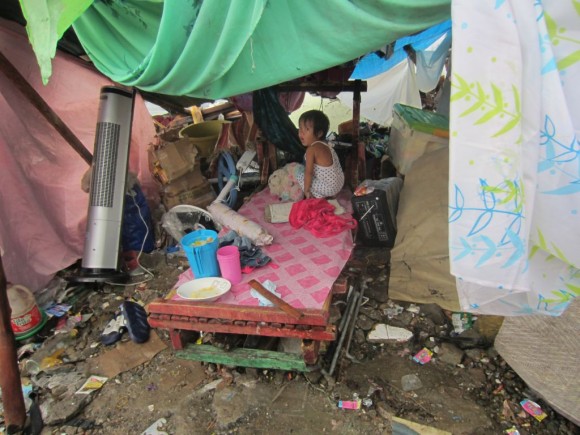
At this point, words have to fail me again. I thought in my roaming around Tacloban I had seen the destructive power of the typhoon. However, nothing I had seen compared to what had happened around the market and this shantytown. This area had been totally devastated. My jaw literally dropped when I saw what had happened. My mouth actually opened, and it hung open as I walked around. I tried to close it, but I found it difficult to do so. Then it would open again. The scene simply got worse and worse the farther I went. It was a nightmare scene. My usual route into this neighbourhood was impassable. It’s strange that this experience has even brought new meaning to words that I thought I already knew. The word “impassable” is a common one for me. And I thought I knew what it meant. Most of the time, I didn’t think it really meant impassable. On other bike trips I’ve taken over the years, I’ve dealt with many seemingly impassable roads. I could just lift my bike over the rocks or the river and carry on. But this typhoon has shown me the true depths of a word like impassable. That road that led around the shantytown – the one that I had cycled on when I arrived in Tacloban – was buried beneath twenty feet of what used to be the city. Nothing could get through that. I stared at it blankly until a young woman came up to talk to me and see what I was about. She had been here during the typhoon and by a sort of miracle, her two-story house was still standing and somewhat intact behind her. It had been sheltered by a concrete structure in the market and survived the wind. I called it a miracle house. I could hardly believe that it still stood there. This woman told me about how they had all had to climb up onto the roof and ride out the storm there. I looked at that exposed roofline and marvelled at what she must have gone through. My difficulties simply pale in comparison to everyone else I meet here. I was also extremely surprised at how neat and clean and presentable and groomed this woman was. I had actually made this observation about a lot of people. I never seem to be able to stay clean ever. Even in a clean house, I manage to get dirty somehow. In a typhoon, forget about it. I was a bedraggled mess. But I kept seeing people living amongst the debris and garbage and their clothes would be neat and clean. I have no idea how they managed it.
This woman told me that it was possible to go into the shantytown, but I’d have to go right along the water’s edge. I went in that direction and first came across large groups of people and families taking shelter in a series of what used to be concrete market stalls. They had rigged up whatever shelter they could with old tarps and sheets of tin and scavenged lumber. People were washing clothes and cooking over open fires and doing other domestic things. I even saw a couple of pigs (live ones!) tied up and snorting happily as pigs do. My brain rebelled somewhat at this scene and at the unbelievable scene to come. On its surface, it was a nightmare. But on the faces of the people were smiles. There was laughter. Children were playing games. People called out, “Hey, Joe!” as usual and asked me if I was married and where I was going. It was a bizarre experience. I can conjure up images I’d seen on TV and in books of all the big refugee crises in the world, and the people are always grim and in despair. Here was the worst thing I had ever seen in my life, and people were laughing and joking and smiling. They talked about how bad things were. They used the words and talked about how they were hungry and had no water and how their houses had been completely destroyed. They expressed a litany of terrible problems and dangers. Yet, it was all done with a smile, and I would leave them with the impression that I’d just had a pleasant chat about the weather.
The shantytown itself was, quite simply, gone. The destruction here had been total and breathtaking. I had my little Canon point-and-shoot camera with me and I took pictures of everything I saw, but I wonder if they could even begin to capture the reality. I can’t even describe it. Only one or two more solid concrete structures remained – poking out of the rubble like medieval castles. Everything else was simply a vast field of junk – what used to be a thriving community. The only way into this area was to walk along the narrow top of a cement seawall. I wondered from time to time if I was being wise. I had all of my money and ID and valuables in the bag over my back. I was completely alone and I stood out like a lighthouse on a dark night. I just didn’t know if it was dangerous to go where I was going. But I was determined to make it all the way through and to the ships.
I got the impression that there had been many dead bodies here – many more than were on the other side of Tacloban that I had seen. If that’s the case, then someone must have come and removed them. I saw only two or three human bodies and larger numbers of pigs and dogs.
I was astonished to find lots of people steadily building little shelters. After some thought, though, I realized that this made perfect sense. When I looked at this area, my instinct was to flee, to go away, to find someplace better. But these people have nowhere else to go. This is where their home used to be – their little shack – and they were going about the business of hammering together a new shack. It seemed insane, but it was really the only sane thing they could do. They had nowhere else to go, and if they wanted shelter from the rain, they would have to grab some of the wood lying around and start hammering things together. Some people had already rebuilt a few small latrine platforms out over the water. These were all occupied as I walked past, people being sick into the ocean water below. I saw lots of children crouched naked elsewhere, hanging their butts out over what perch they could find – diarrhoea pouring out of them into the water. I could feel the health disaster developing.
Last night while lying in bed and trying to get to sleep, I tried to put together my thoughts about what I had seen. I kept coming back to one idea. The reality of this scene was of thousands of homes destroyed. But the crazy thing is that this had been a shantytown to begin with. If there were a similar disaster in Canada and people ended up living in emergency shelters like what the shantytown had been, it would be considered a disgrace. The shantytown itself wouldn’t even be acceptable in Canada as refugee and emergency shelter. And this is BEFORE the typhoon. It was that bad to begin with. So one can look at this destroyed area and think it is a tragedy. But the real tragedy was even before the typhoon. In a way, this destruction was inevitable. All the shacks had been of the flimsiest construction imaginable. And they were built right on the shore. It was only a matter of time before a typhoon came and destroyed it. It was inevitable that it would happen sooner or later. These people had essentially been living in the bulls eye of a target – dead center for the projectile to come and wipe it out.
Anyway, the images from that place are coming too fast for me to process them. I can’t even think straight. Eventually, after much adventure, I got to where the ships were. It was the most astonishing thing I had ever seen. These were huge ships – four of them. I can’t even imagine the power of the wind and water that had blown them up there and deposited them high on the hill. Imagine these poor people living there. The massive winds of the typhoon had torn their homes to pieces. Then the ocean had risen up with terrible power and consumed it all. You’d think that would be enough, but then a series of huge cargo ships appear and crash through, smashing everything to bits. What would a person think who had just seen his little wooden shack torn apart by wind, drowned in a flood, and then crushed by thousands of tons of steel in the form of a cargo ship? He must wonder what in the world he had done to deserve all that. It was just crazy. At one point, I had to step over the huge anchor chain leading up to one of the ships. Just offshore, I could see the anchor. It had been dragged there as the ship went inland. I took a picture along the length of the chain with the ship in the distance.
To my surprise, I ran into a Filipino TV crew. They asked me if they could interview me, and I surprised myself by saying yes. I’ve never had a good experience when a TV camera was pointed at me or a reporter talked to me. However, I said yes, and I found myself staring into the massive lens of the camera positioned just a few inches from my face. The guy holding the camera was the one asking the questions, and I had no idea where to look. I tried to tell my story, but the reporter had other ideas and he fed me a bunch of questions with the obvious answers he was looking for. He asked things like, “What do you think of the resiliency of the Filipino people?” Of course, I had to say complimentary things about the Filipino people. He asked a whole series of leading questions like that, and I must have ended up sounding like a babbling fool.
I passed a lot of people scavenging in the ruins of their neighborhood – in the debris and down in the water and mud. One woman had collected a whole bunch of food tins. The labels had been torn off, so she had no idea what was inside any of them. She was selling them and people would take them home and just hope that they contained something tasty and edible. I saw people opening these cans and finding everything from pork and beans to fruit cocktail. A woman had collected enough fruit cocktail cans to fill an entire pitcher from which she was feeding her five children.
At another spot, a young boy had lifted an intact bottle of Coca Cola out of the mud with a cry of triumph. His cry brought lots of other people and they all jumped into the mud up to their knees and started feeling around in the murk to find more bottles. They came up with more bottles of Coca Cola and some Sparkle. They saw me watching them, and they all smiled and laughed and cried out “One shot! One shot!”, holding up their finds like treasures to be admired.
It was difficult at times to tell the difference between a pile of actual rubble and some rubble that had been put together to form a makeshift shelter from the rain. The lucky people had relatives in Tacloban with intact buildings, and they could stay with them. The unlucky ones had to make do with whatever shelter they could cobble together. I spotted some families living inside brand new yellow tents. I asked them where the tents had come from, wondering which NGO had supplied them. They laughed and said that they had looted them from Gaisano.
I tried to return to the harbor area by walking along the debris field that now covered the main street, but I soon gave that up as too dangerous. It was very slow, and one false step could result in a broken ankle or plunging through the debris into empty spaces below and cutting your leg badly. Instead, I slowly made my way back down past the ships to the shoreline and walked along the broken cement wall. All the people moving in and out of this area had to use this wall as well, and we had to step aside to let each other pass. I kept worrying that I was going to be nudged accidentally and sent down into the filthy water – along with my camera.
I picked up my fully charged batteries at the navy ship and left them with two more, saying that I would return later to get them. Back at the pension house, I found it completely empty and deserted. Jeff and Rene had left as had the young man who had been working on the gas stove. It was one of the stranger moments of my life – standing there in the courtyard of that empty and half-destroyed hotel. How in the world had I ended up sole occupant of this place? I felt like Will Smith in “I am Legend”, the last surviving person in the world – eking out an existence in the ruins. Just without the six-pack abs and the German shepherd.
It was a strange afternoon and evening for me. I roamed around the empty hotel, going from room to room to see the destruction and what had been left behind. There was much more damage than I realized. And it was weird damage – almost as if the place had been vandalized. And there was food left to rot everywhere. No one who had occupied these rooms temporarily in the last days had cleaned up after themselves. A terrible smell was starting to develop.From time to time, a person would show up at the gates of the hotel and bang on them. They were very surprised when I opened the gate. They asked after the owners of the hotel, and I had nothing to tell them. I didn’t know where they were or when they would be back. I explained that I was the only one here.
My cell phone was now charged and by climbing up onto the third floor and holding my hand as high as I could, I got one tiny bar of reception. That was just enough, and after a few attempts, I managed to send out a text message to Joe in Taiwan and to Rob in Canada and to my brother Rick. Joe and Rob posted messages on Facebook for me saying that I was okay and had survived the typhoon.
Eventually, I had no choice but to leave the hotel to go back to the navy ship to retrieve my other batteries. I had to leave the gates unlocked behind me and the whole place was now unguarded. I could only hope that I wouldn’t return to find a crowd of looters doing wheelies on my bicycle and walking off with my tent and food and water. I pictured the Toecutter from Mad Max ripping through my possessions looking for gold and guns and bellowing with rage when he finds only underwear and water filters.
I walked quickly through the darkening streets to get to the navy ship and back again as quickly as possible. My batteries were all charged up, and I learned that the ship will be leaving on Thursday at noon and that I could come on board as early as Wednesday (today). It looked like the ship was going to be very crowded. They were estimating as many as 1,500 people trying to get out of Tacloban on that ship. If I got there early, I might be able to get an actual berth and not have to just lie down on the open deck. I was very happy when the people on the ship gave me some water and some biscuits to take away with me. They would have given me much more water, but there was no way for me to carry it.
I found the pension house as quiet and empty (and spooky) as I had left it. There wasn’t a single person anywhere in sight on my street as I opened the unlocked gate and peeked inside. I ducked through the gate and closed it silently behind me, feeling like a thousand eyes were on me even though there was no one there. For dinner, I had a can of corned beef with leftover rice. The rice was in a plastic container that Jeffery and Rene had left behind out on the veranda. I popped off the lid and gave the rice the sniff test, and it seemed fine to me. I was turning into a regular scavenger myself.
Late in the evening, I was very pleased to find that Rene and Jeffery had returned. They had spent the entire day at the airport but were unable to get out. Just getting to the airport and back was a major adventure and they had had to wait for hours in pouring rain, but they were upbeat and cheerful. I found that unbelieveable. I just told them how glad I was that they had come back.
Jeffery’s tales of the airport were very interesting. He said that it was extremely crowded as everyone from Tacloban tried desperately to get out. However, lots of foreigners were now arriving. He said that he saw lots of international media and people from NGOs. I found that to be an encouraging sign, and I started to think that rather than join the hordes trying desperately to leave, I should stay in Tacloban longer. I wanted to see the end of this story. Besides, the ship was promising to be very crowded and uncomfortable. I started to think that I should wait and take the next ship, if there was such a ship.
Tags: cell phone, Philippines Bike Trip 2013, Super Typhoon Yolanda, Tacloban, typhoon, umbrella