
MSF and Antibiotics
I DID go to the Medecins Sans Frontieres medical center yesterday, and it was a very good thing that I did. This sickness is not just a passing thing. I’ve been SOOOO sick. I’ve clearly picked up a nasty bacterial infection in my gut. What drives me crazy is not knowing where I got it from. Which dish was contaminated? At which restaurant? Which glass of water?
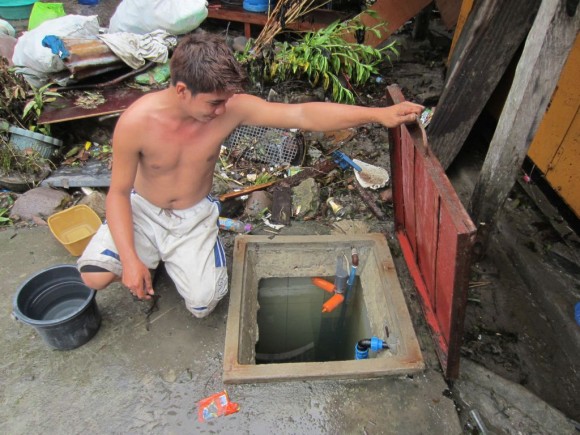
The most obvious answer is that I got sick from the water from the well in the courtyard of this pension house. If that were true, however, I’d be very annoyed. The thing is that I’ve lost count of the number of times I’ve asked Filipinos about the water supply in Tacloban, and about that well in particular. No matter how many times I ask, I never get an answer. Drives me crazy. I was told that there are two sets of water pipes in the city. One set delivers potable water. The other set does not. This raises the question of how you tell the difference. Everyone seems to know that you can drink the water from this or that water pipe sticking out of the ground, but you can’t drink the water from this other one. But how do you know which is which? Do the pipes look different? Everyone answers my question, but the answers never make any sense or really address the question.
The same is true about this well in the pension house courtyard. I’ve asked a million times whether the water is potable. And, in fact, people have told me that it is potable. The water pipe leading to the well comes from the official city supply of drinking water. But I was confused because I never saw anyone get drinking water from this well. They all got it from somewhere else – some pipe on the street. I asked everyone which pipe on the street has the drinking water, and no one has been able to answer me in any way. It’s just so weird.
Finally, I made up my mind to get drinking water from the well. The trick is to get the water directly from the pipe before it goes into the well. The first time I did this, a Filipino man helped me – the same man that helped me empty the fish ponds and clean them up. He held the pipe up so that the water came out in an arc. I collected this water into a plastic bottle and then poured it into a big water container until I had about 20 liters of water. According to all my informants, this was potable water – the same water that I drank every day at all the restaurants in town. Even so, I then treated the water with the purifying solution Waterine that I got from the Davao medical team. I was confident that this water was now safe to drink. It had to be. Yet, here I am suffering from another bacterial infection – the first I’ve had in the Philippines.
After breakfast yesterday, I returned to the pension house and then after another bout of horrific stomach cramps and squirting brown liquid into the toilet boil, I set off to the MSF medical center.
I had seen the MSF banner at the Bethany Hospital as I went past many times, and people had said that MSF was operating there. I figured going to see them was a safer bet than trying to be seen at a local hospital. I took a tricycle there and the tricycle driver drove me right up to the entrance to Bethany Hospital. It turned out that MSF was operating in a different part of the hospital – a part that we’d passed on our way. I asked the security guard where MSF was located, and he pointed off in a direction and then got someone to show me the way. This person walked me through some hospital corridors until we came to another security guard. He spoke to the security guard and apparently got permission for me to pass this way – something that usually wouldn’t be allowed.
I wasn’t entirely sure what was going on, but I passed through and I found myself standing at the entrance to a large and clean and beautiful set of tents being operating by the MSF as a field clinic. I stood in the entrance looking lost. I wasn’t sure if I could just walk in or what. Someone eventually noticed me and gestured for me to come inside. I told a young fellow that I hoped to see a doctor. This fellow was a nurse, and he was extremely friendly and helpful. He sat me down in a chair near a desk where patients were being processed. He then took my vital signs and asked me what my problem was and wrote all of this down along with my name and age and nationality on a patient chart.
A few minutes later, a doctor chatted with me (at least I think she was a doctor) and then another nurse came by. This nurse said that they didn’t have a laboratory, so they couldn’t test stool samples. However, based on what I had told them, it was pretty clear that I had a bacterial infection of some kind and that the standard treatment was a course of my old friend the antibiotic metronidazole. I was then handed a five-day course of metronidazole to be taken three times a day and was sent on my way.
The whole experience was a delight and took almost no time at all. The people were friendly and professional. The medical equipment was all brand new and shiny and clean. The tents were the nicest I’ve ever seen – bright white and spacious and high – more like being inside a nice building than inside a tent. Most of the medical personnel were Filipino, though I did see one very tall and very attractive Western woman. When I spotted her, I hoped she would be the doctor, and I’d have the pleasure of chatting with her. But she never came by.
All the other patients were either young mothers with children or the elderly. I don’t know what their medical problems were, but I did see one poor toddler with a badly infected eye – an eye that had swollen so badly that it was completely closed. It felt good to be sitting there in that clean and modern environment with all this medical stuff going on. I didn’t really want to leave, but I had my medication and it was time to go. I got to my feet with some difficulty, as the pain in my gut was very strong, and I made my way out of the tent. To my complete surprise, I found myself walking alongside a long lineup of people waiting to see the doctors at MSF. By pure chance, I had gone into the tents from the back and had, in essence, cut right to the front of the line. By rights, I should have been at the back of this very long lineup. I felt a bit embarrassed about that, but I was quite glad it had happened. With the pain in my gut, I can’t imagine waiting in that lineup for an hour or two. It would have been a miserable experience. The crazy thing is that many of the people in the lineup – mainly Filipino women with babies, toddlers, and children – thought I was part of MSF and they called out “Thank you, thank you!” to me as I walked along. Little did they know that I was just a dumb tourist, and that I had cut in line in front of them.
Despite the pain, I decided to walk pack to the pension house. I didn’t want to bother with the hassles of getting a tricycle and talking about the price and giving directions. Besides, I wanted to stop at Hayward to get a “load” for my cell phone and to buy some water. I made my way along the street as the invalid I had become – shuffling along with tiny steps and stopping frequently as waves of pain doubled me over. I wondered what people thought of me and my slow progress. I must have looked like the world’s most intense tourist – moving at a snail’s pace and grimacing horribly as I stared at things around me.
I made it to Hayward and was waved inside by Manny. I got a Smartload of 300 pesos. Then while chatting with Manny, I was hit with such a wave of pain that I had to sit down. The pain kept increasing and increasing, and I could only sit there in the chair holding still. Stomach cramps always make me stay still. I end up frozen like a statue, unable to move. I don’t even breathe. Manny asked if I wanted to lie down somewhere in his place. A wise person probably would have taken him up on that offer, but like an injured animal, I wanted to get back to my burrow at the pension house. Considering what was going on deep inside my large and small intestines, I knew that I had a series of intense dates with a toilet, and I wanted to get back to the privacy of my room.
I bought a 6.6-liter bottle of water and a 1.5-liter of Coke from Manny, and then I set off on my slow, shuffling journey. Manny was somewhat surprised that I would walk that distance while carrying so much water. From his point of view, the whole situation was not right. No self-respecting Filipino would be ill completely alone with no family gathered around to care for him. I’m rather used to being ill on my own, so it was no big deal. And I had no problem carrying the water. I wasn’t weak. I just had to go slowly and stop a lot when the waves of stomach cramps washed over me.
The rest of the day and the night passed with me lying on my bed and listening to podcasts while monitoring the activities in my intestines. At the beginning of the day, I hadn’t been 100% convinced that I had a real bacterial infection. Now all doubt was gone. I was very sick, and I was extremely glad that I had made the effort to go to MSF and get that course of anti-biotics. I definitely needed it. I could feel the various meals I’d had over Christmas – now turned to liquid – moving through my intestines. The pain was the worst when the liquid crossed my abdomen and then had to make a turn in my intestines. I’m no stranger to this kind of pain, but this was bad. I started to worry that my intestines would burst under the pressure. I’m not sure if that ever happens, but it would certainly be bad news if it did. Eventually, one of these freight trains of pain would make it through my entire intestinal tract and arrive at the exit. It was pretty obvious when this happened, and I would get up and shuffle into the bathroom and deal with it. The crazy thing is that when you are this sick, there is nothing solid in your intestines for the peristalsis to grab hold of and move along. So it takes a lot of muscular work to build up the pressure to expel the liquid. It’s all a rather exhausting and undignified affair.
I was astonished at how often I had to rush to the bathroom. It was a constant thing, and I wondered each time which meal or snack was now being expelled in liquid form. This continued all through the night and morning and shows no sign of stopping, though the pain has decreased considerably.
Common sense says that I should eat something, but when I’m this sick, I can never bring myself to eat. It is just adding fuel to the fire. I’ll end up weak and irritable from hunger, but there is no way that I am going to put anything into my digestive system that will lead to more bouts of pain like that. I will likely head out into the city at one point. I’ll wait until I have cleared my system and then go. It’s just that I need to recharge my cell phone and my iPod. It would be nice to do that without going outside, but there is no chance to do that. Manny kindly gave me his cell phone number and said that I could call him if I was in trouble and needed to go to the hospital or anything like that. What I really need is electricity, but I can hardly call him to come pick up my iPod for recharging.
A side note to this experience is that my high blood pressure hasn’t changed. I discovered in Taiwan to my intense surprise that I had high blood pressure. I feel like a guy that should have 120 over 80 blood pressure. Why not? I barely drink. I don’t smoke. I’m not overweight. My diet perhaps isn’t the greatest, but it isn’t the worst. But my blood pressure kept coming in quite high when I had readings taken in Taiwan. And yesterday when the nurse took my vitals, my blood pressure registered as 161 over 87. I don’t remember the details from my research, but 161 is quite high and is bad news. I thought that once I left Taiwan and started cycling in the Philippines that my blood pressure would drop. But I guess it doesn’t work that way. Perhaps this high blood pressure is what’s causing the weird sensation of weakness and heaviness in my legs that I get quite often. It’s time to do some Internet research, I guess.
I did say that I was very impressed with the MSF operation, and I was. However, I have to admit to feeling quite unsatisfied once again at having such a brief amount of time with the doctor. In fact, I’m not entirely sure that I even saw a doctor. The people I saw might all have been nurses. I think the doctor only looked at what was written down on the chart and then prescribed the anti-biotics. As a patient, I felt a bit uncared for. I wanted a chance to talk with the doctor and tell my story and feel confident that the diagnosis was accurate. The diagnosis was based entirely on what the nurse wrote down about what I told him. There was no further examination or discussion or questions. I feel that if I were a doctor, I’d want to find out a bit more and probe a bit. It’s like when the medical team at the BFP examined me after my accident and really did nothing at all. I always feel like patients get little attention from doctors. But there was that lineup to consider. The doctor can’t spend twenty minutes talking with me about my health. I’m sure doctors know that once you start talking with a patient, a dozen other symptoms are going to be introduced. I would have brought up the high blood pressure, the weakness and numbness in my legs, the headaches I get from even one bottle of beer, the pain in my joints, and the strange bruises that just appear at random on my hands and feet. I’m fairly confident that all of these things are related and that there is some kind of medical problem percolating away inside my body. I’ve seen doctors about individual problems, but no doctor has ever really talked with me about my health and tried to deal with me as a whole person. Most of the time, doctors can only give you a few seconds of time and want you out the door as fast as possible.
In the late afternoon yesterday, I went out into the courtyard of the pension house to join Rene and Leanne and some of the staff as they enjoyed their coffee break. Leanne (I found out that was her name yesterday) is the heavyset but youngish woman that seems to be mainly in charge at this pension house. I think she is the daughter of the tall thin man that everyone refers to as “the owner.” I’m also beginning to suspect that Rene and Leanne are married. I really don’t know. Family relationships here are bewildering.
I wasn’t aware of this, but the family that owns and runs this pension house is Chinese. It makes sense because I keep hearing that the Chinese own the majority of the businesses in town. And the Chinese community pretty much fled Tacloban at the first hint of trouble, thinking, perhaps rightly, that they would be the first target of any looting and rampaging mobs. This family at the pension house also fled from Tacloban and waited a very long time to come back.
I don’t know anything definite about it, but there seems to be a lot of tension between the Chinese and the Filipinos. It’s strange to even write that sentence because the Chinese are also Filipinos in that they are citizens of the Philippines. But this distinction between the two groups is made all the time and contains a large amount of racism going in both directions. I was speaking with the son of this family the other day – the one that owns the fancy car and the car audio shop – and he was saying that as Chinese, they work hard and save their money. The Filipinos, he said, don’t want to work. He said that they were very lazy and wanted to get everything for free. And even when they earn money, they don’t save it but just spend it on beer and tuba. He was saying all of this while surrounded by all the Filipino workers at the pension house. It’s odd, because I’ve heard from other people that Filipinos have the reputation of being very hard workers.
There is definitely tension. Even I have found that the owners and managers of this pension house speak loudly in irritating voices as they tell the Filipino workers what to do. Their attitude seems to be that the Filipinos are dumb and lazy and you have to monitor them all the time to keep them working. The odd thing is that I never see Leanne do anything. She never works herself. She simply stands around and yells at the Filipino workers while lamenting to me how lazy the Filipinos are.
I find that I am often on the side of the Filipinos. They are expected to put in extremely long hours for very low pay. It’s impossible to stay motivated and work hard when you stay at a job so long each day and end up doing a lot of make-work projects. The owners and managers here also don’t seem to trust them. No matter what they are doing, the Chinese owners stand over them and correct them constantly and tell them to do things a different way. After a while, anyone in those circumstances would lose all sense of initiative and would do nothing until told exactly what to do. What’s the point of doing something when right after you are finished, someone will come along and tell you to do it all over again but differently?
Anyway, I joined Leanne and Rene outside for their afternoon break. They were having Coke and some kind of garlic bread. I sat with them with a bottle of Gatorade. At one point, a young and very friendly man named Carlos joined us. He was friends of the family or related to the family or something.
Carlo was quite interested when he found out that I was Canadian. Many people have heard that Canada has made a special category of visa applications and pre-approved 14,000 or 20,000 typhoon victims to go to Canada on a work visa. People ask me about that all the time, and I have to tell them that I know nothing about it. Carlo had put in an application, and he was asking me about Canada. He said that his cousin lives and works in Canada and his cousin was helping him with all of this. Not surprisingly, Carlo had no idea where his cousin lived or what she did. He also had no idea what kind of work he would do in Canada. It was all about just getting any kind of work that pays better than work here.
Carlo’s family owns a lot of property in Tacloban and rented it out. Unfortunately, it was all damaged during the typhoon, and their tenants had all left. Therefore, they had no income and things were getting tight.
Carlo had a very interesting story to tell about his experiences with the typhoon. In fact, he had gone all over Leyte and Samar and seen everything in the company of a group of Japanese journalists. It took a while and a lot of questions to get the story out of him, but it appears to have come together quite by chance. Carlo was at the airport in the early days of the typhoon aftermath to see off some relatives that were hoping to take a plane to Manila. While he was there, some Japanese journalists approached him and asked if they could rent his car. One thing led to another and the Japanese came back into Tacloban with them and stayed at their house (even though their house didn’t have a roof and they were sleeping under the dining room table).
At first, I was under the impression that these were freelance journalists, but they worked for the second largest print media outfit in Japan. As such, they had resources at their disposal, and they arranged for a big shipment of water, diesel, gasoline, food, and a generator to be brought to Tacloban and stored at Carlo’s house. There were provisions for a full month, and they set off with Carlo to tour Samar and Leyte and report on the typhoon. Carlo saw everything including a Japanese hospital ship with 750-beds that apparently docked at Tanauan. I’d never even heard of this hospital ship before.
I was struck once again at the narrow perspective I’d had of the whole typhoon experience. I had no idea any of this was going on. I’ll have to go back over my typhoon journal and see exactly what happened each day to figure out how I managed to miss so much.
1:00 p.m.
The curmudgeon rears his ugly head.
My iPod ran out of juice, and I no longer have my podcasts to keep me company. I had no choice but to head out of my room and into the city to recharge things. My cell phone also needed recharging. I feel like my welcome at the fire station is close to wearing out. My initial claim on the place was based on the medical team staying here at the pension house. Then I went out with the body retrieval teams and got to know the Canadian team with the cadaver dogs and the American team of firefighters. Then my presence there was made acceptable by Amy, who was simply so friendly that she accepted everyone. Now, however, the typhoon era is ending. The BFP is going back to normal operations and Amy is in Manila. Still, it’s my best bet. I can no longer use Mark’s recharging service. I can’t use any of the public recharging places, since I can’t just stand there for hours and hours watching my gadgets recharge.
When I stepped out of my room, I found another member of the pension house owner’s family – a bubbly woman – out there with the son hooking up some kind of solar panel. It’s a 12-volt system and can be used to light some light bulbs and not much else. She kept insisting that this was very wonderful because I would now have light. I wasn’t quite sure about that since the lights would be outside and not inside my room where they would do some good. But I agreed that these were exciting times and this solar panel would make life just awesome. Actually, I resist any improvements to the pension house because every improvement takes us one step closer to the day when they will ask me to pay for my lodging.
The son has relatively good English – better than Rene’s and Leane’s – and I thought I would risk asking him about the water supply of Tacloban. I steeled myself for disappointment and then hit him with my questions. Predictably, he not only couldn’t answer my questions, he never really listened to them or tried to understand them. It was very frustrating.
It looked like it was going to rain when I left, so I made sure to bring my umbrella. Then I walked down “Fuck You Corridor” towards the fire station. I could tell I was irritable from lack of food and tried to stay calm. The worst thing that happened, though, was the usual chorus of kids screaming “Hey! Hey! Hey!” and the occasional shout of “Merry Christmas.” I appreciate the Christmas greetings, but it’s unfortunate that they are often followed up by a gale of laughter. The laughter turns it from a genuine greeting to just another Filipino joke.
My luck wasn’t with me at the fire station. I was first greeted by a group of guys lounging outside of the big cement building that was under construction and had suffered so much damage. Just trying to be friendly, I went up to them and chatted. I had pretty much only gone to the fire station to take advantage of their electricity and recharge my gadgets. However, I tried to keep up the pretense that I was there to visit and chat and just happened to have my gadgets with me. So I asked these guys about Amy – whether she was back from Manila yet or not. This set the guys off on the usual round of jokes and laughter about my being single and how Amy was single. One joker said that he was willing to act as matchmaker. Laugh, laugh, laugh. I just wanted to slap all of them, but I pretended I was enjoying the conversation, too.
Inside the fire station, things got worse. I had been hoping to just run into Gerald – my one main contact there now that Amy was gone. But I had timed things wrong, and it was lunch time. No one was around, and I finally spotted them all inside one main office. I saw that Gerald was among them, so I steeled myself and knocked on the door and went inside. I really wanted my gadgets recharged.
They kept trying to get me to join them for lunch no matter how many times I told them that I was ill and couldn’t really eat. There was lots of laughter and jokes, and I felt very awkward sitting there with my plastic bag of gadgets and electrical cords and plugs. I tried to get into the swing of things and talk in a lighthearted fashion, but it didn’t work. There wasn’t any point to my trying because no one ever listened to what I was saying anyway. Even when I was having a one-on-one conversation with a person, I noted with rising annoyance that nothing I said ever registered. They didn’t even make an attempt to hear what I was saying. I often feel like throwing crazy statements into my conversation. I could say things like, “When I was a child, I had my brain removed and replaced with a cabbage.” I’m 100% positive than no one would bat an eye. They wouldn’t have heard what I said.
The most awkward conversation was with this older man that I think is one of the bosses. He has a deep gravelly voice and carries himself like the boss. He tried to get me to eat some of the food that was laid out. Five or six people had already done so, and in his hearing I had explained over and over again that I was ill and couldn’t eat. But I guess he didn’t hear any of that. I said, once more, that I was ill, but he didn’t listen to me. He concluded out loud that it was okay that I didn’t like Filipino food. Americans don’t eat rice. Etc. I wanted to slap him.
The conversation felt awkward when he then asked me what organization I was with. I confessed that I wasn’t with any organization and was just a tourist. This made no sense to him at all because I had been to the fire station so many times and had shown such an interest in their operations. He said that he had assumed I was with the United Nations in some fashion. I felt like my cover was blown, and I tried to get some credibility by telling him about my blog and my interest in photography and relief operations. He didn’t listen to anything I said, so I don’t know what he thought of it all. All he said was something like, “So you just travel and spend money.”
People began to leave the room and soon I was just sitting there with my bag of gadgets. Gerald had disappeared, and he was the only person I felt comfortable asking to help me. Luckily, just when I left the office, he was coming down the hallway outside. I bit the bullet and asked him if he could help me with recharging some things. It might have been my imagination or just my own sense of guilt, but he seemed a bit annoyed with me. As I said, I feel like my welcome at the BFP is wearing out. I don’t fit into any category that they can understand. A normal tourist would have long since moved out of the dark pension house and into a hotel with electricity. So why was I was still wandering the streets like an electricity beggar?
I reflected on the atmosphere at the fire station as I walked away in the rain. On the one hand, I get it that people are paid very little and put in long hours, so they are entitled to relax a bit and not take the job too seriously. But I do find the eternal party atmosphere odd and even disturbing. As I’ve said many times, I think in all the happy-go-lucky lifestyle of Filipinos there is room to occasionally settle down and take things seriously. It’s one thing to be proud of one’s ability to have fun and enjoy life even in adversity, but occasionally the adult has to take over and get down to business.
I was tempted to buy crackers and other bits of food as I walked along, but I resisted. I’m going to go for another day and night of no food intake to make sure these stomach cramps come to an end as soon as possible and don’t get started again. A liquid diet is what the doctor calls for. I did stop off at a shop to buy some more Nescafe coffee packets. They cost 7 pesos each and I bought 8 of them. The man at the shop did the math and asked me for 72 pesos. I corrected him and asked, “Isn’t it 56 pesos?” He insisted it was 72. But I insisted it was 56. Then he thought it through and concluded that I was right. He said that I was very good at math. And this was coming from a shopkeeper.
I was annoyed to find the door at the pension house locked. I have no idea why they insist on locking it all the time even during the day. I end up standing out there in the street banging on the steel door until I get someone’s attention and they come down and open the door. I don’t like doing that mainly because I don’t like bothering people, but I’m also aware of staying here for free. It feels arrogant to be banging on the door to be let in while I’m not paying a thing. I had to knock several times and then Elvis finally came and opened it. He was holding a soup ladle in one hand and said that he was really busy, so he was sorry that it took so long for him to open the door. I thought this meant that he was cooking in his room. But I saw that he was sitting with a whole bunch of people – the women doing laundry – underneath the overhanging roof. All of them would have heard me banging on the door over and over again, but none of them could be bothered to get up and open the door. Joy was among them, and the curmudgeon in me rose up and recounted all the things about her as a front desk clerk that bothered me. I’m very glad that I’m not paying anyone to stay here anymore. I’d be annoyed if I were paying.
This illness and the endless rain has got me looking forward to my departure from Tacloban once more. I had been thinking that there were still more things to see and experience, but somehow watching that Typhoon Yolanda DVD has taken some of the wind out of my sails. It felt like there was something special about my experience of the typhoon. But seeing all that news coverage put it all in perspective and made me realize that there is more in the world than just this typhoon. I could stay here for months and chronicle in photographs every change that occurs in the squatter settlements, but there would be nothing new in that. The rebuilding is well underway and the future will include just more of the same until the entire area is rebuilt. I’ve seen enough, I think. Maybe one more trip out to the Anibong area and then I’ll be ready to go.
Tags: Canada, fire, MSF, Philippines Bike Trip 2013, Super Typhoon Yolanda, Tacloban, typhoon