
Day Nine – Super-Typhoon Yolanda
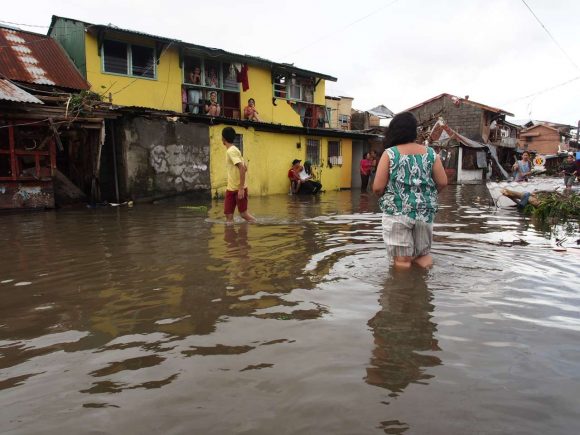
It rained again throughout the night and the morning yesterday. That kept me in and around the pension house. When the sky cleared in the early afternoon, I finally set off with my camera to explore the other side of the Tacloban shoreline and make my way up to the Astrodome.
The streets with their piles of debris and mud and trees and vehicles and furniture have become depressingly familiar. The aftermath of the typhoon has become an accepted feature of the city, it seems. I still can’t easily make my way down the three main streets. They are all blocked by piles of vehicles and junk. Little paths have been carved through them all, but two paths remain extremely muddy. The rains keep replenishing the little lakes that developed there. That leaves me with just one route I can take that keeps my feet dry and clean. That is a long route that takes me into the heart of the city and back out again. Everything I see along the way is so familiar. As a hobbyist photographer I am always looking for interesting angles and objects, and a typhoon leaves you with no lack of those, particularly if you are looking for poignant or ironic sights. One wag even put a large ‘No Parking’ sign on a car that rests on its hood right in the middle of a big intersection. A smashed piano sits just outside the church from which it came. A framed photograph of a child lies on the ground just outside a destroyed home. You could take those types of pictures all day and never run out of them.
I suppose I shouldn’t have been, but I was astonished when I reached the shoreline at Pampango and Magallanes. The destruction was difficult to take in. It was total and complete. In fact, I would say that (saving the four large cargo ships) it was worse than at the shanty town on the other side of the market. The market shantytown area (Seawall and Anibong) was built largely of wood. It was shattered by the wind and water as if it were made of toothpicks. The shantytown here was much more substantial and had many buildings of concrete and steel. Yet, this sturdier construction made no appreciable difference. The entire community had been flattened.
It appears I learned nothing from the other day’s experience, and I set out into the debris field and along the concrete walls in my flippy-floppy Teva sandals. Actually, I had no choice when it came to footwear. My only other option is a pair of light running shoes. I tried to put them on, but my injured foot is so swollen that they wouldn’t fit.
Hopefully, my pictures captured what this area truly looks like. It is impossible to describe it in words. Perhaps if you went to every lumber yard in Canada, gathered up all the wood and tin, shook it up and mixed it with millions of tons of garbage landfill and poured it onto the ground, you’d get just the smallest idea of what it looks like. Of course, you would then have to add in the corpses, which were still there in large numbers.
The presence of all the bodies surprised me greatly. I’d been hearing a great deal about the retrieval of bodies, and I’d seen it being done along the coast from the cathedral to the Leyte Park Hotel. I assumed this process had continued all the way around Tacloban, but it hadn’t been.
As soon as I arrived at the shore, some local people called out to me and started pointing out the bodies. One boy pointed at the ground right around me. I looked down and saw just a few bits and pieces of human flesh twisted up and bent and just sticking out from the pile of wood. This boy then went with me to the cement seawall and he pointed out all the other bodies there. He hardly needed to do this as the sight was so stark and shocking that it would have taken a very distracted person not to notice them. They floated in the water all over the place – almost all of them on their stomachs with their four limbs bent below them as if they were crawling on their hands and knees. All the bodies I had seen, whether in the water or land, had assumed this crouched position. I gather that the nature of the human body dictates that it bends to this shape as it stiffens and then rots.
It also appears there is no end to the stages of decomposition and these come at a frightening pace. The face of the debris fields in the city remains constant. Nothing ever moves or changes there. But these bodies change every day presenting a rainbow of different colors, shapes, and textures. These bodies had turned yellow now and their skin had formed a wax-like appearance. I don’t know what indignities their faces had undergone, as these were underwater. I remembered yesterday that I had the book “Stiff” on my Kindle, and it contains a chapter all about the stages of decomposition of the human body. I started to read it again last night to see if it conforms to what I’ve been seeing here.
Some of the concrete structures in this shantytown survived. A group of boys led me to one three-story house that had survived and guided me up to the roof. I’m sure that everything I do on these photographic outings is unwise. Certainly walking through this debris field was very dangerous. And who knows how unsteady the remaining standing buildings are? I kept thinking that just adding my weight to the roof will suddenly cause the structure to topple over. I could not, however, resist the view, and I was well rewarded for taking the risk. The view from up there was of the end of the world. Astonishing destruction as far as the eye could see. And the destruction and change wasn’t limited to the urban landscape. Tacloban is surrounded by a ring of low hills. These, too, had been transformed by the typhoon. I remember them being lush and green, covered in trees. Now they were bare and brown, all the vegetation having been torn away by the force of the wind. Off in the distance, I could make out the still-standing spire of the main cathedral. I framed a number of photographs to have that cathedral spire sitting artfully in the background.
The family that owned this house was still living there. They were sitting around the now empty main floor. In a way, it was like they had gone back to the beginning of the construction process when the first stage was to pour the concrete walls. Those concrete walls were all that remained. Everything else had been ripped out by the wind and flood – every window, door, appliance, and stick of furniture. All gone. The place had been swept totally clean as if there had never been anything there but concrete to begin with.
Beyond that point, my path forward became much more difficult. The seawall had been torn to pieces and I had to make my way inland, find a way over the debris and then go back out. I had been through this neighbourhood a few times with my camera before the typhoon, and I sort of remembered what used to be here and there around me. When I got to large gaps I had to step over, I slowed right down and became very careful, not wanting to risk another fall. I only have so many limbs, fingers, toes, and camera lenses to sacrifice to my stupidity. From a distance, I probably looked like a strange arthritic 90-year-old man creeping along. I threw “strange” into that sentence, because how else would you describe a solitary six-foot white foreigner with a camera in his hand and a pannier bag on his back walking in this place where he had no reason to be?
I came across a few groups of men huddled underneath what shade they could find and passing around a jug of tuba. They all wanted me to take their picture, and they struck the usual poses. I made the same joke each time and called them the “Typhoon Survivor Club.” This always got a big laugh. I’ve mentioned that I admire the way the Filipinos continue to smile and laugh and be cheerful through this disaster. Yet, at times, it seems a little inappropriate and out of place, like the vulgar jokes and laughter aimed at the bodies floating in the water. I wonder if Filipino society might benefit in the end with a bit of seriousness injected into it to temper the levity and zest for life.
I heard many more stories about the typhoon. One very young girl was presented to me as a true typhoon survivor. She had been washed into the sea all by herself from San Jose across the open water. She managed to keep herself afloat long enough to grab hold of a mango tree. She held on until she reached Tacloban. That short story captures nothing of what it must have been like. Reaching Tacloban would have been nothing like just coming to rest on a nice sandy beach. The storm was still raging, the flood ten- or twenty-plus feet deep and immense waves crashing down onto countless tons of floating debris and exposed steel and concrete. How she managed to make it safely is difficult to imagine.
Most of the buildings still partially standing were the concrete shells of what used to be the barangay multi-purpose halls. One of them was three stories high, and the tin roof had been ripped off to expose a steel skeleton underneath. The survivors here had climbed all the way to the roof, but the water reached them even there. They had to lash themselves to the steel trusses with rope to avoid being washed away and into the sea. Then they were stuck up there for a long time with no food or water or shelter. What a different experience to mine. I stood on my second floor verandah in relative comfort drinking hot coffee and snapping pictures. For me, the typhoon (once it was clear the flood wasn’t going to reach my room) was a big show – a spectacle. For these people it was life-and-death.
I had become accustomed to seeing the bodies floating in the water. But here, I saw large numbers of them on land in the debris field and in the remaining shells of the buildings. People said that bodies had been carried inside their houses by the flood and deposited there. Then the buildings crashed down and buried them. Some people whose houses still stood refused to go back to them because there were now rotting bodies inside them – the bodies of strangers carried through their windows and doors by the flood. It certainly adds an entirely new layer to the concept of the uninvited guest – the one that outstays his welcome.
I was told that a large number of people had died in one particular barangay multi-purpose hall. It was the only concrete building in that area, and it was thought to be the safest place to go. People left their wooden homes and crowded into this concrete structure. Unfortunately, it sat right on the water’s edge and the wind and storm surge utterly destroyed it. Concrete and steel seem exceptionally strong sitting there in unmoving air. Grab it with my muscles, and it won’t move a tiny bit. But throw the moving air and water of a syper-typhoon at it, and it bends and breaks as if it were no more than brittle plastic.
It strikes me as odd now that when the typhoon hit and my hotel was flooded, I didn’t spare much thought for the thousands of people living in the shantytowns. That isn’t because of selfishness. It was really because of a profound lack of awareness. To be kind, you would say that it was a lack of experience. I honestly did not know that such damage had occurred. I could only go by what I saw around me. The buildings in my neighbourhood were badly damaged and flooded. The street was transformed into a river ten or eleven feet deep. Being an idiot, I pictured this same situation occurring throughout Tacloban. What didn’t occur to me was that my hotel sits inland several hundred feet and the land rises to that point. For the water to be ten or eleven feet deep here, how much deeper must it have been right at the shore where the shantytowns were located? I honestly don’t know the answer, but the ocean must have risen forty feet or more. However, even if that thought had occurred to me, I still wouldn’t have understood the true situation. The water at my hotel was moving very slowly. It had come into the hotel courtyard and filled it like a water truck filling a swimming pool. The water rose steadily and swirled around, but that is all. From all accounts, it was much different at the shore and the water had struck with the sudden force of a tsunami.
My understanding of the wind was also sorely lacking. I described what the wind felt like when I went down into the flood to rescue my bicycle. In the one tiny area where some of the wind made it through a gap in the hotel wall and stairwell, it hit me with the force of a cannon. I described it to some people later on as the feeling of a having a Greyhound bus fly through the air and slam into my back. It just flattened me and pushed me down into the water as if I was as insubstantial as a dust mote. Yet, this was just a tiny bit of the strength of the wind. This pension house presented its solid concrete back to the wind and blocked nearly all of it. More than that, other buildings between us and the shore would have blunted the wind. The bit of wind that struck me managed to sneak through a narrow opening that attaches to a stairwell. If that is what I felt there, what must it have been like on the unexposed shore? I think it is one of those things that you have to experience to begin to understand it. In any event, the shantytowns had no chance at all against that wind let alone the onrushing flood.
I stood up here on my second-floor verandah completely oblivious to what had happened on the shoreline. Had I known, I would have rushed immediately to that area to see for myself, if not to offer what help I could. But it never occurred to me. Once the winds died down and the floodwater lowered to a manageable level, I made my way through the flooded streets to higher ground and to Manny’s store. There, I stocked up on water and food for myself.
In my defense, I note again that I had no understanding at all of what had happened and how powerful the typhoon had been. I knew there had been a flood and lots of damage, but the true scale of it was not known.
My sense of security and calm was added to by the mood of those around me. None of the Filipinos were reacting in any way as if there was an emergency. There was no urgency in the air at all. We entertained ourselves by gathering up items that were floating in the water in the courtyard and by watching the first stages of the looting going on in the streets. It never once occurred to me that thousands had died and that the shantytowns must have been wiped out. If I ever again experience a direct hit from a super-typhoon in a low-lying coastal city, I’ll know what to expect. The chances of that, of course, are slim.
This lack of a sense of urgency might also be explained by a built-in separation in the economic classes in the Philippines. Yesterday, for example, after my long walk through the devastated shantytown, I was astonished to climb back up to street level and find the street absolutely roaring with traffic. There was so much traffic going past, that I found it difficult to cross the street. There was a buzz of activity. A gas station had opened, and there was a long line of vehicles waiting. I think there was a rule that they would only put gas in the tanks of vehicles, not in separate containers. I say this because I saw people get gas and then immediately drain that gas out of the tank and into bottles, I assume for resale. I saw a young boy with a tub of unbroken bottles of Sparkle. I bought a bottle from him for 15 pesos – a moderate typhoon mark-up from the regular price.
All this was going on while just a couple hundred feet away, dozens upon dozens of bodies were rotting in the water and people were picking through the wreck that used to be their homes. Out of sight, out of mind. Before the typhoon, perhaps these shantytowns were largely ignored. And after the typhoon, it’s the same.
My day was not nearly over at this point. The battery in my camera was empty, and I made a point of stopping at the fire station to see if I could plug in my various chargers. They were very accommodating and I plugged in my Olympus and my Canon charger. I returned a couple of hours later to pick them up and plug in my second Olympus battery. It was very interesting to sit there and watch all the activities of the various rescue crews. A very professional-looking search and rescue team from South Korea had arrived and were setting up their tents and other equipment. They had, in particular, a wonderful lighting system that made the area much more pleasant than it otherwise would have been. The Koreans were coordinating with the BFP to perform body retrieval. Many search and rescue teams seem to have come here and found there wasn’t any rescuing to be done. Their missions have all been changed over to body retrieval.
The real action, however, was taking place over at the RTR (Remedios Trinidad Romualdez) Plaza where the Davao 911 emergency medical team had set up. It was a much bigger operation than the BFP operation and seemed to be getting bigger every day. They had arrived with many vehicles, including a bus, three dump trucks, an amphibious vehicle, two ambulances, a K-9 unit truck, a police vehicle escort, and several more. They were well-supplied and had brought all their own equipment including large generators, lighting systems, shovels, food, water, and medicine. There was a professionalism there that I hadn’t seen anywhere else in the relief effort. (Though I had seen very little of the relief effort other than the work of the BFP and the Red Cross. I have no idea who else is here and what they are doing.)
I noted, in particular, that there was a lot of activity around three or four tables covered in medical supplies. I stood there for some time to try to understand what was happening. It appeared that people were being seen by doctors at one location and then were provided with a written prescription. They then took this prescription over to the tables, and staff and volunteers filled the prescriptions and gave them instructions on how to take the medicine.
I struck up a conversation with one of the main doctors there. His name was Dr. Bong, and he was very well-spoken and seemed very much in control and in his element. He told me about how the system worked, and he said that the biggest problems they were encountering were respiratory problems and diarrhea. For that, they were distributing antibiotics. They were also supplying tetanus shots. From the beginning, they had been quite clear about their mission. It was to retrieve bodies and provide medical assistance. They were not there to provide food and water. I was extremely impressed with the operation. It felt much closer to what I expected a true relief effort to look like – in particular that they had shown up with their own supplies. They understood that there was nothing in Tacloban. For them to be effective in providing help, they had to bring all their own food and water and supplies and shelter and power. If not, they would just be extra bodies needing to be taken care of in a place that didn’t have enough to take care of the people already there.
Dr. Bong heard a bit about my story – particularly that I had been out there wading through the flood water immediately after the typhoon and had since fallen and suffered many open wounds. He suggested strongly that I get a tetanus booster shot and that I continue treatment with doxycycline for a full four weeks (one pill per week after the initial larger dose) to prevent leptospirosis. A nurse was detailed to give me the tetanus shot, and he also gave me a bottle of water purifier called Waterine. I was very glad to receive that.
While talking to Dr. Bong, we were joined by a westerner and I spent some time chatting with him. His name was Darrel. A bit later, we were joined by a second Westerner, a woman named Sandy. The two of them were both from Davao and had volunteered to come up with the relief effort and help out.
It was extremely interesting to speak with them, and I found out how this Davao relief effort came to be. I had been wondering about that ever since I saw them begin to get set up. Why was there such a team from Davao? Why from there in particular? Why not from some other city or some other province or region? They told me that this was all because of their rather strong-willed and straight-talking and straight-acting mayor. The mayor had seen the situation in Tacloban on TV and decided right away that Davao should send a relief team.
Everything about this relief team seemed different. It was just better-organized and better-supplied and seemed more purposeful than anything I’d seen anywhere in the Philippines. It looked, in essence, like something that had come from another, much richer, country. Sandy and Darrell confirmed that Davao was in fact quite a different place – more developed than other places in the Philippines. Talking to them has made me interested in going there to see the place for myself.
1:00 p.m.
I went down to the park to see the Davao team off. Everyone was busy packing up and I had a chance to sit and talk for a long time with Darrel and Sandy. Through our chat and through a name card they gave me, I learned that they were in fact mother and son and were missionaries. On top of that, Darrel had a type of natural history bone museum in Davao.
I was surprised that the Davao team was leaving. It felt too early. Darrel and Sandy had arrived only on Friday and had had only one day – Saturday – to work. Now they were leaving. That seemed rather silly considering that it took them 24 hours to get here by bus. The rumour about this is more than a little disturbing. According to the rumour, the mayor of Tacloban or other government officials made it clear that they didn’t want the bodies cleared quickly. They wanted them to remain where they were so as to garner more international sympathy and keep the aid flowing. The mayor of Davao disagreed with this profoundly and decided that rather than be part of such an unethical farce, he was going to pull his team out and let the MMDA (Metro Manila Development Authority) take over. It’s hard to say whether this act should be called noble or self-serving. His team was here and working. If he really had the interests of the people at heart, he would let them stay and continue. Pulling them out because of politics is not such a great move, even if it is based on principle.
I was also surprised that so little effort seemed to be being made to identify the bodies. It looked like they were simply being dumped into mass graves and covered up. Darrel and Sandy’s team found bodies with cell phones and wallets. Rather than use them to identify the bodies, they were buried with them. The reason for this was that there was expected to be a second budget available for body identification. When that money became available, they would dig up the bodies and try to identify them. Doing it this way maximized the amount of money that would be provided. If these stories are true, they are both indicative of a very sad and unfortunate situation.
A doctor in the Davao team gave my toe another examination and he recommended that I complete a course of anti-biotics. He particularly encouraged it when I told him that a fair amount of pus had been coming out of the wound this morning. They had given the bulk of their supplies over to city hall already, but they rummaged through a bag in an ambulance and found antibiotics for me. They are apparently very powerful and expensive ones with two anti-biotics combined into one. He called them a type of medical bunker buster. I take one of these twice a day for five days. Hopefully, that will prevent any sort of infection from taking hold.
I stayed at RTR plaza until all the trucks had been loaded up and they drove off back to Davao. I was sad to see Darrel and Sandy go. They were both wonderful people and spending time with people from my own cultural background was very refreshing. It’s nice to speak with the full knowledge that you are being listened to and understood. I speak with the various Filipinos here, but I rarely feel that any communication has taken place. My words get through, but not the meaning.
The park felt empty and desolate once this large team with all their vehicles had left. Indeed, Tacloban itself felt empty and desolate. This Davao team gave off a strong atmosphere of a group of people working together for a common goal. They had team spirit and energy. Without them, Tacloban feels like people sort of just sitting around and waiting for something to happen. Perhaps there is a center of purposeful activity somewhere, but I don’t know where it might be.
In addition to the antibiotics, I was given three more bottles of water, a lunch of rice and chicken, a bag of candy, some iodine, and even a bag of Fisherman’s Friends. The doctor who gave the Fisherman’s Friends to me had no idea he was giving me my second favourite treat in all the world – second only to salted licorice.
It has, unfortunately, been raining all morning, and it came pouring down hard when I left from RTR plaza. Luckily, I had had the foresight to bring my big red and white umbrella. With this rain, I don’t see any big photographic walkabouts today.
Tags: barangay, BFP, Philippines Bike Trip 2013, Reaching Tacloban, Super Typhoon Yolanda, Tacloban, typhoon