
Day Four – Super Typhoon Yolanda
As if a super-typhoon and storm surge weren’t enough, a low-pressure system has moved into the Tacloban area, bringing with it more rain. I was woken up early this morning to the unwelcome sound of rain drumming against my windows and, of course, pouring through the cracks and flooding the room. Being an idiot, I had put the second mattress on the floor with many of my belongings on top of it. I did this when I used the heavy bed frame to barricade myself in my room (to protect myself from the real or imaginary roving bands of looters). Now I had to leap to action and wrestle that bed frame back into its place and get the mattress on top of it before everything got soaked again. It wasn’t easy to do, and I ended up sweating heavily and getting all banged up. Not the best way to wake up. Of course, all things are relative, and I have tremendous sympathy for all the people that are out there in the open without the benefit of this roof that I have over my head. An early-morning struggle with a bit of water coming in through the windows is nothing compared to being out there in the mud. Yesterday, the sun was out and the ground began to dry a little bit. Now everything will be muddy, making life much more unpleasant once more. It’s astonishing how big a difference being wet versus dry can make.
My brain is still in something of a whirl, and I don’t have much hope of being any more coherent this morning. Maybe I’ll start with just waking up yesterday morning and see where that takes me – assuming I can even remember that far back. A lot has happened each of these post-typhoon days, and it’s hard to keep up.
I cooked up some Campbell’s Soup (Cream of Mushroom) and dumped in a tin of something called “Potter Meat.” Once the meat was in the soup, I couldn’t even see it, but I assume that protein made it into my system. I was annoyed to find that my digestive system had finally rebelled against the sudden change in my diet, and I was sick. That can make things difficult.
After my soup breakfast, I set out into the city to try to get on the Internet at City Hall. I still haven’t been able to contact the outside world and let anyone know that I’m all right. The main street near my hotel was still a total mess. I can’t help but contrast the situation with what would happen in Taiwan or in Canada. I remember that in Taiwan, the very morning after a typhoon, I would go outside to find crews hard at work fixing downed power lines and other things. Certainly, three days afterward, heavy machinery would be at work clearing roads. But here, nothing like that has occurred. The roads are just as impassable now as they were the day of the typhoon. Ordinary people don’t have the tools necessary to shift all the heavy vehicles and trees blocking the streets. I can’t even guess how long it will take for the roads to be cleared – if they ever will be. Estimates I’ve heard for the power being restored have been revised upwards to around six months now. The situation, rather than improving, continues to deteriorate. I had assumed that in two or three days, stores would begin to open and what stock they held would be sold. The reality is that nothing is being opened. And anyone with the means to leave the city is doing so and going elsewhere. The city feels like it is being abandoned and left to its fate. The family that owns this hotel, for example, just picked up and left. I find that so difficult to understand. Wouldn’t they want to stay and protect their hotel and do what they can to prevent any further damage? I was also surprised when they left without contacting me in any way. They did not tell me they were leaving or check in with me at all. I didn’t even know they had left until people on the street told me so. On the bright side, I guess that means they won’t try to charge me for staying here these past couple of nights. I had been wondering about that. I think it would have been in very poor taste of them to try to charge me, but who knows? I pictured myself agreeing to pay them but at a reduced rate. What is the going rate for staying in a semi-derelict, flooded building with no services at all and having to barricade yourself in with your own bed for protection from escaped prisoners looting the city?
I made my way down the main street and up, over, and through the big pile of vehicles and trees. A regular pathway had formed along one side that didn’t involve climbing over the actual vehicles. You just had to climb over the trees. It was a very narrow path and still extremely muddy. I had no choice but to step once more into gooey, ankle deep muck. I can’t even imagine what nasty things are percolating in that muck by now. With my petty brain, I couldn’t help but notice how the Filipinos still fought their way through this narrow path. There was only room for one person at a time. I would step to the side to let people past, but then people behind me would surge forward and take up the space I’d vacated causing a bottleneck. People just pushed and shoved their way through. Their instinct when a path narrows seems to be to speed up and get physical while mine is to slow down and make room for others.
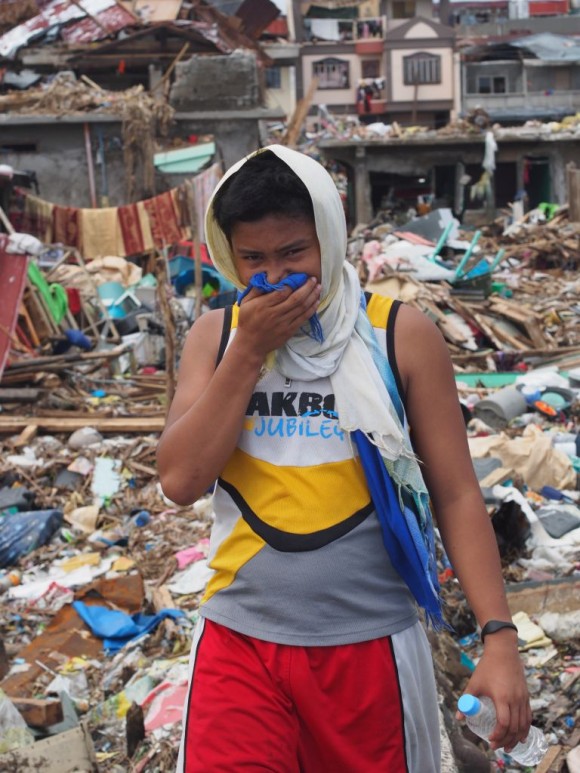
The biggest change in the city was noticeable the second I stepped outside – the smell. The bodies of all the dead people and animals still hadn’t been moved, and they were rotting in earnest now and the smell was very strong everywhere I went. People were wearing face masks now or had wrapped shirts around their mouths. This smell was also a new experience for me. At times, it was overpowering, and I couldn’t make myself breathe. Normally, when there is a bad smell, you stop breathing through your nose and then breathe through your mouth. I opened my mouth to breathe that way and then found that my brain and body wouldn’t cooperate. The smell was so foul that my lungs wanted nothing to do with the air whether it came in through my nose or my mouth. People I talked to were now discussing epidemics and such things. Honestly, that thought hadn’t even occurred to me. It shows once again how much of an idiot and a babe in the woods I am. I keep expecting the situation to improve, and I don’t even realize that there are more and more ways that the situation can and probably will deteriorate. And it makes sense. Every disaster story I’ve seen in the news over the years eventually gets around to things like cholera epidemics and dysentery. These are all very good reasons for people to leave as soon as possible. I have made no serious attempt to leave because I keep thinking I will just ride my bike out once the roads seem a bit safer. But with everything going on, perhaps it would have been better to avail myself of this mythical C-130 that appears to be ferrying emergency cases to Cebu. When I first heard about this C-130, I imagined it was a myth. But I have seen it fly overhead many times and lots of people have told me that I should go to the airport and try to get on board. They say that as a foreigner, I could surely get on. That is probably true, but I don’t know that they would also accept my bicycle and all of its luggage. It’s not something that I am going to willingly leave behind. Late last night, actually, I heard about another option – this one a very intriguing one. I was told that there is an American naval ship in the harbour, and it will be evacuating people to Cebu on Friday. I was encouraged to go to the harbour and put my name down. I’m thinking seriously about this now as many more stories are starting to come in about the destruction all over Leyte. Cycling away from this place might not be possible after all. I’m also worried about my poor bicycle. It is more damaged than I initially realized. I saw this morning that my rear view mirror was smashed. The headset is getting stiffer and stiffer. I imagine seawater is in there rusting everything up. My pedals are also seizing up, and I have no idea what is going on inside the hubs and bottom bracket. I can easily see getting just a few kilometres outside of Tacloban (assuming I can make it that far) and finding that my wheels grind to a halt. While moving the bike this morning to deal with the new flood of water, I noticed that the valves of my inner tubes were rusting up. I unscrewed the plastic cover on the rear wheel’s inner tube, and there was a sudden rush of air out around the valve. The rear tire just went flat. It was very strange. It wasn’t flat before. It was holding its air. But when I wiggled the valve stem, it broke some kind of seal and the air just rushed out. I haven’t had time to see if this is just a simple puncture or something more serious. I’m unhappy about this, because I have a new tire on the rear wheel and this tire was nearly impossible to get on. I think it will be impossible to get it off. With all these things piling up, the thought of getting evacuated by plane or ship is starting to sound appealing. It’s one thing to have the adventure of cycling out of here. It is quite another to do so at the risk of life and limb, and it is impossible to really ascertain what is going on out there in the rest of Leyte. It might be better to just get to Cebu as soon as possible and have my bike overhauled there. I’m such an idiot. I could have avoided all of this trouble if I’d only taken my bike inside as the typhoon approached. But I wasn’t expecting ten feet of seawater to flood into my hotel. That poor bike just hasn’t been treated very well on this trip.
There have been other changes that have made think seriously of getting evacuated. I’ve already mentioned that no stores are opening and probably never will open. That means the water I have in my cupboard over there is the only water that I’m going to get. I have a water filter, but I don’t think it would be wise to drink any of the local water whether filtered or not. Before the typhoon, there was a clear distinction between pumps that produced drinkable water and those that produced bad water good only for laundry and showering. It’s unlikely that any pump is producing remotely drinkable water now. As I walked around the city, I saw many people getting water at various pumps. I asked all of them if the water was drinkable, and they all said no. It was only for washing. That makes me wonder where the local people are getting their drinking water. I have a few liters of mineral water, but I was lucky to get that.
The bigger problem appears to be that the last remaining member of the hotel staff – the friendly and helpful Jeffery – is leaving. That means there would be no one here except me. And that means that I wouldn’t be able to leave the hotel grounds. I would have no way of locking the gate behind me. Seeing an open door, passersby would certainly poke their head in to look around and seeing an apparently abandoned hotel, the looting would almost certainly begin. It wouldn’t take them long to find room 17 and my possessions inside it. If Jeffery leaves, I would have to leave also.
Another problem is that the well in the courtyard appears to be running dry. I don’t really understand how that well operates. I thought it produced groundwater, but there is also a small pipe at the top with a floating valve assembly. This water appears to be coming from a pipe supply. But yesterday, I noticed that the valve assembly was gone and the water wasn’t flowing anymore. I asked about it, but I didn’t get any answers that I understood. But it looks like the well is going to run dry. That would leave no water for flushing the toilet. It’s one thing to stick it out and wait for better conditions, but the city appears to be coming down around my ears.
I did notice some positive changes in Tacloban. I spotted armed soldiers here and there, so some security is beginning to arrive. I never see them patrolling the streets or anything like that, but at least there are some around. And as I made my way over to City Hall, battling the horrific smell coming from the beach area, I saw that some people were now collecting the bodies. There was quite a large pile in evidence and I saw men heading to the shoreline with a number of body bags. So some attempt is being made to finally deal with the problem. I had heard that the mayor and local medical officials were arguing about this. The mayor wanted the bodies identified, but the medical community wanted the bodies in the ground as fast as possible. I think the medical community has to be right. So much time has passed that I don’t imagine many of the bodies would be recognizable anymore anyway.
At City Hall, I was disappointed to find that there was a huge crowd of people waiting to use the two or three computer terminals there. It would take hours and hours of waiting in line to get to use a computer, and I couldn’t wait that long, especially with my sick stomach.
I left City Hall and made my way along the coast road toward the Leyte Park Hotel. As I walked, I spotted all the same bodies in the exact same spots. There was one pair that stood out. There was the bloated body of a man lying on his back on some cement. Beside him was a small plastic container. A little baby was inside the container with its feet sticking up into the air. That baby had been there on the day of the typhoon. Four days later, it was still there.
I went to the main entrance of the Leyte Park Hotel and climbed up to the lobby area. It was a completely different scene up there compared to the rest of the city. I was looking for information about the roads leading out of Leyte, and I approached the front desk. While there, another man started talking to me. He turned out to be one of the managers of the hotel and he offered me a free room at the hotel. He said it was a small room and like everywhere, there was no electricity and no water. He went so far as to say that they could offer no clean sheets or even food. But it would be safer for me to stay at Leyte Park Hotel than where I was. The offer was enticing, but I found it hard to believe. My experience in the Philippines has been that people will sometimes talk a lot about something and then it turns out to be not true or impossible. I did not want to pack up all of my stuff and move it all over to the Leyte Park Hotel and then find out there was no room. I had to make sure of this room before I made the move. So I told the guy that, yes, I would love to have a room there. Thank you very much. Then I asked to see the room so that I could make arrangements. That’s when things fell apart. He said he had to go, and he handed me over to the man at the front desk. Apparently, the guy with the keys to the room was not there and I would have to wait. I said I didn’t mind waiting. I waited a long time, and then the guy at the front desk disappeared. He told me to wait, so I waited. Half an hour later, he came back and not surprisingly, he said that there was no room. Sorry. I don’t know what changed between the offer and now. Perhaps nothing. My guess is that the room never existed at all. The managers just wanted to be nice and talked about it even though it didn’t exist. It’s like how people constantly told me there were boats available for trips to here and there, but then when I tried to close the deal, the boats always vanished. As if they never were.
The Red Cross was still up there at the hotel. I don’t know what they are doing in Tacloban to help, but it must be something. I also chatted with a man who turned out to be with Oxfam. He had arrived just recently. I told the man that I was likely to be in Tacloban for a couple more days, maybe longer, and I would be happy to help with anything and act as a volunteer for Oxfam. Unfortunately, there was nothing for me to do. This man was something of an advance team, and he was there to just assess the situation and then set things in motion. There was nothing for volunteers to do as yet. His language actually had a familiar – and somewhat unpleasant – ring to it. It brought me back to my university days when I was studying International Development and everyone talked about “action plans” and “committee reports” and “assessment reviews” and a thousand other buzzwords. He and two or three Filipinos eventually got to their feet and walked down out of the hotel and into Tacloban. He said that they were going to investigate and talk to people and see what they needed. I had to laugh inwardly at this. It wasn’t a great mystery what people needed. But that is how NGOs work, I guess. Things go slowly. Local people are somewhat cynical about all this. I heard people chatting about reports about relief efforts. Someone said they’d heard that so many tons of aid had come from this country and so many tons of aid had come from that country. But then they spread their hands wide and looked around and wondered where all this aid was. No one had seen any of these mysterious tons of aid. I have walked all over Tacloban for days now and talked to hundreds of people and not a single person anywhere has received any kind of aid from anyone. So where were all these tons of food aid and other items?
The Oxfam people were walking in the same direction I had to follow to get back to my hotel, so I walked with them. I kept up a stream of chatter, but it didn’t seem to make much impression. No one was particularly interested in my take on the typhoon even though I had been here when it happened and experienced it firsthand and had been all over Tacloban in the days since. I guess they had seen it all before. They were old hands. The man kept saying things like how they had just completed a major campaign in this place or that place. He was thinking more about the inner workings of the world of NGOs than the situation right in front of him. There was no sense of urgency at all. I wonder if NGO work is always like that. But I shouldn’t be critical. It takes time for things to happen. It is one thing to want to “help”, but it is quite another to put that help into concrete form. I have felt the urge to help throughout the previous days, but what is there to be done? It is all I can do to get food and water for myself. I can’t exactly march around the streets handing out rice and cooking stoves. I don’t have either. And if you are outside this situation – back in Canada, for example – and you want to help, well, what can you do? It’s not an easy matter to transport clean water and rice around the world to here.
Some media had also arrived at the Leyte Park Hotel. I saw a man with five massive cameras strung all around his body. He had “Reuters” emblazoned on every camera. Another pair of men walked past with a big video camera and a trolley loaded down with tripods and other gear. I couldn’t help but feel that these guys were a little late to the party. The typhoon had been days ago. It occurs to me now that I could have offered to show them some of the video and pictures I had shot during the typhoon. I remember not long ago seeing a television documentary about a guy who made his living by filming typhoons. It took tremendous effort for him to figure out where a typhoon was going to hit and then get there in time to film it. Flights are usually cancelled, airports closed, etc. And then there will be roadblocks, and he won’t be allowed near the disaster area by soldiers and police. Then even if he manages to get any footage, he has to somehow transmit it somewhere. If he is the first to produce video like that, he can make some money. But he has to be first, and that isn’t easy. He has to have his own power source and satellite gear to upload stuff. He can’t count on there being power and Internet wherever he lands. I can understand that. I was here right during the typhoon, and even if I were a journalist covering it, I would have been helpless. There was no way to contact the outside world.
Also as I walked along the coast road to the Leyte Park Hotel, I came across a small group of young boys. They were lounging on a fence and watching the world go by. They saw me and they shouted out the ubiquitous Philippines tourism slogan: “It’s more fun in the Philippines!” Who knew that street urchins had that kind of sense of humor?
Getting back to the NGO idea for a minute, it strikes me that NGO personnel don’t have the freedom to take the risks that an individual like me has. Long ago when I was in Guinea, I had conversations about this with NGO workers. They couldn’t just show up in Conakry and stay in a typical local hotel. For insurance purposes, they had to stay in the best hotels possible so that they had security. The same thing here. The story – the thing that is happening here in Tacloban – is down here in the streets all around me. But all the foreigners that have come to report on it and help, automatically end up at the one luxury resort in the city – high up on a hill with a beautiful view of the ocean – far away from the reality. And that can’t help but have an impact on your attitude. When I went up to the Leyte Park Hotel, I had passed, once more, all those dead bodies rotting away, all the people scavenging among them, the homeless people trying to build a shelter from the rubble. So when I got to the hotel, I was in a fairly grim mood. And the mood of the NGO workers seemed inappropriate. They were lounging around and joking and laughing amongst themselves, just waiting for this or that bureaucratic detail to be dealt with, gathering up clipboards and pens before heading out into the city to see “what people need.”
I don’t know why I’m so upset about that. It just rubbed me the wrong way. The one group of people that have impressed me are the Mormons. On the very day of the typhoon, I saw them out in force wearing bright yellow vests and getting their hands dirty. I saw an entire truckload of them up at City Hall on their way out into the city to get to work. I don’t know what they were doing, but they were clearly active and getting things done. They were on the frontlines instantly and very visible. I saw lots of people from other NGOs, but they were all up at the Leyte Park Hotel.
More news. It’s eight o’clock in the morning now. The rain is getting much stronger. I went outside and got the news that this was classified as another typhoon – a Signal One, in local terms. This downpour is not something that the city or the people or, indeed, the entire region needs. I was also told that we were now under quarantine – which means that no one is allowed to leave the city. I don’t know if that is true, but it isn’t good news.
I guess all the guys that were going to leave this hotel – the last remaining staff member and some of his friends – now have to stay. They had plans to leave Tacloban and make their way back to their families in towns far away. But with this rain, I think they have to stay put. I also found a new tenant at the hotel – an injured fireman named Gerald. Gerald had been staying at a barangay hall with his family. He said it was very bad there. Very crowded. He knows the owner of this hotel, and he got permission to come here and bring his family. So I guess they will be moving into one of the empty rooms. That’s good news for me as it will mean some security, and I will be able to go out into the city.
Gerald’s arrival makes me think of another aspect to this whole disaster. I could be very wrong about this, but there seems to be a certain lack of a community feeling. Witness the owners of this hotel simply vanishing without even bothering to check with their sole remaining foreign guest. And this hotel may be nearly a ruin, but the empty rooms are still a thousand times better than being out on the streets. I have this very large room all to myself with two large, comfortable, dry beds. While walking around over the last couple of days, it occurred to me that I could offer some desperate people shelter. But this isn’t my hotel, and I can’t really do that. Is it reasonable, however, to imagine that the owners of this hotel could have done so? There are perhaps twenty empty rooms here. A hundred people could easily be given shelter. If this were a disaster movie, I can imagine a scene where local people all pitch in together to provide what shelter and food and water they can to others. These movies always have selfless doctors and nurses moving from bed to bed and ministering to the sick. Perhaps there are scenes like that in the city. I don’t know. And the Leyte Park Hotel is doing what it can – giving free rooms to its employees and their families.
Anyway, I don’t really know what I’m talking about. There is just this sense that overall, people are looking out for themselves and no one else. Those who could afford it and had a place to go have all left the city. Those that remain have all they can handle just taking care of themselves and their immediate family. This hotel is a good image of this idea. There are twenty empty rooms that could offer shelter to those whose homes were destroyed. Yet, instead of doing so, the hotel gates are locked and barricaded, and we build a big bonfire to deter looters. Anyway, things seem to be going from bad to worse. I had hoped to go down to the port first thing this morning and see about getting on this naval ship to Cebu. To be honest, it is more the novelty and adventure of it that appeals more than anything else. My situation isn’t great, but I still don’t have the sense that I am in any danger. I don’t face any kind of real emergency. It’s true that I am a stranded tourist, but I don’t feel that way. With this heavy rain, I might have to wait before I head to the harbour.
Yesterday, I also managed to track down a local man named Dan that I had met earlier. His house is actually right across the street from my hotel. I spotted him in his yard and stopped to chat for a minute. He told me about a place that was offering free phone calls. They had a cell phone connection of some kind. I followed his directions and came to a big building with a cell phone tower. I approached a man at the gate and he said that, yes, they had a phone and people could use it to make calls. That was great news, and I asked if I could use it. He said that I could, and he went on about how lots of people used the phone to contact family and all of that. It was great, and it was wonderful. Yet, like the boats, the room at the Leyte Park Hotel, and many other things, when it came right down to it, there was no phone. I finally brought our conversation around to can I use the phone right now? And he said that no, the satellite hookup was down, and I’d have to come back in an hour. He also pointed out that they had a generator hooked up to an extension cord. It was possible for people to charge up their phones and other devices for free. Could I do so? He said that I could. So I rushed back to my hotel and got my cell phone and charger and even my camera batteries and charger. But when I got back, all the outlets were being used and there were none available for me. People seem to offer a lot and talk about a lot of things, but the reality always appears to be slightly different. I end up not believing what anyone says. So I have severe doubts that this American naval evacuation ship exists. It will be interesting to find out, though.
I shouldn’t end my journal session on such a negative note. Lots and lots and lots of good things have happened. After all, even though the hotel family fled, they have allowed me to stay here. That has been a lifesaver. I can’t imagine what I would have done if they’d told me to leave. I’ve also gotten to know a family across the street. It is a woman named Liv, her husband and her son. When I saw Liv yesterday, she said that she had gotten some water, and she insisted on giving me a one-liter bottle. That was very generous of her. And the guys at this hotel cooked rice last night over a fire. When it was done, they invited me join them and I had a good meal of rice with a can of spicy chilli tuna. In fact, one man who planned to leave today insisted on giving me his leftover food. He gave me four packages of noodles and a can of tuna. He didn’t want to take it with him, and he didn’t want to just leave it behind, so he gave it to me. Finally, another man gave me a 500-peso load card for my cell phone. He had an extra one that someone had given him, and when he found out that I had no credit on my phone, he just gave it to me and he refused to let me pay for it. Incredible generosity all around.
Tags: bike, Hayian, Leyte Park Hotel, NGO, Philippines Bike Trip 2013, Super Typhoon Yolanda, super-typhoon, Tacloban