
Super-Typhoon Yolanda – My First Three Days
“Start from zero.”
This sentence was on the lips of many people in the days after super-typhoon Yolanda struck. Many thousands of homes and businesses had been destroyed. People were left with nothing but what they had on their backs and what they could scavenge from the debris-strewn streets. “Start from zero.”
The astonishing thing was the smile and the laughter that always accompanied this sentence. I knew from my own experience that Filipinos had a great capacity for laughter and enjoying life. Seeing it in these conditions, however, beggared belief.
On the day after the typhoon, I encountered a group of six men and women down at the ocean’s edge. They had a plastic tub filled with muddy clothes and a small bag of chips and other junk food. The 300 km/h winds of the typhoon and the storm surge had torn their homes to pieces and scattered the fragments in fifteen feet or more of flood water. The clothes and the junk food were all that they had left in the world. Yet, they laughed and joked, and they offered me some of their food as they rinsed the mud off their clothes in the ocean water.
“We don’t know where we will go after this,” said one of the men with a smile.
I thought about that as I looked around at what used to be the attractive waterfront area of Tacloban city. There was nothing there now but mountains of debris, mud, and toppled trees stripped of all their leaves. It looked like a completely new city. Unrecognizable. When this man said that he didn’t know where they would go, he wasn’t referring to some distant future and building a new life. He was talking about today, the next hour, that night. When they finish rinsing their clothes of the mud, where would they go with no home to go to? There wouldn’t even be any land where their home used to sit. Chances are they had lived in one of the thousands of flimsy shacks that crowded the back areas of every square inch of Tacloban. There would be no land there to inhabit – just piles of debris, thick mud, and even vehicles stacked on top of each other.
Another man I met on that beach told me a story that still sends shivers up and down my body. He was from the barangay of San Jose located near the airport on a narrow peninsula off the coast of Tacloban. The typhoon had struck there first, and from all reports, the barangay of San Jose did not exist anymore. It had been wiped off the face of the earth as surely as if a giant hand had pushed it into the sea. The flood water at my hotel in Tacloban had been ten or eleven feet deep. How much deeper must it have been at San Jose? This man’s story gave me some idea.
He walked up to me with a shirt wrapped over his head and covering one eye. Something had jammed into that eye during his fight for his and his family’s life. I was surprised when he told me he was from San Jose. How had he ended up in Tacloban? How? As the man said, when the typhoon struck and the ocean waters rose, “There was nothing to hold onto.” He and his wife and two daughters were swept away and into the raging ocean. He would surely have drowned, but he managed to grab hold of the trunk of an uprooted banana tree floating in the water with him. His daughters and his wife held on with him. For the next two hours, they struggled to hold on. Time and time again, his wife, at the end of her strength, gave up and she sank down into the ocean. The man said that he reached down and grabbed her by the hair and pulled her back up and pleaded with her to keep going and not give up. One small piece of luck was that the typhoon had struck in the early morning hours, and it was now daylight. Though the typhoon still raged, he could make out land – the shore of Tacloban. The typhoon winds were pushing them in that direction, and he pleaded with his wife to hold on until they reached land. After two hours of this life-and-death struggle, they reached land. Now, the day after, he was walking up and down the shoreline gathering up pieces of wood and other material to build a shelter for his family. His home on San Jose was gone. In fact, chances were that the pieces of wood that made up his home on San Jose were now part of the massive piles of debris on the shoreline of Tacloban.
This man’s story shed a new light on what I had seen all along the coast as I walked around with my camera. I had wondered where all the tremendous piles of material – wood, tin, smashed televisions, everything you can imagine – had come from. I imagined that the storm surge had pulled it out from Tacloban city when the flood waters receded. Yet, there seemed to be too much of it. I began to realize that I was likely looking at the remains of San Jose. The entire barangay had been shattered by the powerful winds and then pushed into the ocean by the flood. It had floated across the water and ended up here at Tacloban.
The bodies I had seen – thirty in all that morning – had likely come from San Jose as well. People with experience of this sort of thing probably wouldn’t have been surprised to see the bodies. I had no such experience, and the bodies came as a real shock. The first, pointed out by a man scavenging on the shore, was just a foot sticking out from a deep pile of wood. It looked to be a young person’s foot, someone in their twenties or thirties, though man or woman I couldn’t tell. When the man was waving at me and pointing to something in the piles of wood, I had an idea of what he was pointing at. Yet, the sight of that foot hit me like a punch in the stomach. It, like all the other bodies I then started to see, just seemed sad and forlorn. Forgotten and lost.
Many of the bodies struck me as being in odd positions and laid out in unusual ways. Then I discovered that people had pulled them out of the water and laid them on the shore to be found and collected later. These people were busy collecting things from the shore – items that they could sell or use to rebuild their homes. The typhoon was barely over. The winds still raged and howled so loudly that night that people couldn’t sleep. Yet, there was no time for mourning or for shock. People instantly set about scavenging – pulling together piles of good timber that they could use to build a new home. There was no time to waste. If they waited, other people would grab the best material and they would be left with nothing. As they worked, they came across the bodies and took the time to pull them up onto the cement piers and the cement walls along the shore. The bodies lay there, exposed and vulnerable and sad. The water had stripped away most of their clothing, leaving, in most cases, just underwear.
I would likely have not seen many of these bodies by myself. The debris field was so extensive that the bodies were lost to view in it – tiny, unimportant things. But the local people assumed that I, with my camera in my hand and my bag on my back, was with the media or an NGO and was documenting the disaster and the casualties. They called out to me, called me over, and then pointed out the bodies. Some of them were still in the water, piled up on the rocks, the waves washing over them and moving their limbs and their hair. Skin and flesh had been scraped away by the rocks and wood leaving large patches of white bone. The elements did not waste any time in reclaiming these bodies. It was hard to believe that just hours earlier, they had all been living and vibrant humans, just like those climbing over the debris and scavenging around them. Now they were just flesh and already coming apart in the water. One man surprised me by being fully clothed. I wondered about his story. He was clearly a farmer, and he still had his machete in its wooden sheath wrapped around his body. A short distance further along the shore, I was surprised to see the tiny body of a baby boy laid out on the cement – almost as if he were sleeping. I hadn’t seen this boy until I was right beside him. I just happened to look down and was startled to see him at my feet. I half expected his eyes to open, and it was exceedingly strange to realize that they never would open again.
I wondered how many more bodies were out there. The rumour-mill was in full swing in the city, and though people had access to no more information than I did, they were saying with authority that as many as ten thousand had died. From what I saw around me, I couldn’t imagine that anyone would ever know for sure how many had died and how many homes had been lost. How, in this chaos, could you possibly figure that out? Any numbers that eventually appeared in the international media could only be guesses.
It was strange to be in the middle of an event such as this. I was here, a first-hand witness, and yet with no electricity, no Internet, no cell phone reception, and no television, I had no idea what was going on. People in other countries probably knew more about this typhoon and what was happening than I did. How powerful had the typhoon really been? It seemed to have hit Tacloban city dead-on, but was that true? Had the typhoon also caused this kind of devastation elsewhere in the Philippines? In Samar? In other cities in Leyte? I had no idea what was going on anywhere. I only knew what was going on right around me, and that was more than enough to deal with.
My own personal experience of the typhoon began in the days leading up to it. I had just extended my tourist visa for another two months and fully intended to leave Tacloban the next day. But while I was at the immigration office, I got a nasty surprise. A man came in with a bundle of the day’s newspapers, and he threw them onto the table in front of me. Right on the front page of every newspaper was a big story about a super-typhoon heading straight for Tacloban.
Looking back, I am astonished at how casual I was about the whole thing. After all, I had experienced many typhoons while living in Taiwan. For me, they had come to mean a day off work and a few somewhat exciting hours listening to the wind howl and the rain pummel the roof of my rooftop apartment. I would make sure to have enough food and water for a day or two, and I would pass the time surfing the Internet, watching movies on my computer, and comparing notes through Facebook with other people experiencing the typhoon. When the typhoon passed, I would venture outside to see how many trees had fallen over and how many signs in my neigborhood had been damaged. The 7-11 would be open, and I would go there and stock up on food and milk and coffee. There was always some serious damage and landslides and flooding somewhere in Taiwan, but it generally meant little more to me than stories on the Internet and videos on YouTube.
That was my life with typhoons, and when I saw that a typhoon was heading toward Tacloban, I didn’t think nearly enough of it. I realize now all the things that I should have done. For one thing, I should have gotten out of Tacloban. I had the opportunity and the time to do so. But I decided to just wait it out here. I was in a comfortable hotel room and thought it would be better to stay put rather than be out there on the road on my bicycle. Now, I see what was wrong with that impulse. Tacloban sits right on the coast facing the typhoon and is a very low-lying city. In fact, I had had a conversation about this just recently. If you are in a city right on the ocean, and you have the chance to head inland away from the typhoon, you should take it. I see that now.
I think, though, that I can be forgiven for my casual attitude. No one in Tacloban seemed worried in the slightest about the typhoon. I saw a couple of people working on their roofs – tightening ropes and putting down tires and that sort of thing. But that is all. And as people have told me repeatedly, there has never been a typhoon like this in their lifetime. The local people were expecting some high winds and some rain and perhaps a bit of flooding. No one could have imagined what was really coming our way.
Still, I can’t believe my stupid attitude. I can see now all the things that I should have done. With a typhoon on the way, the power is certainly going to go out. So you should charge up all your batteries – especially your cell phone batteries. I didn’t do that. You should stock up on water and candles and matches and food. And when I say “stock up” I mean stock up. I should have laid in enough food and water for at least a week, even for two weeks or even a full month.
I wasn’t completely clueless about all this, and, in fact, I’m much better off than most people. Most of the preparation for a typhoon is standard for a guy travelling on a bicycle anyway. I already had camping gear and a stove and fuel and water and food and flashlights and batteries and a lighter. All my important items were already waterproofed and in safe locations. That’s just normal for a guy on a bike living out of his pannier bags. And to add to that, I got extra water and food and fuel – enough to last two or three days. Even having that much, I thought I was over-preparing. I, along with everyone around me, had no idea what was coming. I was so casual about all of this that I even left my bicycle outside locked up to a post in the courtyard as I normally do. I didn’t even bring it inside.
The typhoon was scheduled to arrive on Friday morning, and on Thursday night, I went to bed without a care in the world. I half expected the typhoon to veer away from the Tacloban area and not even get here at all. I slept well that night and at some point, the wind must have picked up because I was woken up by the sound. I put in my earplugs, rolled over, and went back to sleep.
My idiocy continued when sometime later, I woke up to find the wind getting stronger and the rain beating against my windows. It was lighter outside, so the sun must have risen, though I have no idea what time it was. I hadn’t bothered to look at my watch. Still lying in bed, I grabbed the remote control and turned on the TV. I intended to look for news of the typhoon. Before I found anything, the power suddenly went out. It’s a testament to my stupidity that when the power went out, I was just annoyed. It seemed like an inconvenience, and I was annoyed that I wouldn’t have access to the TV during the typhoon. It’s almost like the power going out was a surprise, and I have no idea why I was surprised. The power goes out in the Philippines all the time. Just the slightest problem results in the power going out. Blackouts were so common as to be scheduled. I had become accustomed to the power being out on Sundays. It just happened all the time. So of course the power went out during a super-typhoon! And it wasn’t like the power was going to be down for an hour or two or even a day or two. To me, it looks like the power won’t be restored for a long time. A local man with some knowledge of the situation said he’d be surprised if power was restored within two months. Three months was his estimate. He’d be very happy if the power was back on in even a month. Had I suspected that, I wouldn’t have been so casual.
Another annoyance came in the form of the poorly fitted windows in my room. Two of the frames were bent out of shape and the windows wouldn’t fully close. Had I known what this super-typhoon was going to be like, I would have tried to fix them or gotten someone from the hotel to fix them. As they were, and as the wind and the rain got stronger and stronger, water began to pour through the cracks and into my room. I was very annoyed at this. I had been anticipating just lying on my bed, drinking coffee while listening to the wind and the rain batter against my windows. Instead, I was on my feet and sopping up the water with a towel and squeezing it out into the bathroom. The rain got stronger, and the water started to come in by the gallon. It was starting to get serious, and I had trouble keeping up with the flood. Still, I was just annoyed more than anything. I was imagining giving the hotel a strongly worded complaint about the poor maintenance of their windows and the problems it was causing me.
Then, to my utter surprise, there was no water in the bathroom. I went to wash my hands in the sink, turned on the tap, and nothing came out! Hmm. This was something I hadn’t anticipated. Having no electricity is one thing. It means no bad TV movies and no lights. I can work through that. But no water in the bathroom at all? That means no showers. No flushing the toilet. No washing your hair. No washing your clothes. What could have caused the water to shut off? I had no idea. In any event, I realized I would want to flush the toilet at some point, and I started squeezing out my towel into a handy bucket. That way, I’d have at least one bucket of water available for a toilet flush.
Meanwhile, the wind was getting stronger and stronger. I was no longer worried about the cracks around the windows. I was starting to get worried that the windows would be ripped right out of the wall. Since the window frames were warped, I couldn’t lock the windows at all. The wind was grabbing the edges and once it got a good hold, it would rip the windows out completely. So I grabbed some rope from my pannier bags and started tying up all the handles on the windows to keep them as tightly closed as I could. Then, after all of this, it finally occurred to me to go outside my room and see what was going on out there. That I hadn’t done so previously shows just how casual I had been about the whole thing.
I went to my door, opened it, and looked out into an unbelievable scene. It was a total and complete shock. I was expecting wind and rain. But what I found was a disaster movie unfolding. The street wasn’t a street anymore. It was a fast-flowing river. Where had all that water come from? Water was pouring through the gates into the hotel’s courtyard. It looked to be about three feet deep already. Even then, I was pretty casual about everything. It just never occurred to me how much worse it could get. It hadn’t even occurred to me to go down and get my bike. I thought it wouldn’t matter if it got a little wet during the typhoon. I’d dry it off and oil the chain and all would be good. In fact, I thought about getting my bike, but I thought it would be a bit silly and embarrassing.
I’m still amazed at how dumb I was. After all, I was practically addicted to YouTube videos from the tsunami in Japan and the ones in Indonesia and Thailand. I watched those videos all the time and kept tracking down new ones. I was fascinated with the power of the water and how people reacted in those situations. I think about disasters quite a bit and the dumb things that people do in them. And here I was in my own disaster and doing much, much dumber things. I was just standing there and doing nothing. I had seen the devastating power of floods, but I wasn’t taking any action.
In my own defence, I can say again that I didn’t expect the flood at all, and I had no clue how bad it was going to get. No one was expecting it. If I’d known that the entire ocean was going to rise up and flood the city, I’d have prepared for that. But I didn’t know. And there was a certain element of feeling invulnerable. I had become so used to just witnessing disasters. Disasters affected other people. Sure, I was in the Philippines, but I was a tourist here. I was just a visitor, here to observe. Surely, things wouldn’t affect me personally. At some level, I felt my status as a foreign tourist would exempt me from real danger. It’s a silly thought, but it was there.
I think I was finally snapped out of my daze when I realized that all the people who had been in the rooms on the first floor were climbing up the stairs with all the possessions they could carry. They were heading for the third floor – heading for higher ground. A young man who works at the hotel came by where I was standing, and he told me that if the water reached the second floor, I would have to get out and get to the third floor, too. That was a shock. The water reach the second floor? Was such a thing possible? Was it?
I looked down and saw how quickly the water was rising in the courtyard. I had earlier seen a car down there. Now the car was gone – hidden underwater. Big chunks of wood, large glass display cases, coolers, computers, and other items were swirling around in the water and bashing into each other. Then I realized that my bike wasn’t at risk of just getting wet. If I didn’t rescue it, and fast, it was going to be destroyed. I quickly changed into just a pair of swimming shorts and put on my sandals and rushed along the balcony and to the stairs. I still felt a bit silly, to be honest. Other people were probably out there rescuing family members and seeing their homes destroyed. It felt silly to be rushing to the rescue of my bicycle. But it was important to me, and down the stairs and into the water I went. I never could have imagined how difficult it would turn out to be. The water came up to my chest and swirled around, knocking me off balance. I had to hold on to anything I could to keep my balance. I had to fight my way past all the junk and vehicles in the courtyard. Meanwhile, the wind was a demon. I had never experienced anything like it. It had a power that simply couldn’t be resisted. When it blew against me, it pushed me around like a rag doll. I was largely protected by the hotel walls, but there was an opening and the wind rushed through that like a freight train. I had to go through this area, and the wind was a battering ram that simply pushed me over and down into the water. There was nothing I could do to resist it. The meagre strength in my back and legs was nothing compared to it.
Holding on tight to cement columns and the steel frame of a big trailer, I fought my way to where my bike was locked up to one of the hotel’s cement support columns. I was wondering how in the world I was going to reach the combination lock to unlock it, but it turned out that the bike was floating in the torrent. My bike’s huge tires were helping me in this regard, and the air in the tires had floated the bike to the surface, helped by the force of the water rushing around me. I managed to raise the combination lock up out of the water and go through the numbers and unlock it. I put the cable around my body and secured it with the combination lock. Then I grabbed the bike – holding it above my head – and tried to go back the way I had come, but it was impossible. The wind was far too strong, and every time I tried to move, it simply batted me backwards and off my feet again. I wasn’t sure I could make it the other way, but I had no choice and I went out into the courtyard and headed toward a different set of stairs. The wind was lessened here, and I made it to the stairs and joined the other people fighting their way up.
With my bike safely in my room, I went back out onto the veranda to watch the storm and monitor the rising flood waters. Despite my experiences rescuing my bike, I still wasn’t attuned to the danger I was in. My plunge into the water and wind had been exciting – like something from an action movie. It was only later that I realized the true risk I had taken. The real danger had come in the form of the debris in the water and flying through the air. I am a good swimmer, and I didn’t imagine that I was at risk of drowning, but all around me, the hotel and nearby buildings were being torn to pieces. Chunks of tin roofing and other heavy things were flying though the air and whipping past. It would only have taken one of those to hit me in the head to have made things very serious. I was also out there among cars and trucks and trailers. These were now floating in the water and moving around. I was tripping over all kinds of things hidden in the water around my feet. All it would have taken was for one of the vehicles to float into me and trap me or for me to fall and get tangled up in something under the water – perhaps held there by the cable lock, which I had stupidly wrapped around my body and locked. But I was oblivious to all of this. I was still in tourist mode, and after I rescued my bicycle, I grabbed my camera, thinking that it was lucky that my camera was somewhat waterproof. I wanted to record some video of the typhoon winds and the flood waters racing through the streets. I moved along the veranda of the second floor, filming as I went. Then I climbed up to the third floor to get a better view. The hotel had suffered a lot of damage up there. The ceiling had come down, and there was twisted metal and roofing all over the place. Rather than do the sensible thing and retreat, I walked down the veranda on the third floor and kept filming. At any point, more of the ceiling could have come down. A piece of tin roofing could have sliced through the air and taken my head off. But I wasn’t thinking about that at all. It was still largely a game to me. It was only when I reached the open door of one of the rooms that a bit of common sense started to creep in. I looked in the room, and I saw that it was crowded with some of the people that had been evacuated from the first floor. For the first time, I gave that some real thought. I had been extremely annoyed that some rainwater had gotten through the cracks of my windows and I had had to mop it up. I’d had to mop up BUCKETS of water, after all. Yet, their rooms were now filled with water six or seven feet deep, and who knows how many of their possessions they’d managed to save? Who knows if everyone had gotten out? I still had my private – relatively dry – room all to myself. I had my camping stove and fuel and food and waterproof bags. These people had largely been taken completely unawares, and they had homes and family out there in the storm somewhere. Seeing them sitting in the dark, packed in that room, sobered me up. This wasn’t a game to them.
By the time I went back down to the second floor, the water had risen a surprising amount. I could no longer see any of the windows on the first floor. The water had filled the rooms right to the ceiling. The very ridiculous idea that the water could reach the second floor was now looking like a distinct possibility, and being a complete idiot, I hadn’t packed anything in my room. All my stuff was scattered everywhere. If I had to suddenly evacuate, I’d be in trouble. Why in the world was I traipsing around taking pictures and video when everything I owned was in danger of being swept away in a flood? I watched the water for a couple more minutes and noticed a distinct rise in the water level. It was time to pack up and get ready to head for the third floor.
I went back into my room and began the crazy task of packing. Luckily, I was well practiced at it, and I fell into my normal routine of packing up my pannier bags for a day of cycling. Even so, I found it hard to slow down and take my time and concentrate. My heart was racing, and I started throwing things in willy-nilly, making mistakes and getting sloppy. Then, as always seems to happen to me, I felt the sudden, ridiculous need and urge to go to the bathroom.
This is something of a pet peeve of mine when it comes to movies and TV shows. I see people in movies having crazy adventures, and I always wonder how they deal with the normal demands of life – staying clean, cooking food, finding water, going to the bathroom. You can watch Leonardo DiCapprio racing around the Titanic for hours and hours and hours rescuing people and fighting and running and climbing. When I watch that movie, I imagine myself in that situation, and I realize that my life being what it is, I would suddenly have to stop and deal with the calls of nature. And to my dismay, this is exactly what happened to me during the great super-typhoon of Tacloban. The water had reached the balcony of the second floor. I had been going outside to check on it while I packed, and it was starting to look unstoppable. Unbelievable as it had seemed, it looked inevitable that the water was going to breach the second floor and flood those rooms – and me with it. And I had waited too long. I wasn’t nearly packed, and I started to think in terms of grabbing the most valuable items – my passport, money, ID, camera, camera lenses, etc. – and making sure of those. If I had to make a sudden dash for it, at least I’d have the essentials. Luckily, as I said before, all of that stuff was already largely waterproofed and to hand. But I hadn’t counted on the sudden and undeniable urge to head for the bathroom.
I have been in a fair number of ridiculous situations in my life. They seem to follow me around. I’d have trouble picking out the winner for the most ridiculous situation of my life, but a contender would certainly be the time that I fell fully into a deep pit of cow shit in India while on my way to a culture show we were putting on for the villagers. I was dressed in nice clothes, as I was to portray the priest in a wedding ceremony. I had to be hosed down before the show could go on. There are many, many more such situations, most of which I’d hesitate to make public. Perhaps all people have these experiences and just don’t mention them. In any event, sitting on the toilet in my waterless room in Tacloban while the storm surge of a super-typhoon was creeping inch by inch up toward me is now the champion of ridiculous situations in my life. One could say that I should have just held it in. But that wasn’t a possibility. There was nothing I could do about it but sit on the toilet and let my body do its thing. My body is rather slow about these matters, and it takes some time. It was the strangest situation of my life, and I was glad that I had the sense to smile and laugh about it.
To my utter relief, the call of nature was finally dealt with, and I took my bucket of water that I had soaked up from the floor and prepared to flush the toilet. It was the weirdest sensation. The water outside my room had risen to ten feet. Yet, I was about to flush a bucket of water down the toilet. I had no idea what would happen. Would it work? If so, where would it go? In fact, adding to my panic, while I was sitting on the toilet, water had begun to spout upwards out of the sink right in front of me. The pressure of the flood water was coming right up the pipes. To my relief, the toilet somehow flushed. Where it all went, I have no idea, but at least it wasn’t all floating around my bathroom floor adding injury to insult.
With that matter taken care of, I went back to my packing. I’d lost quite a few precious minutes and I threw caution to the wind and began simply grabbing things at random and stuffing them into pannier bags and pockets. Then I got my waterproof covers and put them on all the pannier bags. They wouldn’t do much good if the pannier bags were submerged, but they would help keep things dry from the rain if I found myself stumbling around outside in the torrential downpour.
I was finally fully packed and ready to evacuate to the third floor if necessary. I went outside, and to my immense relief saw that the water was no longer rising. The water was right there at my feet as I stood on the veranda – lapping against the cement floor I stood on. But it didn’t seem to be rising further. I appeared to have dodged the bullet.
The rest of the day was spent moving around the second and third floor verandas watching the awesome spectacle of the typhoon and talking with the other people in the hotel. One large group was there for a wedding – a wedding that was scheduled for that very day. I commented to one of the men that worked at the hotel that I was surprised to see so many guests in the hotel. He said that he and the other staff had pleaded with people not to come, but they had insisted and came anyway. The wedding was cancelled, of course, and now they were stuck here.
One couple were residents of Tacloban. I’d noticed the husband in particular because he was dressed in the height of outdoors fashion with a burnt-orange Columbia Sportswear jacket, high-tech river-running shoes, and quick-drying shirts. He also had a new-looking Nikon DSLR around his neck, which he was trying to keep dry in a waterproof stuff sack. He said that he and his wife and his young son lived in Tacloban, but his wife was so worried about the typhoon that she insisted they leave their home and stay in this hotel for safety. I found out later that she had lived through a terrible storm and flood in Manila a few years ago, so she had good reason to fear what was coming. They had driven their car to this hotel and had parked it in the courtyard. It was completely submerged in the flood and probably was totally destroyed. In fact, the destruction in the main courtyard of the hotel was astonishing. There had been no time to move anything to safety, and everything was gone – the office with its computers and televisions, all the coolers and water-vending machines. The cars and trucks, the large diesel generator. There were two large fish ponds in the courtyard and all the fish in them had died. They were freshwater fish, and the storm surge consisted of salt water from the ocean. The water in the courtyard was filled with items from the hotel. As the water level started to go down, people tried to rescue various items, such as snack food and water bottles – anything that could be eaten or drunk. The hotel had sold chips and other junk food from glass display cases. These were now floating in the water, and staff tried to hook them with poles and ropes and drag them to the verandas and retrieve them. The large cases eluded them, and one guy decided to go get them. He first had to cut through a rope in order to get down some stairs, and he borrowed my knife to do that. Then he grabbed a large, round water container to use as a flotation device. He pushed off from the bottom of the steps and almost immediately seemed to be in trouble. The water level had gone down a lot by this point, but it was still over his head. The round container was too slippery, and it rolled out from his arms. I assumed he could swim, but it didn’t look like it. His arms flailed for purchase on the container while his head sunk under the water. He seemed to be in danger of drowning, and I quickly went to the bottom of the stairs, and got ready to rescue him. The water was about six feet deep at that point, and I could nearly have walked over to him. But then his feet found some kind of purchase under him and he pushed off and sort of paddled to the side, where he was safe. I almost offered to go in the water after these display cases. It would have been no problem to get them, but I thought better of it. Chances were that the water was filled with sewage and other contaminants. Plunging into the water just to rescue some soggy potato chips and peanuts didn’t seem worth the risk. I don’t know that one can acquire skin infections and eye infections and ear infections in flood water like this, but it seemed likely.
The one casualty at the hotel was the big guard dog, Rambo. As the typhoon approached, someone had put him inside the back of one of the trucks that was always parked in the courtyard. Then, somehow, they forgot all about him and he drowned. I hated to think of poor Rambo suffering in that truck and then drowning as the water level rose. I couldn’t believe that they just left him there to die, and I asked a few people about it. Rambo was in the truck while I was out in the water getting my bike and all the people were being evacuated to the second and third floors. Had I known he was in the truck, I could have opened the doors and let him out. It seems weird to me that they forgot about him. My sense from the reaction of the hotel staff was that they just couldn’t be bothered to let him out. It wasn’t that they had forgotten about him. He just wasn’t a priority. They HAD saved the five yappy dogs that drive me crazy with their incessant parking. I guess those dogs belong to the owner of the hotel and are considered pets. Rambo was just a guard dog, and no one was particularly attached to him. The death of poor Rambo has left a bad taste in my mouth.
Water flowed down the main street outside my hotel for the rest of the day and into the night. When the typhoon winds and rain stopped, people started emerging from their homes and hiding places. The main activity of the day began almost immediately – looting.
I’ve seen lots of TV news footage of looting from countries around the world, but I’ve never seen anything like the looting I witnessed here. There was a casual tone to it. At first, it would be difficult to even call it looting. The items people were gathering up were floating in the water out in the streets. It seemed fair game to pick them up and make off with them. What puzzled me was the worthless quality of many of these things. I saw one man at the far end of the flooded street holding onto a single plastic chair. He was wading through water up to his waist, carefully feeling his way with his feet and a long bamboo pole. He would throw the plastic chair ahead of him as far as he could and then walk to the chair, pick it up and throw it again. He went past my hotel with his chair as I watched in astonishment.
As the hours passed, the looters found new techniques. A popular one was to float the main compartment of an old refrigerator. They pushed these refrigerator compartments along like a boat and filled them up as they went. I saw groups of men go past with hacksaws and wire cutters in their hands. They were snipping free the electrical wires around them and taking those as well as some pipes around the wires. A couple of the buildings in my neighbourhood seemed to be empty. The large steel shutter doors had been ripped open by the typhoon, and the looters went inside these places to see what they could get. There were a few cars and other vehicles on my street, and people wrestled the doors and windows open and crawled inside and took what they could. People in nearby houses were visible. They were already cleaning up and organizing. They watched the looters at their work and seemed quite unconcerned about it. The most touching scene I witnessed involved a dog. I don’t know where it thought it was going, but it came up the street swimming steadily through the water. It stopped at the side of the street once in a while when it found a pile of debris it could rest on. Then it went back into the water and kept swimming. It reached the open doors of one house – one that the looters had entered many times – swam inside and disappeared. I never saw it emerge, so I imagined it had found a safe spot to hole up.
By mid-afternoon, the flood water had gone down to about three feet. I decided to take the risk and go out of the hotel. The hotel staff felt it was too dangerous to go out there, but I didn’t have that feeling. I had seen all kinds of ordinary people wading through the water – even a group of teenage girls, one wearing a white T-shirt with the words “You Could Have All This” emblazoned on the front in large black letters.
I wanted to see what was happening beyond my hotel and the one street I could see. But I also wanted to see if there was any water and food out there. Quite fortunately, I had made the acquaintance of a local businessman just the day before the typhoon. His name was Manny and he operated a bunch of stores around this part of the Philippines. He had one here in Tacloban, and I had gone inside to see about buying some supplies for the typhoon. I got to talking with Manny and found that he spoke quite good English. He was, in fact, an American citizen and was what could be called a colourful character. Manny had told me that his store would be open no matter what. I decided to head in his direction.
I moved carefully through the water – feeling ahead with my feet. The last thing I wanted was to sustain a bad cut or fall into a deep hole. I got to the corner where my street intersected with a main street, and the sight that greeted me stunned me. The destruction was unbelievable. There was a large house on the corner that I had never seen because it was hidden behind a cement wall. Now it was fully exposed to view – the high cement wall had been completely washed away. Buildings all around me had been completely destroyed. Those still standing were little better than wrecks with the first floor destroyed by the flood. Where possible, people had retreated to the second floor, and they were still there sitting in rows in windows and along the roofs. Of some buildings, only the skeleton remained. The walls had all been torn off leaving just the structural beams. It was possible to look right inside and even through these buildings. The people were still inside them and going about their lives – cleaning up and even cooking as if they were on an open stage and performing.
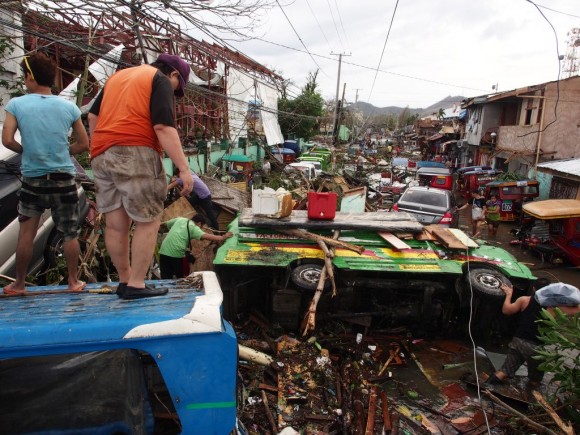
Soon, I found my way blocked by a massive pile-up of trucks, cars, jeepneys, tricycles, trees, and telephone poles. It blocked the entire street from one side to the other and extended for two hundred feet. The only way past was to climb up onto the vehicles and trees using your hands and feet – urban mountain climbing. It was more than a little dangerous, but with a lot of care, I made it across.
On the other side of this pile of vehicles, the water started to go down and soon disappeared altogether. This was higher ground, and the floods had receded completely. I had stopped to talk to a number of people as I made my way along. We exchanged stories of our experience of the typhoon. People were astonished to see me and were even more astonished to learn that I had been here during the typhoon. They assumed at first that I had just arrived with relief organizations. Little did they know that I was looking for relief for myself.
Words have to fail me in describing the destruction I saw around me that day and the following days. Every single business that I was accustomed to frequenting was more or less destroyed. There was the place where I used to buy fried bananas on a stick – gone. There was a nice coffee shop – gone. All the telephone poles were down. The trees were down. Vehicles were tossed all over the place like a giant’s playthings. Vast piles of debris and mud were everywhere. Being me, I had my camera in my hand, and I was taking pictures as I went. And the Filipinos being Filipinos, they called out to me to take their picture and struck gang signs and otherwise posed. There was laughter and jokes everywhere. I continued to be astonished at how good-natured everyone continued to be. You’d think they were at a carnival rather than in the epicentre of what had to be one of the worst disasters in recent decades in the Philippines.
I was happy to see that Manny had been true to his word. His store was open, and customers were pouring into it. At the time, I didn’t fully appreciate this fact. I eventually learned that Manny’s store was the ONLY store in all of Tacloban that opened its doors. In fact, he had never closed. Seeing his open doors and his smiling face probably contributed to my continuing calm attitude. That his store was open on the actual day of the typhoon made me feel that many stores would soon open and life would go on. I was, of course, completely wrong.
Manny was a unique character and in many ways quite a wise one. He was well aware of the dangers to come – that of looting in particular. He knew that people would eventually break into stores and loot them. So he reasoned that it was better to keep his doors open and sell his goods. Better to sell everything than lose it to looters.
I also saw a humanitarian streak in him. People were already desperate for food and water and other items. He had a store full of material, and he made it available to people who needed it. I noticed over the next few days that none of the stores in Tacloban were open. This certainly contributed to all the looting that followed. People were willing to pay for what they needed. But that was impossible with all the stores closed. People began to feel insecure. They began to panic. If more business owners had opened their stores, people would have relaxed and behaved well. With everything closed, the looting began.
Still, it is hard to blame the storeowners. They were probably dealing with the damage to their homes and danger to their families. Plus, as Manny told me, there was a risk that even paying customers would get out of control. He told me that one or two stores in this neighbhorhood had actually opened, but the crowd of customers grew so large that they couldn’t handle them, and the customers quickly turned to looters and took everything. Manny and his staff had a knack for keeping things under control.
As I said, this was the afternoon of the actual typhoon day, and people were still relatively calm. This calm mood affected me, and I found that I reverted to my idiot state. Here I was at a store with fully-stocked shelves and instead of buying all the water I could, I bought one six-liter bottle and left it at that. At the time, it was all I could carry anyway, but I should have purchased several more and made a few trips. It would have been extremely difficult to carry that water over the obstacles between Manny’s store and my hotel, but I could have done it. Again, a certain embarrassment kept me from buying everything I wanted to. It would have felt somewhat rude to rush the shelves and pile up a mountain of goods. So I selected a few things here and there. I found the last remaining package of spaghetti sauce. I also found some canned soup and pasta. Manny, I discovered, had a second floor to his store and he stocked it with imported goods. He had a lot of Western customers for these goods. I went up there and found cans of Campbell’s soup and good batteries and canned ham, things like that. I bought an assortment of these items – paying a bit more since they were imported items – and carried it back to my hotel inside a waterproof stuff sack.
I took a different route on the way back, a route that took me past the prison. I didn’t think I’d be able to climb over the wall of vehicles with my bottle of water and other goods. This street was even worse than the other one. I didn’t even recognize it as the same street. The shacks on both sides had been wiped out, and the cement wall around the nearby school had disappeared, giving a completely new view of the surroundings.
It was easier to make my way down this street. I did have to climb over lots of trees and piles of debris, wading through deep water, but it was a little bit easier than climbing over the vehicles on the other street.
That night was a long one. The typhoon wasn’t quite done with us, and powerful winds continued to rage and the rain came down. It wasn’t nearly as strong as when the center of the typhoon arrived, but the wind was so loud that it was impossible to sleep.
In the morning, I made some coffee and oatmeal on my camp stove and then set off into the city with my camera in my hand. I first made my way to the shore. There, I encountered even more destruction than I’d seen up to that point. It’s impossible to describe the change. A wide divided street goes along the shore there, and its entire length was an endless string of downed trees. Nearly every tree had been toppled, and they all fell across the street and blocked it. It would obviously take lots of heavy machinery to even begin clearing the way. And who knew when such machinery would be available?
There used to be a big fence of steel and cement along the entire shoreline. This is something I’d commented on before in Tacloban and in other places like Guiuan, how a lot of the beautiful waterfront areas were hidden behind high walls and buildings. Well, the fences and walls were all gone, and I was presented with a view of the ocean and coast I had never seen before. It was incredible.
I walked along the shoreline in awe. There had been a number of cement and steel structures there, and they had been ripped apart as if struck by bombs. A massive boat was perched high up on a hill, left there by the wind and flood. Bodies were strewn about either in the debris or up on the cement walls and piers. People were busy scavenging everywhere looking for anything that they could carry off. Many were inside the buildings, and I heard them tearing things free. There were drums of diesel fuel here and there, and people were siphoning off the fuel into large containers and carrying them home.
My walk took me along the shore and then down the main road past the Leyte Park Hotel – or what was left of it. Downtown, the scene of destruction continued. Everywhere I looked, there was some new awesome spectacle of the power of the typhoon. Cars were parked where no cars could possibly reach under normal circumstances.
At the large department store Gaisano, I came across a huge crowd of looters – hundreds of people outside on the street waiting their turn to get inside and grab what they can. I don’t know why Gaisano was targeted by the looters so early. They have two large stores in Tacloban, and both were ransacked before any other place. I could only shake my head as I watched the looters go past with their booty. One would expect them to concentrate on food and water, but they were carrying off the craziest items, like car baby seats and plastic tables. People had put together makeshift sleds out of pallets and whatever else they could find. On these sleds, they piled up whatever they could grab. Then they tied ropes to the sleds and dragged them down the streets. The scraping sound of those sleds became a constant accompaniment to the day of looting.
I imagine wandering around Tacloban with my camera in my hand at this time wasn’t the smartest thing to do, but I didn’t really sense that there was any danger. People were clearly looting the stores, but it was being done in a fairly cheerful way. I spoke to a number of people and they displayed no sense of doing anything wrong. They were simply delighted that everything was free. They encouraged me to go get what I could for myself. After all, it was free. Many stories were circulating. One story was that the owners of Gaisano had deliberately opened their doors and invited people to come inside and take what they wanted – a sort of humanitarian gesture. That seemed unlikely. Another story was that several people had died in Gaisano – trampled by the press of looters. Judging from the massive crowd I saw outside, that story seemed likely.
It was only while moving past this crowd that I felt somewhat uneasy, and I didn’t hang around. I didn’t want someone to decide that I was worth looting. There was a McDonald’s nearby, right on the harbour, and I wasn’t surprised to see that it had been torn to pieces by the typhoon. I also wasn’t surprised to see that there were no boats anywhere.
From there, I turned back into the city and walked along the main streets – streets that I was very familiar with but now looked entirely different. I was surprised at the level of destruction. The flood had apparently been just as bad here as it had been down around my hotel. Another surprising (perhaps not so surprising) thing was the junk food that looters were carrying. People went past me everywhere with huge plastic bags of chips and chocolate and biscuits and Coca Cola on their backs. I was also very surprised at the complete lack of official figures. The streets here were made up almost entirely of businesses. Most of them still had their steel shutters down. Only a few had been broken open and looted. But there was no one standing guard anywhere. Security guards with guns are a constant presence in every business. Normally, they are everywhere. But where were they now? Were I a business owner, I imagine I would have my security guards there with their guns. Failing that, I’d be standing there myself. But everything was left unprotected.
More to the point, there were no police, no soldiers, and no city officials. There was no one in uniform of any kind. In a disaster situation like this, the first thing you expect to see is the police and perhaps soldiers. Yet, they were entirely absent. Where were they?
I was exhausted by the time I made my way back to my hotel. I had walked all over the city and seen scenes like nothing I’d ever imagined. Along the shore, I saw more and more bodies washed up. The roof of the main cathedral had been torn off. The bell tower still stood, but the roof had been torn away. At the foot of the cathedral fence lay a jet ski. Just up the street from the cathedral, I came across a large police boat with two immense outboard engines. It sat right in the middle of an intersection where the flood water had left it. It seemed impossible. From there, I could look down a long steep slope to the water’s edge. I don’t have the math to be able to calculate the distance from the water’s surface to where this boat sat, but it had to be fifty feet or even more. What was the final figure for the height of the flood? I wondered. The water had been ten feet deep at my hotel, but the hotel sits relatively high on the land compared to sea level. What was the vertical distance from the top of the water that had been lapping at my feet at the second floor to the normal level of the sea? I have no idea, but it is a scary thought. I had no idea that a typhoon could cause such a storm surge.
The story of the storm is coming to me in fits and starts. That is likely because I am so tired and dirty, and this is now Monday morning, 72 hours after the arrival of the typhoon. Friday was the day of the typhoon. It was a stroke of luck, if you can call it that, that the typhoon occurred in daylight hours. Had it been night, the death toll would likely have been far higher than it is. On Friday afternoon, I went out into the water and saw the first scenes of the destruction here in my neighbourhood. Friday night, the storm continued, and on Saturday, I went out for a much longer walk – the one that took me all along the shoreline and to downtown. I also stopped by Manny’s store a second time. The full scale of the disaster was sinking in, and I realized that unless I found a way out of Tacloban, I would need more food and water. Manny’s store was the only place where I had a chance of getting anything.
Manny’s store was still open that second day, but he had taken the wise action of closing the main gate. He found that he couldn’t handle the number of customers that had crowded inside his store’s tiny spaces. Now, he had put a series of tables out in his store’s courtyard. Some of his staff and family members were carrying armloads of products front inside the store and putting them on the tables. Meanwhile, customers were crowded four or five people deep along the fence. They stuck their arms through the fence and pointed to the products they wanted. The transactions were done safely through the fence in this manner, and things proceeded smoothly considering the situation.
I caught Manny’s eye, and he came to the gate and unlocked it and let me inside – one of the many, many perks of being a foreigner. Considering I was alone in a foreign country in the middle of the greatest disaster I had ever witnessed, I was more than happy to accept the few benefits that came with being a foreigner.
Manny got a chair for me, and we sat outside and talked about the events of the last two days. I complimented Manny on opening his store to the public. As far as I could tell, he was the only person in all of Tacloban to have done so. He said that one of his motivations was to sell his stock rather than have it looted, but even so, it was a good thing to do. If all the storeowners had done so, things would have gone much better for everyone. I also complimented him on the wisdom of his new arrangements with the tables outside his store. It was working very well. I’m a big fan of organization and systems and this was an excellent example of adapting to these extreme situations.
Manny explained that he was also rationing. Many customers had come wanting to buy everything, but he limited purchases to certain amounts. Manny was nothing if not outspoken and he talked about the levels of corruption in Filipino society, and he himself played no favourites. He said he had lots of people coming to his store claiming to represent this or that politician and asking for a lot, but Manny treated them the same as all his customers. Manny also did not raise his prices. The prices during the typhoon and its aftermath were the same as they were before the typhoon.
An interesting side note is that when I arrived at Manny’s store, I ran into two young American guys. They had just purchased some water and other items from Manny and were heading back to their hotel. In the brief time I talked with them, I learned that they were with the Peace Corps. And the Peace Corps, in its wisdom, had evacuated them from their villages in Samar and brought them to Tacloban – the place where the typhoon hit hardest. They were expecting to be flown to Manila or Cebu, but they were put up in the GV Hotel. They spent one night there, but then the entire hotel shut down and they were asked to leave. They had no staff to run the place. They ended up in another hotel called Lai Rico just up the street. I went to Lai Rico the next day to track these guys down. When I first ran into them, I was a bit anxious to buy some water at Manny’s store, and I cut our conversation short. I would have loved to have heard their more of their story, but water was a priority. When I got to Lai Rico, I was told that they had left and gone to the top-end Leyte Park Hotel and possibly from there to Cebu, so I never saw them again.
While I sat there chatting with Manny, I got more and more anxious about buying some food and water. I was pretending to be relaxed and unconcerned, but I was being affected by the large crowd of people at the fence quickly buying up everything that Manny’s staff put on the table. I didn’t see any more large bottles of water, however. All he seemed to have left were the small bottles – each containing 12 ounces. I didn’t want to presume on my new acquaintance with Manny, but I wanted some of that water. I pointed out to Manny that he didn’t seem to have any more of the large bottles of water. I did this as a casual way of introducing water into our conversation. I had been invited into his store and offered a seat as a guest and friend. Now it was a bit awkward to transition into a customer. Manny was quick on the uptake, and he asked me if I wanted water. I said that I did and asked him how much water one customer could buy. I think he said that he limited his customers to six bottles, but since I was a friend, I could have as many as twenty. I quickly took him up on his offer and I went over to a case and put twenty bottles into the stuff sack I had brought with me. These small bottles cost 13 pesos each, which made buying water this way extremely inefficient. It was roughly three times more expensive than buying water in the large 6-liter bottles. But I wasn’t about to complain. I could survive without food, but not without water. And, when I finally am able to leave Tacloban on my bicycle, I will need water on that day. Once I’d paid my 260 pesos for my twenty small bottles of water, I felt a little bit better. I had about nine liters of water back in my room. My new purchase was of seven liters, giving me a total of sixteen liters. I don’t know how much water a person needs per day, but I also had several cans of soup, which was mostly liquid, and two small cartons of milk. I had enough alcohol to run my Trangia stove for perhaps three days, maybe four if I was careful. And then I could switch over to diesel fuel and use my Trangia X2 burner.
It wasn’t surprising how quickly I adapted to my new situation. Human nature is nothing but adaptable. I’d made a lot of mistakes and continued to make them, but I was learning. Water quickly became all-important, and I learned not to waste a single drop. I would cook a meal, but then I would add some water to the pot to rinse it out. I swirled the water around to clean the pot, but instead of dumping it down the drain as I would normally do, I drank it. Nothing went to waste. Even when I brushed my teeth, instead of rinsing my mouth and spitting the foamy water out, I swallowed it. Every little bit helped. I kept assuming that life would slowly get back to normal and that water would become available, but I think that assumption was a Canadian one. The reality here in Tacloban appeared to be that things would be very slow getting back to normal, if, in fact, they ever did. A lot of time had passed since the typhoon, and I saw no evidence anywhere of anything changing. There were no road crews at work clearing the fallen trees and removing the vehicles. All the streets were as completely blocked as they had been from the beginning. There were no police and no soldiers anywhere providing security. There were no medical staff anywhere in sight. The looting appeared to be getting worse and worse. There was no distribution of food and supplies from the government or relief organizations. There was simply nothing happening, and I had little hope that that would change anytime soon.
Saturday night, I went to bed very early. I spent some time getting organized when I returned to my room. I organized my food and water in my room and took stock of what I had and how long it might last. I also tended to my body. I had suffered a number of cuts to my feet as I walked around, including a nail puncture to the bottom of my left foot. That was a ridiculous thing to happen. I had stopped to chat with a man at a street corner. He had just come from Gaisano, where he had made off with several large bags of stolen goods, and, bizarrely, a metal display case. He told me about his house – almost totally destroyed – and how he and his family had had to rush to a nearby building and climb up to the second floor, where they waited out the storm. It was clear that this man couldn’t carry all of his booty by himself, especially since the remains of his house were on the other side of a huge pile of downed trees, wood, and vehicles. On impulse, I asked him if he needed any help. To be honest, I wasn’t being helpful. I just thought that by carrying his booty to his house, I would get to see the damage to his home and meet his family. He carried the metal shelves and I picked up the three large bags. They were extremely heavy and the man said that I should be careful since there was glass inside one of them. I think he had stolen some table lamps along with the piles of junk food and Coca Cola. We first had to make our way over this big pile of debris. It was a tough climb, and we had to stop several times to figure out our next step. At one point, this man pointed down and told me to be careful because there was a big nail sticking up from a piece of wood. He had been telling me to be careful a lot, so I wasn’t really paying attention. I knew that there were nails everywhere, so I was always careful. But I took one step and was thrown off-balance by the heavy bag of table lamps. I had to put my foot down without looking, and I stepped right on the nail. It went through my thin sandal like it wasn’t even there and jammed into my foot. Luckily, I managed to jerk my foot away before it went in very far.
When I got back to my room later, I spent a long time treating my various cuts and scrapes with the denatured alcohol that I used in my Trangia stove. Some weeks earlier, I had been suffering from several infected mosquito bites – something I always got in the Philippines. I had never found a way to prevent these bites from getting infected. And the infections always got worse and worse until I was forced to the hospital for a series of antibiotics. Well, this time I had the brainstorm of using this denatured alcohol. I applied it regularly to all the infected bites, and to my delight, they all were cured. I could really feel the alcohol working because it stung insanely. With that experience in my mind, I set about treating the cuts on my feet. One on my big toe in particular was already infected. My toe was red and swollen and hot to the touch. I soaked some toilet paper in alcohol and held it to the cut. I made sure the cut opened up wide and the alcohol got in deep. It hurt like blazes, but I repeated the process over and over again. Throughout the night, whenever I woke up, I took the time to apply the alcohol again. I’m glad to say that it seems to have stopped the infection in its tracks and all the cuts look okay.
I also took the time to rig up my mosquito net. My room had been free of mosquitoes before, since I largely kept the windows closed. But now with the windows wide open to keep cool and the city covered in water, the mosquitoes were thriving. I had to screw a hook into a hunk of wood above the closet and ran a rope from that hook to the window. From that rope, I hung the mosquito net. It wasn’t perfect, but it would do.
This brings me to Sunday. Having gone to bed early, I woke up extremely early. I made a cup of coffee and oatmeal in my room and spent some time writing in this journal. Then I set out into Tacloban once more. Helicopters had now arrived and were flying over Tacloban regularly. People said that a relief center had been set up in a nearby park and that there was now free Internet at City Hall. I made my way down the main street and over the huge pile of vehicles and trees. On the way, I ducked into a school to find hundreds of people there surviving as best they could. The school buildings had been badly damaged – roofs ripped off and walls thrown to the ground. But people were there in large numbers doing what they could. I found many people cooking rice over fires they made from scrap wood. It was a sad scene.
Near the park, I found thousands of people in long lines stretching in all directions. They were clearly waiting for some kind of food distribution. Three large helicopters were in the middle of this park with armed soldiers standing guard around them. People said that the president of the Philippines had arrived for an inspection tour.
Just a short time later, I was at the park again and everyone was gone. All those thousands of people had vanished. There was no way they could have gotten any food, so what happened to them? People told me that the whole thing had been a charade set up by the mayor. He knew that the president was coming, and he announced that food would be distributed, and all these people showed up. Once the president had come and gone, they announced that there was in fact no food, and everyone left. It was a show for the president. I have no idea if any of this was true, but that was the story going around the streets.
I walked down by the shore again as I made my way around Tacloban, and I saw that all the bodies I’d seen before were still there and they had been joined by many more. In a very short time I learned more than I ever needed to know about how quickly a human body starts to rot once you die. It came as a complete and utter surprise and shock. It had only been roughly 48 hours since the typhoon struck, but the bodies were already in a very bad way. I had never seen anything like it. I never imagined that a human body could look like that. I still haven’t managed to process this new information. For one thing, the bodies had blown up like balloons. They were huge and looked ready to explode. Heads, torsos, arms, legs – they were all blown up to several times their regular size. Large bubbles had formed under the skin and the skin was peeling off. The faces and heads were black. Worst of all, their tongues and eyes had swollen to such a point that they had burst out of their heads. Their mouths were forced open and their tongues stuck out in a misshapen and horrible way. Their eyes had popped right out of their sockets and bulged outward, the white still there and a stark contrast with the black face. It was the most horrific thing I have ever seen. I guess that rescue workers, police, and people in the medical field are used to this and know how quickly this happens to a human body. But for a normal person like me, it is a completely new thing. I had absolutely no idea that this happened and that it happened so quickly and how truly horrifying it is. The faces were worse than anything you could ever see in the worst horror movie. The faces, in fact, looked angry. With the eyes bulging out and staring, they looked furious with me – staring right at me with incredible anger. I know it was just the trick of what was happening to their bodies, but I wouldn’t have blamed them for being angry. They had been left in the ocean and forgotten. I have no idea what government office would officially be in charge of dealing with dead bodies, but whatever office it is, it hadn’t managed to get to work yet.
The horrors of the scenes around me piled one on top of the other. I saw a young toddler blown up to an immense size out on the rocks, his misshapen face turned to me in angry appeal. There was a body far out in the water bobbing along like a grotesque raft. I saw the body of a woman lying on her back on the sand of a small cove. She was completely naked and her body was easily three times the size it would normally be. Black and blue and beaten and swollen, it was the worst thing I have ever seen. Right after spotting her, I saw a man – a live one this time – running fast across a field toward me. I was startled and wondered what in the world he was doing. Was he running at me? Was he mad and going to attack and rob me? Was he running away from something? It was exceedingly strange. All I could do was stand there as he ran. The man came right at me and then ran past me moving very, very fast. He ran down to the beach and right to the body of this dead woman. I had a wild moment when I thought he was going to throw himself on it. Perhaps it was someone from his family. But he ran straight past the body to the water’s edge. Then he undid his pants, pulled them down, and let loose a violent stream of diarrhoea into the water. I don’t know if he saw the bloated body just two feet away. He probably did and simply couldn’t worry about it. He had more pressing needs of the living to deal with. That, perhaps more than anything else, might be the image I’ll take with me from this experience – a horrible image.
A ways past this, I came to the shoreline beside the fancy Leyte Park Hotel. Oddly enough, in all my time in Tacloban, I had never gone to this hotel. I had never entered the grounds to look around. It took the destruction of a typhoon for me to visit it. I saw now that it had many bungalows on the cliff beside the water. These were strong buildings made of cement and steel. Yet, they had been torn to pieces by the typhoon. I assume the guests that had been staying in them had been moved to the main building. I was surprised to see that this was a very large hotel. I had had no idea of its size before. It also had two nice swimming pools with a bar and beautiful views of the ocean. It would have been a nice place to relax and enjoy a cold beer. It was too late now, as everything around it had been destroyed.
I made my way into the main building of the hotel thinking that I might be able to track down the Peace Corps volunteers. I never did find them. In the lobby area, there was an area set up by the Red Cross – a relief and assistance center.
Before this, I had also gone up to City Hall. I had been told that they had an Internet connection there. Most things people told me turned out not to be true, but this was true. There were tents set up with a row of computers attached to small Honda generators. Unfortunately, there was a huge crowd of people waiting to use them. I wanted to leave a message on Facebook saying that I was okay and had gotten through the typhoon okay. But there were just too many people. It would likely have taken four or five hours of waiting in line to get to a computer, and who knows that it would even work when I got there. I thought about trading on my white face and foreign nationality. I could probably have made my way innocently to the front of the line to ask a question and then been allowed to use a computer right away. But I thought that wouldn’t be fair, and I decided to wait until a time when the crowd of people got smaller.
Back at the hotel once more, I found an entirely new atmosphere – one of panic and fear. The one or two staff remaining at the hotel were running around the courtyard telling everyone in a loud voice that if at all possible we should leave and head for Ormoc or Cebu or anywhere. The looting had gotten worse, they said, and now large crowds of armed men were going from house to house and stealing everything they could find. The thousands of prisoners at the prison – just two blocks over – had escaped and joined the rampaging mob. One young guy in particular was telling these stories. He said that he had come in from his home today and found that the huge, modern Robinsons shopping mall outside of town had been looted. That really shocked me. I had had no idea the trouble could have spread that far. But it appeared to be true. Mobs had smashed their way into the mall and were making off with everything they could carry.
I was trying to not let the spreading panic infect me along with all the rest. I had been out all over Tacloban by myself and had seen nothing to indicate there was so much danger. I had witnessed looting, but it was a friendly almost ridiculous type of looting.
The staff and the few remaining guests at the hotel were, however, taking all this news very seriously. The young couple – the guy with the Columbia Sportswear clothes – immediately packed up and left. He said that he had to protect his wife and baby. He knew someone with a motorcycle that worked and this person had offered to drive them out of Tacloban. Within minutes he was gone.
One man told me that the owner of the hotel and their entire family had left by military helicopter to Cebu. They knew someone in the military and had gotten a seat on a military helicopter. Someone whispered to me that I should immediately head for the Leyte Park Hotel. They might let me stay there and there might be security. He also said that there was a military C-130 plane heading for Cebu, and if I went to the airport, I might be able to get on it. Failing that, I should go to the police station and get protection. My informant at the hotel said that he had taken his money and put it into a plastic bag and buried it in the mud. He had taken his valuables – what few he had – and hidden them in the shattered ceilings of the rooms on the third floor. I witnessed this guy carrying a big steel box and dumping it into the water that remained in the fish pond. He said that this was the hotel safe, and he was hiding it from the looters that were sure to come. He told me again that I should get on my bicycle and get out of Tacloban right away. He said he would leave if he had a bicycle or any other transportation. He might even leave on foot. He also told me that I should hide my valuables in the ceiling, too. Unfortunately, this was not possible for me, since everything I owned was valuable in one way or another. I had far too much expensive gear to have a hope of hiding it. And loading up my bicycle and cycling off into the growing dark with rampaging, looting mobs and thousands of escaped prisoners hardly seemed wise. Maybe I was wrong, but the safest course by far appeared to be to stay right where I was. I decided on this course of action, but then my faith in my decision was almost shattered. Another guy that I had seen in and around the hotel and who seemed connected with it, appeared with a large assault rifle or sub-machine gun. He also had a pistol. He showed me the machine gun and a few large clips of bullets and asked me if I knew how to use it. I could only laugh and say that I had no experience with a gun like that. I’m sure I could pull the trigger as well as the next person, but I’d have to be shown how to use it properly. Was this guy really offering me a machine gun to protect myself? What in the world was going on?
A short time later, I saw this guy emerge from a room with his pistol and machine gun. He walked down the stairs and out the front gate and disappeared. The one remaining guy that I knew worked at the hotel didn’t like that at all. He had told me earlier that at least they had a pistol and machine gun for protection. Now even that was gone. His plan was to barricade the gate with everything he could find. Then he and some other guys (I had no idea who they were) would build a big bonfire in the courtyard and stand guard all night. Hopefully, this would keep the looters out. He didn’t seem to have much hope in this strategy, though. He said that if the looters really did come, he would likely let them in and let them take what they wanted. There was nothing of value left in the hotel anyway. Everything was in ruins, and he had buried his money and put the safe in the fish pond. Of course that left only the idiot foreigner with his bicycle and expensive camera gear.
I looked out over the city from the vantage point of the third floor veranda. Everything was quiet. I heard no shouting or fighting. I saw no fires (there had been only one big fire that I had seen during the typhoon’s aftermath). Could there really be that much danger out there? Everyone was leaving the hotel. The only people left were me and one older Filipino man plus this young man – practically a boy – who worked at the hotel, and some of his friends.
This boy and his friends were true to their word and built a big bonfire out in the courtyard. They used all the scrap wood and scrap plastic from the storm and poured diesel fuel over it and set it alight. They put some benches on the veranda on the second floor and gathered up all the fire extinguishers. These weren’t to fight fires but to fight the looters, they said.
It was a very strange experience. Myself, I didn’t think there was any imminent danger. I certainly didn’t think there was as much danger as everyone said. Yet, this was their country and they must know more about its workings than I did. And they weren’t messing around. Most people had fled – including the entire family that owned and ran the hotel. That they had done this without even consulting me was a bit disturbing. If this young man made good on his idea to leave on foot, I’d be left completely on my own in a dark and abandoned hotel with just a bonfire blazing away. I still felt the safest thing to do by far was just remain where I was. Was I crazy to think this? In any event, getting police protection, hopping on a C-130 army transport plane, cycling off into the dark all seemed impossible if not insane. All the roads leading away from the hotel were blocked. I could barely walk down them and had to climb over huge barricades. There was no way of riding my loaded touring bike anywhere until the roads were cleared. And, to be honest, I’m just lazy. I was nicely settled into this room with food and water and a comfy bed and my camp stove. There was a well in the courtyard, and it had started to work again and I could fill buckets from there to flush the toilet and take showers. The water was salty and left a sticky residue on my body, but it was still refreshing. I was quite happy where I was and the thought of all the work of packing up and leaving for places unknown was not appealing at all.
As the night progressed, I sat with the guys out on the veranda. We all had our eyes glued on the street and front gate – watching intently for any trouble. True to Filipino form, these guys were laughing and joking and cooking a big pot of plain rice over the diesel-soaked bonfire. I eventually retired to my room to cook up a pot of soup and read a book or something. While I cooked my meal, I thought about my situation. I couldn’t hide my valuables as the others had done. Perhaps the best thing I could do – all things considered – was just barricade myself in my room. If the worst happened and a bunch of looters showed up and fought their way in and past the brigade of fire-extinguishers, I could make it very difficult for anyone to get inside my room. I was lucky to the extent that this hotel room is extremely sturdy – all cement with iron bars over the windows and a relatively strong door. The lock on the doorknob and the latch were laughably cheap, but the door itself was pretty solid. If I could block the door, I would be fairly secure. A stroke of luck came my way when I realized that the bathroom door was located in such a position that if I swung it all the way open, it would block anyone from opening the main door. If I could jam that door into place, it would act as a very effective barricade. Another stroke of luck is that there are two beds in this room, and the bed frames are extremely strong and heavy, made from some serious hardwood. I thought about removing the mattresses from both beds and using the two bed frames to block the doors.
In the end, things worked out in such a way that I only had to use one. Remarkably, when I put this bed frame on its side and dragged it (with great difficulty) to the short hallway leading to the main door, its strong legs fit exactly between the main door and the edge of the bathroom door. By jamming it into that space, it served to completely stop the door from opening. I jammed it in and then moved the bed frame onto an angle so that it was pressed up against the opposite wall. I could hold it in place with my body and no one short of someone with a bulldozer would be able to shift it an inch. If it came to a serious fight, I even had the option of moving the second bed frame and jamming it in place. It would take far more than human strength to shift both those bed frames the way I could set them up.
Of course, a truly serious and determined mob given enough time could still get in. They could, for example, somehow rip the iron bars out of the bathroom window. It would take a serious machine to do it, but it could be done. And the window was just big enough to admit a body. But that body would have to get past me, and I could make that very difficult. If this body had a gun, of course the game was over. There was nothing I’d be able to do, but they’d still have to get through that window in order to use the gun. There was no way to get through the door the way I had rigged it. The Swiss Family Robinson could not have come up with anything better and more secure. It was a pretty safe bet that a mob of looters would not have the discipline to get in. They would move on in search of easier prey. At least that was my strategy.
The night that followed was a pretty strange one. After the crazy day and the even crazier evening, it was hard to get my brain (and my heart) to slow down. My mood wasn’t helped by the gunfire that I started to hear all around. This wasn’t gunfire off in the distance but nearby right in the next streets over. I told myself that these were all warning shots being fired into the air. And I’m pretty sure that was true. Still, it is hard to fall to sleep inside a barricaded room with gunfire all around. The only way I could manage it was to put in earplugs. But was that wise? Wouldn’t it be better to hear trouble coming? In the end, I used earplugs and managed to get some bits of sleep here and there. The fire-extinguisher brigade kept the bonfire going most of the night, and we escaped being looted.
I awoke this morning to a world that had little changed from the preceding day. The bonfire was smoking in the muddy courtyard. The streets were still full of debris and destroyed vehicles. The last thing I wanted to do was pack up my bike and hit the road. I was glad when I tracked down my young panic-stricken warrior from the night before, and he said that he and his friends had gone out into the streets and seen soldiers moving around. So he felt safer and he was going to stay. The only other person in the hotel – the older man – had left. He had plans to go to Manila, though I don’t know how. While I was out in the courtyard chatting with the young warrior, a plane went by overhead and with his sharper eyes, he made out that it was a Cebu Pacific passenger jet, probably heading for Cebu City. So things were happening. The airport was open and people were flying out.
My plan is to stay here in Tacloban a bit longer. I am in no huge rush to go anywhere else, and I’d rather wait until things are more settled. I also want to see how things progress. I go on these trips mainly to have new experiences, and this certainly qualifies. I’m not in a huge rush to go somewhere where nothing is happening. I’d like to see the end of this story and see the city get back on its feet a little bit.
One big concern is my bicycle. I commented earlier that I didn’t think it mattered if it got a bit wet in the typhoon. But that would be with rainwater. It had been totally submerged in salty seawater. Saltwater is death to most mechanical things, and a bike is no exception. I did my best to clean and dry and lubricate the chain and gears. But there is nothing I can do about the headset and the hubs and the bottom bracket. I found this morning that the headset was almost completely seized up. I had to work it hard and long to get it moving again. Who knows how long it will work? And who knows what is happening in the hubs and the cranks? All those bearings could be rusting up and seizing up. I have no way to fix them myself. The earliest I could do that might be in Cebu.
Hopefully, today I can get on the Internet and let people know that I’m okay. And perhaps I can take my bike out and do a bit of exploring further afield and find a way out of the city. I hear some motorcycles moving around now so there must be come kind of passable route. I’m told that the roads are passable outside of Tacloban. I just have to get outside the city, and that might not be easy. My path will take me right by Robinsons Mall, and that should be interesting.
One final note, then it is time for breakfast. One thing I feel lucky about is that I extended my tourist visa when I did. I actually did it three weeks before my current visa expires. The immigration office here is very accommodating. Most places in the world won’t let you extend a visa until it is almost expired. Here, it doesn’t matter and I managed to get a two-month extension even though there was nearly a month still left on my old one. Now I’m glad I did that. I’m sure the immigration office here will take a long time to be functional again, and I don’t have to rush to get anywhere that has a working one. Time for breakfast and then to head back out into Tacloban and see what is happening in this post-super-typhoon world.
Tags: bike, Philippines Bike Trip 2013, San Jose, Super Typhoon Yolanda, super-typhoon, Tacloban, Tacloban City, typhoon